
Quick Answer
For towing most travel trailers, the F-150 holds a meaningful payload advantage over the Ram 1500 in equivalent configurations — but neither truck delivers the comfortable margins dealers imply. With a loaded 28-foot trailer and two people in the cab, a mid-trim F-150 can land under 200 lbs of remaining payload margin. A comparably configured Ram 1500 can land in the negative. We ran the same math on the other big three in F-150, Silverado and Tundra compared.
The tow rating is not the constraint. Payload is.
Why Tow Ratings Don’t Settle F-150 vs Ram
Most truck buyers spend weeks comparing the F-150’s max tow rating against the Ram 1500’s. Neither number is what limits your real-world towing. The door sticker you’ve probably never read is. Every pound of passengers, gear, and tongue weight eats into a budget that’s smaller than you think — and the two trucks start that budget at very different places.
Half-ton buyers routinely choose between these two trucks based on tow ratings that are close enough to call a tie. The payload numbers tell a different story, and that’s where the comparison actually lives.
F-150 vs Ram 1500: Door-Sticker Specs
These specs come from the door sticker, not the brochure. The brochure maximum payload number applies to a single idealized configuration. Your actual truck has its own number, printed on the driver’s side door jamb. That number is the one that governs every tow you make.
Ford F-150 SuperCrew 4×4 (XLT, 3.5L EcoBoost)
- GVWR: 7,050 lbs
- Curb weight: 5,370 lbs
- Payload capacity (door sticker — not brochure): 1,680 lbs
Ram 1500 Crew Cab 4×4 (Big Horn, 5.7L HEMI)
- GVWR: 6,900 lbs
- Curb weight: 5,490 lbs
- Payload capacity (door sticker — not brochure): 1,410 lbs
That 270-lb gap between the two trucks is the starting point. What happens to it depends entirely on the trailer.
The Trailer: Loaded 28ft Travel Trailer
For this comparison, we’re using a representative 28-foot travel trailer — a weight class that’s extremely popular among half-ton buyers and consistently marketed alongside both F-150 and Ram 1500 tow ratings.
- Dry weight: 5,800 lbs
- GVWR: 7,500 lbs
- Tongue weight: 12–15% of loaded trailer weight (see next section)
One critical note: dry weight does not equal loaded weight. The 5,800-lb figure is the trailer leaving the factory with nothing in it — no water, no food, no clothes, no gear. Nobody tows it that way.
Dry vs Loaded Trailer Weight
Loaded travel trailers routinely exceed their dry weight by 15–30%. That 5,800-lb dry weight becomes 6,670 to 7,540 lbs once you account for a full fresh water tank (600–800 lbs), groceries, personal gear, and the supplies that accumulate across a weekend trip.
For this analysis, we’ll use 7,200 lbs as a realistic loaded trailer weight — well within the 7,500-lb GVWR, but significantly heavier than the spec sheet suggests.
If you’re budgeting your tow around the dry weight on the manufacturer’s website, you’re planning around a number that doesn’t reflect how you actually travel.
Tongue Weight: The 12–15% Rule
Tongue weight — the downward force the trailer hitch exerts on the truck’s rear — should run 12–15% of total loaded trailer weight. At 7,200 lbs loaded:
- 12% = 864 lbs
- 15% = 1,080 lbs
We’ll use 1,080 lbs (15%) for this analysis. That is the correct figure for a properly loaded trailer, and it counts entirely against your truck’s payload capacity. Tongue weight is not separate from payload — it’s one of the biggest line items in the subtraction.
F-150 vs Ram 1500: Payload Math
F-150 SuperCrew 4×4 (XLT, 3.5L EcoBoost)
| Item | Weight (lbs) |
| Truck Payload Capacity (door sticker — not brochure) | 1,680 |
| minus Driver + Passenger | minus 340 |
| minus Gear / cargo in truck bed | minus 150 |
| minus Tongue weight (15% of loaded trailer weight) | minus 1,080 |
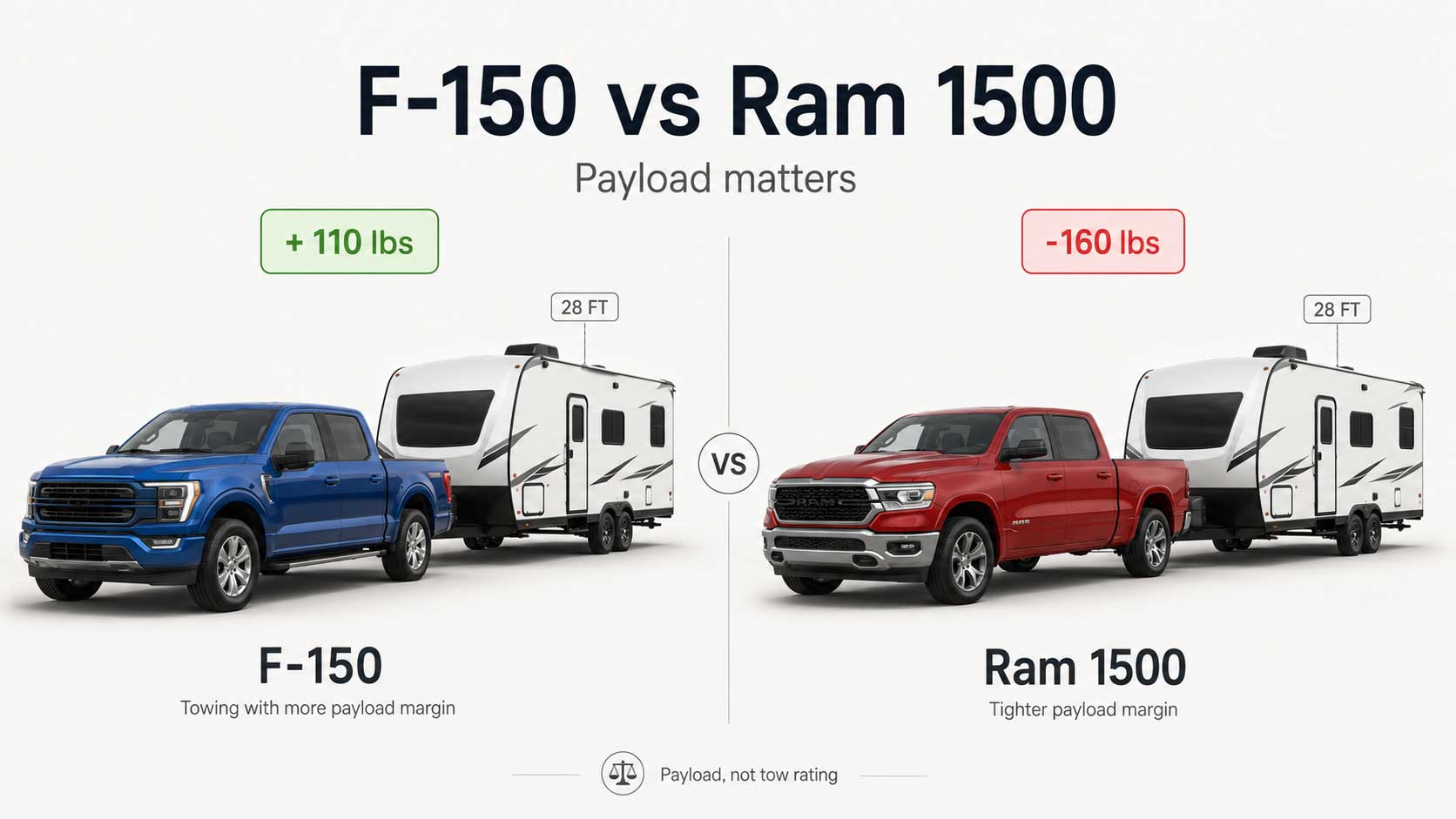
| = Remaining Payload Margin | **110 lbs** |
Ram 1500 Crew Cab 4×4 (Big Horn, 5.7L HEMI)
| Item | Weight (lbs) |
| Truck Payload Capacity (door sticker — not brochure) | 1,410 |
| minus Driver + Passenger | minus 340 |
| minus Gear / cargo in truck bed | minus 150 |
| minus Tongue weight (15% of loaded trailer weight) | minus 1,080 |
| = Remaining Payload Margin | **-160 lbs** |
Why the Ram Goes Negative
The F-150 clears this scenario by 110 lbs. That is the distance between legal and overloaded. Add a third person in the cab — roughly 200 lbs — and the F-150 goes negative too. The Ram 1500 is already 160 lbs over capacity with two occupants and a modest amount of gear, before the trip starts.
Both trucks list this trailer as well within their tow ratings. Both trucks, in real-world loaded configuration, are at or past their payload limits. One exceeds it by 160 lbs with two passengers aboard.
If you’re wondering where your truck would land in this calculation, don’t guess.
For a named trailer, see whether a 2026 Ram 1500 HEMI can tow a Grand Design Imagine.
Not sure if your truck is within safe limits? Towing Limit Pro helps you verify your real setup using your actual payload sticker, passengers, cargo, and trailer numbers.
- Remaining payload (what you actually have left)
- Realistic tongue weight estimate (loaded, not brochure)
- GVWR margin + a clear safety buffer
- Risk-zone warning if your setup is pushing limits
Tip: Use your truck’s yellow door sticker payload for the most accurate result.
Verdict: Which Half-Ton Tows Better?
F-150: Borderline. In this configuration, the F-150 passes — by 110 lbs. That margin is real but fragile. A heavier passenger, a second box in the bed, or a trailer loaded slightly above the estimate eliminates it. The F-150’s payload advantage over the Ram 1500 is clear in the numbers; turning that into a safe real-world margin requires knowing your specific door sticker number and running the calculation against your actual trailer weight.
Ram 1500: Risky. The Ram 1500 in this configuration is already over payload capacity before accounting for any variability in trailer loading. That is not an edge case — it is what the math shows on a standard 28-foot trailer with two occupants and modest gear. The Ram 1500 is capable engineering paired with a payload number that makes 28-foot travel trailers a tight pairing in most configurations.
The comparison most buyers make — tow rating versus tow rating — misses the actual constraint. The number that determines whether your tow is structurally sound isn’t on the window sticker at the dealership. It’s on the door jamb of your specific truck, and it’s already being consumed the moment you load passengers and gear.
Know your real margin before you hook up.
Most half-ton trucks hit their payload limit long before they hit their tow rating limit — and most owners don’t realize it until they’re already committed. Verify your exact setup and know where you stand.
- Remaining payload (your real limit)
- Realistic tongue weight (loaded)
- GVWR margin + safety buffer
- Clear risk-zone indicator
Best results: use your yellow door-sticker payload number and your loaded trailer estimate (not dry weight).
FAQs
Why does the F-150 have more payload than the Ram 1500 if they're in the same class?
Payload is the difference between a truck's GVWR and its curb weight. Both figures vary by configuration — cab size, bed length, engine, drivetrain, and equipment packages. The F-150's higher payload in equivalent configurations reflects a combination of higher GVWR and, in many trims, a lower curb weight. Neither number is fixed across the nameplate. The only figure that applies to your truck is the one printed on your driver's side door jamb.
What's the difference between tow rating and payload capacity?
Tow rating is the maximum weight a truck can pull behind it. Payload capacity is the maximum weight the truck can carry — in the cab, in the bed, and at the hitch point. For travel trailer towing, tow rating tells you whether the trailer's total weight is within range. Payload capacity tells you whether the combined load of passengers, gear, and tongue weight is within your truck's structural limit. Most real-world towing problems come from exceeding payload capacity, not tow rating — because tow rating is the number dealers discuss, and payload capacity is the number that actually governs the tow.
Does a weight distribution hitch change the payload math?
A weight distribution hitch shifts some tongue weight load from the tow vehicle's rear axle to the front axle and the trailer's front axle, which reduces rear sag and improves handling. It does not reduce the tongue weight pressing against your truck's payload capacity. That downward force at the hitch still counts against your door sticker number — it's just distributed differently across your axles. If you're already at payload capacity, a weight distribution hitch makes the truck feel more level. It does not make the tow legal.
If my trailer's dry weight is under the tow rating, does that mean I'm fine?
Not automatically. Tow rating and dry weight each describe one dimension of the tow. Dry weight doesn't reflect how heavy the trailer actually is when loaded for a trip — that number is typically 15–30% higher once water, food, gear, and personal items are aboard. And tow rating says nothing about whether your truck has enough remaining payload capacity to handle tongue weight after accounting for passengers and cab load. A trailer that's comfortably within tow rating can still push a truck past its payload limit. Both numbers need to clear, not just one.
Does it matter which trim of F-150 or Ram 1500 I buy for towing?
Significantly. Payload capacity varies by hundreds of pounds within the same nameplate depending on cab configuration, bed length, engine, and option packages. An F-150 Regular Cab 4x2 can carry well over 2,000 lbs. An F-150 SuperCrew 4x4 with certain option packages might carry 1,400 lbs. The same variation exists across the Ram 1500 line. The configurations most commonly marketed to travel trailer buyers — crew cab, four-wheel drive, with towing packages — are often not the configurations with the highest payload. Verify your specific truck's door sticker before pairing it with a trailer.