
Quick Answer
It depends entirely on your truck’s specific door-sticker payload — not its tow rating. Many half-ton trucks are factory-rated to tow trailers in this size range, but payload is what actually runs out first.
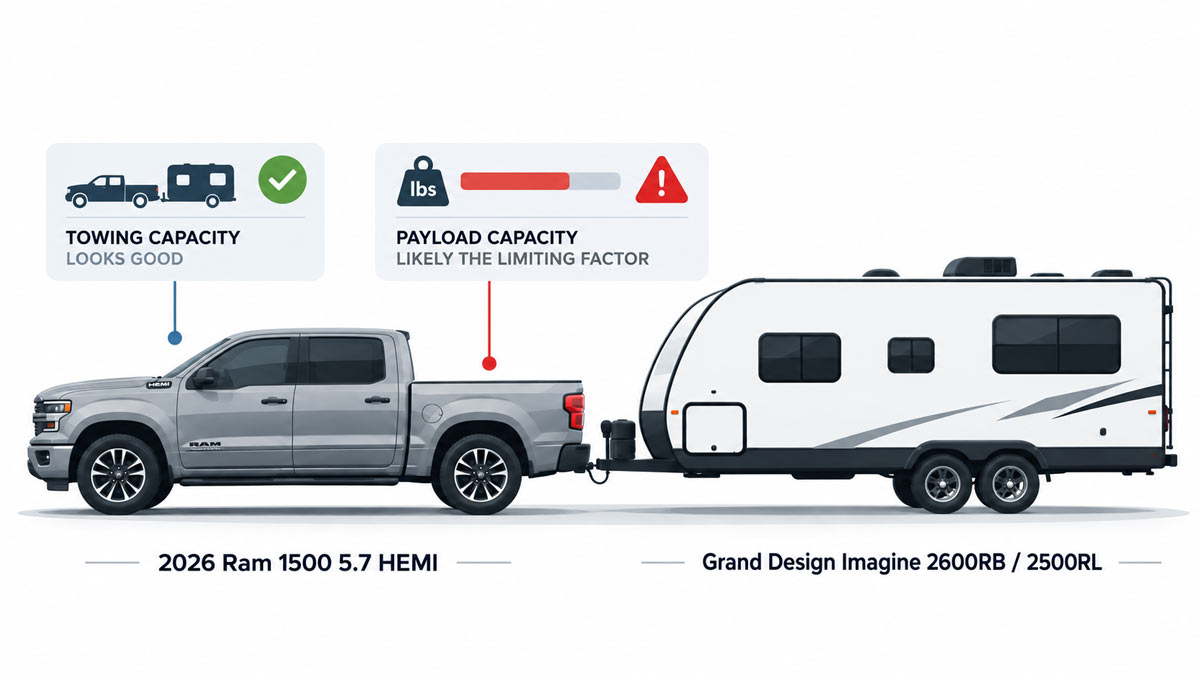
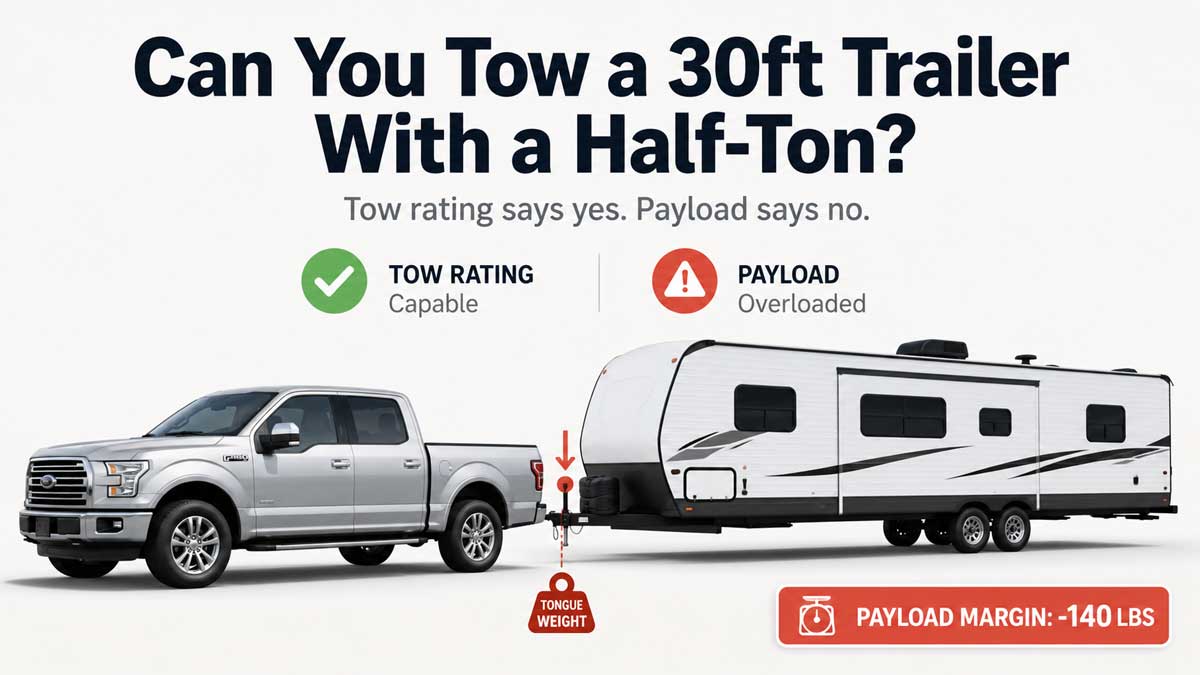
Tow rating and payload are two different numbers. For 30ft trailers, payload is the one that fails.
What ‘Half-Ton Towable’ Really Means
Every RV lot in America has a salesperson who will tell you that a 30ft travel trailer is “half-ton towable.” Sometimes they’re technically right. But “towable” refers to the hitch, the frame, and the axles — not to whether your truck can carry what that trailer puts on it without exceeding the limit printed on your door jamb.
The tow rating is marketing. Payload is engineering. For 30ft trailers, those two numbers are on a collision course.
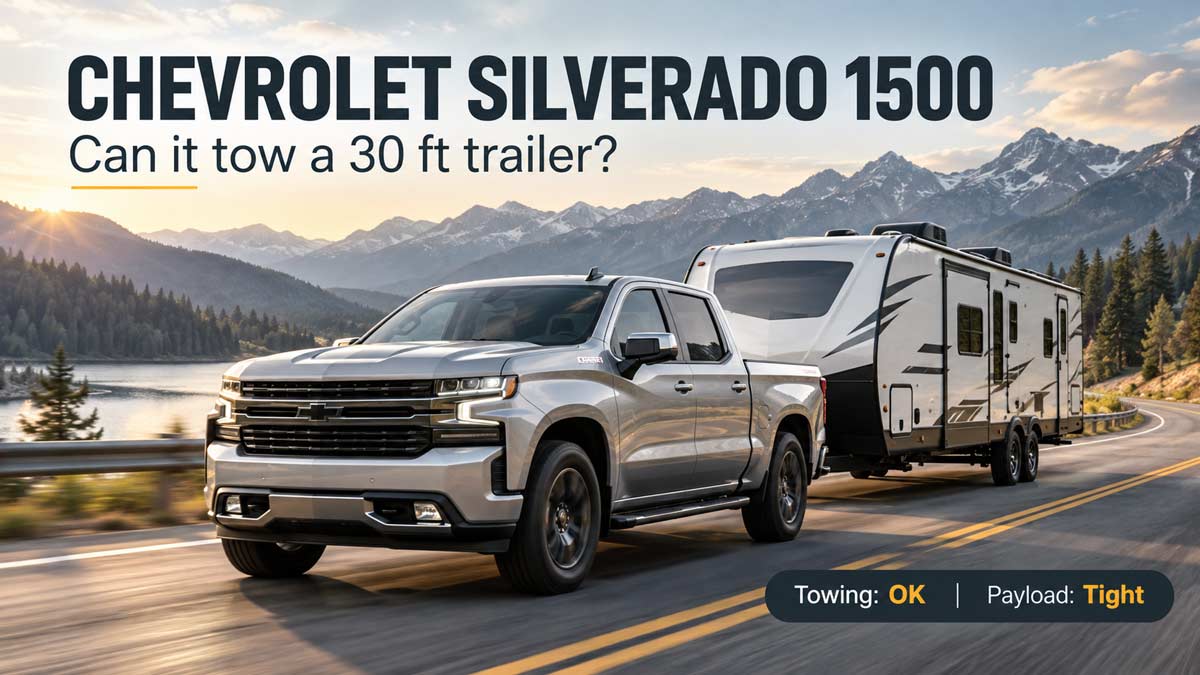
The Truck: Silverado 1500 LTZ
This scenario uses a 2024 Chevy Silverado 1500 LTZ Crew Cab 4WD. The numbers come from the door sticker — not the Chevy brochure or a towing guide published online.
- GVWR: 6,800 lbs
- Curb weight: 5,320 lbs
- Door-sticker payload: 1,480 lbs
That 1,480-lb payload is what remains after the truck itself weighs in. It covers everything: passengers, cargo in the bed, and the downward force the trailer puts on the hitch ball. The Silverado 1500 brochure advertises payload figures up to 2,200 lbs across the model family. That number requires a specific cab, bed, powertrain, and trim combination that most buyers don’t purchase. The door sticker is the only figure that matters for your truck, in your configuration, as it sits in your driveway.
The Trailer: A 30ft ‘Half-Ton Towable’ Model
The trailer in this example is a 30ft travel trailer marketed explicitly as “half-ton towable.” Common specs in this category:
- Dry weight: 6,200 lbs
- GVWR: 7,995 lbs
- Manufacturer-listed tongue weight: 950–1,000 lbs
That manufacturer tongue weight is measured with the trailer empty. Dry weight does not equal loaded weight. By the time you add clothing, food, water in the tanks, camping gear, bikes, tools, and a full propane supply, you are not towing a 6,200-lb trailer. You are towing something significantly heavier.
30ft Trailer: Dry vs Loaded Weight
A 30ft travel trailer at 6,200 lbs dry is a useful starting point. It is not your actual tow weight.
Loaded trailers routinely exceed their dry weight by 15–30%. That same 6,200-lb trailer, packed for a multi-week trip with water in the tank, gear in the pass-through, and equipment on the rear rack, realistically weighs 7,100–7,400 lbs. That is still within the trailer’s 7,995-lb GVWR — and it is also nearly 1,200 lbs heavier than the dry figure.
For this analysis, a conservative loaded weight of 7,400 lbs is used. That assumes the fresh water tank is half full, not empty, and that the trailer is carrying a realistic amount of gear rather than nothing.
Tongue Weight: The 12–15% Rule
Tongue weight is the downward force the trailer exerts on your hitch ball. It counts against your payload — fully and directly. The standard range is 12–15% of loaded trailer weight.
Using 15% on a 7,400-lb loaded trailer:
7,400 × 0.15 = 1,110 lbs of tongue weight
That 1,110 lbs does not sit in the cab or the bed. It loads directly onto the rear axle through the hitch receiver. Your truck’s payload budget absorbs every pound of it.
Silverado 1500 Payload Math With a 30ft Trailer
| Item | Weight (lbs) |
| Truck Payload Capacity (door sticker — not brochure) | 1,480 |
| minus Driver + Passenger | minus 360 |
| minus Gear / cargo in truck bed | minus 150 |
| minus Tongue weight (15% of loaded trailer weight) | minus 1,110 |
| **= Remaining Payload Margin** | **−140 lbs** |
Over Payload Before It Moves
The margin is negative 140 lbs. This truck and this trailer, loaded conservatively, are already over the payload limit before the rig moves an inch.
That is not a comparison of brochure extremes. That is two adults, a modest amount of bed cargo, and a trailer loaded to 7,400 lbs — which is still 595 lbs under the trailer’s own GVWR. There is nothing unusual about this scenario. It is the standard combination.
The Silverado’s tow rating is 9,500–13,300 lbs depending on configuration. The 7,400-lb loaded trailer clears that number with room to spare. The hitch will handle it. The payload will not.
If you’re wondering where your truck would land in this calculation, don’t guess.
Not sure if your truck is within safe limits? Towing Limit Pro helps you verify your real setup using your actual payload sticker, passengers, cargo, and trailer numbers.
- Remaining payload (what you actually have left)
- Realistic tongue weight estimate (loaded, not brochure)
- GVWR margin + a clear safety buffer
- Risk-zone warning if your setup is pushing limits
Tip: Use your truck’s yellow door sticker payload for the most accurate result.
Verdict: Risky for Most Half-Tons
This combination is overloaded. The math produces a negative margin under realistic loading conditions, and the scenario used here is not extreme — it assumes one passenger, 150 lbs of bed cargo, and a trailer loaded to 93% of its GVWR. A second passenger, a heavier gear load, or a fuller water tank makes the deficit worse.
The risk is not about driving feel. A half-ton towing an overloaded trailer may behave normally on flat highway at speed. The problem shows up in reduced brake effectiveness under load, accelerated wear on the rear suspension, and the gap between what your truck is rated to carry and what it’s actually carrying — a gap that becomes a liability issue when something goes wrong. A negative margin is not a borderline situation requiring judgment. It is a number that has already crossed the line, before any assumptions about the road ahead.
A Silverado 1500 trim with a higher payload rating — some work-truck configurations come in above 2,000 lbs on the door sticker — changes the math meaningfully. A lighter 27ft trailer does too. So does a 3/4-ton truck. Those are different trucks and different trailers. This one is over. For a newer truck with more payload, see how a 2027 Silverado 1500 with a 30 ft travel trailer works out on GM’s 1,940 lb best case.
Know your real margin before you hook up.
Most half-ton trucks hit their payload limit long before they hit their tow rating limit — and most owners don’t realize it until they’re already committed. Verify your exact setup and know where you stand.
- Remaining payload (your real limit)
- Realistic tongue weight (loaded)
- GVWR margin + safety buffer
- Clear risk-zone indicator
Best results: use your yellow door-sticker payload number and your loaded trailer estimate (not dry weight).
FAQs
My truck's tow rating is 10,000 lbs and this trailer is only 8,000 lbs loaded. Why is this still a problem?
Tow rating and payload are separate engineering limits. Tow rating describes what the hitch, frame, and drivetrain can handle. Payload describes what the truck can carry before exceeding its Gross Vehicle Weight Rating. A trailer can be within tow rating and simultaneously push the truck past its payload limit — both constraints apply at once, and whichever runs out first is the binding one. For half-ton trucks towing 30ft trailers, payload exhausts before tow rating in most real-world configurations.
Does the dry weight on the trailer sticker reflect what I'm actually towing?
No. Dry weight is recorded at the factory with empty tanks, no supplies, and no gear. The moment you load clothing, food, water, tools, bikes, and propane, the trailer weighs more — routinely 15–30% more. A 30ft trailer listed at 6,200 lbs dry can realistically weigh 7,100–7,400 lbs on a normal trip. Payload math requires loaded weight, not dry weight. Treating dry weight as the working number is one of the most common errors in this calculation, and it consistently makes the margin appear better than it actually is.
What happens at a weigh station if my truck is over on payload?
Weigh stations check Gross Vehicle Weight — the total weight of truck plus trailer on the scale. If you are over on payload, your truck is likely over its GVWR as well, which means the truck itself registers as overweight regardless of where the trailer's axles land. Penalties vary by state but range from hundreds to thousands of dollars, and enforcement officers can require you to offload cargo before proceeding. In an accident, an overweight vehicle creates a liability exposure that an insurance carrier may use to reduce or dispute a claim. The weigh station is where the math on paper becomes consequences on paper with dollar signs.
Can a higher-payload trim of the same truck model fix this?
Sometimes, but it requires verifying the specific truck on the specific lot. The Silverado 1500 family spans payload ratings from roughly 1,400 lbs to over 2,000 lbs depending on cab configuration, bed length, drivetrain, and trim level. A regular-cab, two-wheel-drive work truck carries a very different door-sticker payload than the LTZ Crew Cab 4WD in this example, even though they share a model name. If you are evaluating a half-ton for a 30ft trailer, the only number that matters is the payload on the door sticker of the exact truck you are considering — not the model family's advertised range.
Is there any 30ft trailer that actually works with a half-ton?
Yes, but the combination requires discipline on both ends. The trailer needs a dry weight well under 5,500 lbs and realistic loaded weight that keeps tongue weight within 850–950 lbs after accounting for full loading. The truck needs a door-sticker payload above 1,800 lbs, which typically points toward work-trim configurations rather than luxury packages. Ultralight 30ft trailers exist — some aluminum-framed designs come in under 5,000 lbs dry — but they are not representative of what dominates dealer lots under the "half-ton towable" label. Run your real numbers on the specific trailer, the specific loading assumptions, and the specific truck before any decision is made.