
Quick Answer
On paper, both trucks look like capable towing machines. In reality, the Silverado 1500 carries significantly more payload capacity than the Tundra in comparable configurations — and that difference determines whether your tow is legal, not the tow rating. Want the Ford in the mix too? See our F-150 vs Silverado vs Tundra payload comparison with the same 7,000 lb trailer.
The Silverado’s advantage over the Tundra isn’t horsepower. It’s payload.
Why Engine Specs Miss the Point
Every Silverado vs. Tundra comparison on the internet spends three paragraphs on engine specs and exactly zero sentences on the number that actually decides whether your trailer goes anywhere legally.
Tow ratings are what dealers put on window stickers. Payload is what determines whether your setup is over GVWR before you leave the driveway.
Silverado vs Tundra: Door-Sticker Payload
These figures come from the door sticker — not the brochure. Brochure numbers reflect the lightest, most stripped-down configuration in the lineup. The door sticker reflects the actual certified capacity of the specific truck in your driveway.
Chevy Silverado 1500 LTZ 4×4 Crew Cab (2024)
- GVWR: 7,200 lbs
- Curb weight: 5,360 lbs
- Payload capacity: 1,840 lbs
Toyota Tundra Limited 4×4 CrewMax iForce MAX (2026)
- GVWR: 7,615 lbs
- Curb weight: 6,010 lbs
- Payload capacity: 1,575 lbs
The Tundra actually has the higher GVWR. The payload gap is still about 265 pounds. That gap comes entirely from curb weight — the Tundra’s hybrid drivetrain and CrewMax cab configuration add mass the truck carries before you ever attach a trailer.
The Trailer: Loaded 28ft Travel Trailer
For this comparison, we’re using a mid-range 28-foot travel trailer — a segment both trucks are routinely marketed against at dealerships.
- Dry weight: 6,400 lbs
- GVWR: 8,000 lbs
- Tongue weight (manufacturer estimate): 800–960 lbs
One critical note: dry weight does not equal loaded weight. The 6,400 lb figure assumes the trailer is empty — no water in the tanks, no food, no clothing, no gear, no fuel in the generator. That number changes the moment you start packing.
Dry vs Loaded Trailer Weight
A 6,400 lb dry weight trailer routinely becomes a 7,400–8,000 lb loaded trailer once you account for real-world contents:
- Fresh water tank filled (60 gallons × 8.3 lbs = 498 lbs)
- Clothes, food, and gear: 200–400 lbs
- Full propane tanks: 40–60 lbs
Loaded trailers commonly exceed their dry weight by 15 to 30 percent. For this analysis, we’re using a loaded weight of 7,500 lbs — conservative, but realistic for a family weekend trip with moderate supplies.
Tongue Weight: The 12–15% Rule
Tongue weight should be 12 to 15 percent of loaded trailer weight. At 15 percent:
7,500 lbs × 0.15 = 1,125 lbs of tongue weight
That 1,125 pounds sits on your truck’s rear axle and counts directly against payload capacity — not against the tow rating. Tow rating doesn’t absorb tongue weight. Payload does.
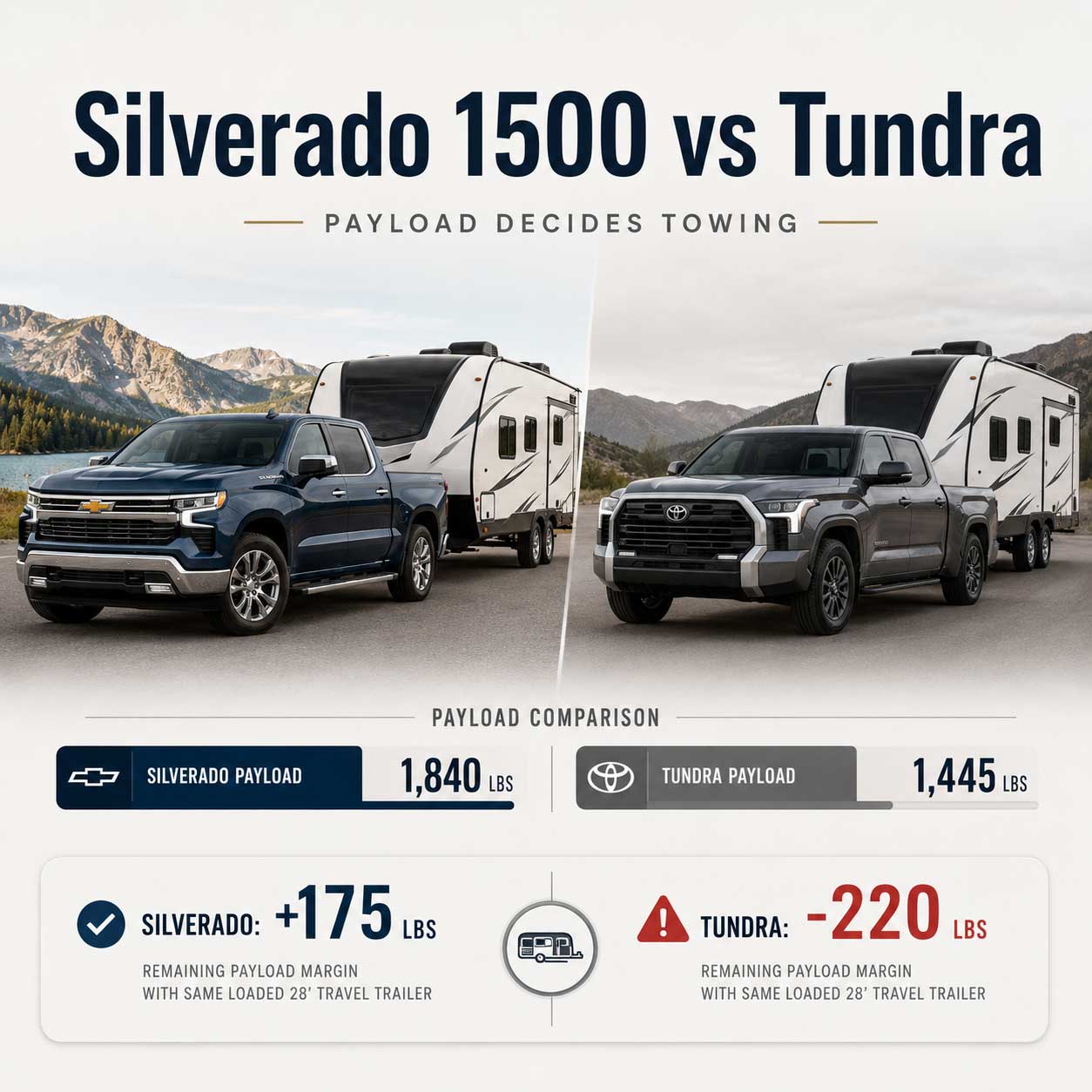
Silverado vs Tundra: Payload Math
Chevy Silverado 1500 LTZ 4×4 Crew Cab
| Item | Weight (lbs) |
| Truck Payload Capacity (door sticker — not brochure) | 1,840 |
| minus Driver + Passenger | minus 340 |
| minus Gear / cargo in truck bed | minus 200 |
| minus Tongue weight (15% of loaded trailer weight) | minus 1,125 |
| = Remaining Payload Margin | **175 lbs** |
Toyota Tundra Limited 4×4 CrewMax iForce MAX
| Item | Weight (lbs) |
| Truck Payload Capacity (door sticker — not brochure) | 1,575 |
| minus Driver + Passenger | minus 340 |
| minus Gear / cargo in truck bed | minus 200 |
| minus Tongue weight (15% of loaded trailer weight) | minus 1,125 |
| = Remaining Payload Margin | **-90 lbs** |
How the Tundra Goes Over GVWR
The Silverado survives — barely. One hundred and seventy-five pounds of margin with two adults, standard gear, and a modestly loaded 28-foot trailer. That is not comfortable headroom. One extra passenger, heavier packing, or tongue weight that climbs past 15 percent closes it entirely.
The Tundra, in this configuration, is over by 90 pounds before the trip begins. Close, but over is over. That is a GVWR violation in the driveway.
Both trucks carry nearly identical advertised tow ratings for this class of trailer. The payload math produces a completely different picture. See how every major 2026 half-ton ranks once payload, not tow rating, sets the order.
If you’re wondering where your truck would land in this calculation, don’t guess.
Not sure if your truck is within safe limits? Towing Limit Pro helps you verify your real setup using your actual payload sticker, passengers, cargo, and trailer numbers.
- Remaining payload (what you actually have left)
- Realistic tongue weight estimate (loaded, not brochure)
- GVWR margin + a clear safety buffer
- Risk-zone warning if your setup is pushing limits
Tip: Use your truck’s yellow door sticker payload for the most accurate result.
Verdict: Which Tows a Travel Trailer Better?
Chevy Silverado 1500 LTZ 4×4 Crew Cab: Borderline
The Silverado has enough payload to tow a 28-foot trailer with two adults and moderate gear, provided tongue weight is managed carefully and the bed stays reasonably light. The 175 lb margin is real but thin. A third passenger, a heavier packing list, or tongue weight above 15 percent eliminates it. This setup is legal in this scenario, but there is no room for casual additions.
Toyota Tundra Limited 4×4 CrewMax iForce MAX: Risky
The Tundra’s iForce MAX hybrid system adds curb weight that directly compresses payload. In this configuration, the math goes negative before the trailer moves. This is not a statement about the Tundra as a platform — a lighter SR5 4×2 in a double cab carries considerably more payload and may produce an entirely different result. But the Limited CrewMax iForce MAX, with two adults and standard gear, cannot tow this trailer at this loaded weight without exceeding GVWR.
Trim selection is not a style decision. It is a payload decision. The truck that fits your trailer is the one with enough payload capacity for your specific combination — and that answer is on the door sticker, not the window sticker.
Know your real margin before you hook up.
Most half-ton trucks hit their payload limit long before they hit their tow rating limit — and most owners don’t realize it until they’re already committed. Verify your exact setup and know where you stand.
- Remaining payload (your real limit)
- Realistic tongue weight (loaded)
- GVWR margin + safety buffer
- Clear risk-zone indicator
Best results: use your yellow door-sticker payload number and your loaded trailer estimate (not dry weight).
FAQs
Does a weight distribution hitch change the payload math?
A weight distribution hitch redistributes tongue weight across both axles of the tow vehicle and the trailer's front axle — it does not remove tongue weight from your payload calculation. You still carry the full tongue weight against your truck's GVWR. What the hitch changes is how that load is distributed across the suspension for levelness and handling. It helps with sway and rear squat. It does not give you additional payload capacity. Run the same subtraction either way.
The Silverado and Tundra have similar tow ratings — doesn't that mean they're equal for this trailer?
Tow rating and payload capacity are different numbers measuring different constraints. Tow rating describes the maximum weight the hitch assembly and drivetrain are rated to pull. Payload capacity describes the total weight the truck is federally certified to carry — occupants, gear, and tongue weight combined — before exceeding GVWR. A truck can have a 12,000 lb tow rating and a 1,400 lb payload. In that case, the payload runs out long before the tow rating does. Matching tow ratings between two trucks does not mean matching payload math.
Why does the Tundra CrewMax iForce MAX have so much less payload than a base Tundra?
Every option and configuration choice affects curb weight: hybrid drivetrain, extended cab body, larger seats, panoramic roof, running boards. Curb weight rises with each addition. GVWR is set per configuration by the manufacturer. The gap between GVWR and curb weight is payload — shrink that gap with added equipment, and payload decreases. The Tundra SR5 4x2 in a shorter cab carries significantly more payload than the Limited CrewMax iForce MAX, by up to about 275 pounds. Configuration determines capacity. The door sticker on your specific truck is the only number that counts.
Why do the manufacturer's advertised payload figures differ from the door sticker number?
Manufacturers advertise maximum payload, which applies to the base, lightest configuration in the model line. Your truck has more content, more weight, and therefore less payload than that headline figure. The door sticker is a federal certification tied to your specific vehicle identification number and your specific build. That number and the brochure number are not interchangeable. When you're planning a tow, the door sticker is the document that matters.
What if I load the trailer below dry weight — does the math change significantly?
It changes, but not in the way most people expect. An empty trailer sitting at dry weight still produces a tongue weight that loads your payload. A 6,400 lb trailer with zero added contents still puts roughly 800 to 960 lbs on the hitch ball. The improvement from towing a lightly loaded trailer versus a fully loaded one is real but incremental — and the truck's payload capacity and the occupant load remain fixed regardless of what is in the trailer. Running the math on the actual loaded weight you expect to travel with, rather than the manufacturer's dry weight, gives you the only figure worth planning around.