
Quick Answer
Ranked by published payload in common Crew Cab 4×4 configurations, the Chevy Silverado 1500 and Ford F-150 come out on top, the GMC Sierra 1500 and Ram 1500 follow, and the Toyota Tundra trails. But no ranking matters until you subtract your passengers, gear, and tongue weight from whatever number is on your door sticker. For a closer look at the top three, see our head-to-head payload math on the F-150, Silverado and Tundra.
The payload on the window sticker is a ceiling — what’s left after subtracting everything else is your actual margin.
Why This Ranking Ignores Tow Ratings
Every comparison article on half-ton trucks leads with tow rating. Editors list the numbers, rank the trucks, and move on. The problem: tow rating is not the constraint that decides whether your trailer is safe to pull. Payload is. And payload shrinks the moment you sit in the driver’s seat.
This ranking ignores tow ratings entirely. It orders 2026 half-tons by payload capacity in common towing configurations — and then runs the real subtraction to show what margin survives after passengers, gear, and tongue weight enter the equation.
The Trucks: Payload Specs by Configuration
Payload figures below are each manufacturer’s published payload for a common Crew Cab, 4×4, short-bed configuration — the best case for that setup, not the headline maximum manufacturers advertise in press releases. Trim and options add weight, so your door sticker will usually show less. If your truck has a different cab style, engine, or drivetrain, your door sticker will show a different number. The door sticker is the only number that counts.
| Truck | Example Configuration | GVWR | Curb Weight | Published Payload |
| Chevy Silverado 1500 | 2026 Crew Cab 4×4 short bed, 5.3L | 7,100 lbs | 5,110 lbs | ~1,990 lbs |
| Ford F-150 | 2026 SuperCrew 4×4, 5.5-ft bed | up to 7,400 lbs | — | ~1,980 lbs |
| GMC Sierra 1500 | 2026 Crew Cab 4×4 short bed, 5.3L | — | — | ~1,960 lbs* |
| Ram 1500 | 2026 Crew Cab 4×4 5’7″ bed, 3.0L Hurricane | 7,100 lbs | 5,260 lbs | ~1,840 lbs |
| Toyota Tundra | 2026 SR5 CrewMax 4×4 5.5-ft bed, 3.4L twin-turbo V6 | 7,210 lbs | 5,500 lbs | ~1,710 lbs |
These are representative examples for common configurations. Ford publishes its figure for the SuperCrew 4×4 as a best case across engines, not per engine. *We couldn’t find GMC’s own 2026 payload figure for the Sierra, so that row uses GM Authority’s 2026 payload table. Your truck’s door sticker is the authoritative number — not the brochure, not the spec sheet, not the dealer’s sales conversation. Cross-shopping an electric pickup? See how the Cybertruck’s towing capacity holds up against its payload.
The F-150’s headline 2,440-lb payload belongs to a Regular Cab 4×2 with the 8-ft box and the 3.5L EcoBoost. In the SuperCrew 4×4 spec, a common towing setup, Ford’s best case drops to 1,980 lbs — still ahead of the Ram and within 10 lbs of the Silverado, but well short of the marketing number.
The Trailer Side of the Equation
For this comparison, the example trailer is a popular mid-size travel trailer in the 28–32 foot range:
- Dry weight: 6,200 lbs
- GVWR (manufacturer maximum): 8,500 lbs
- Listed tongue weight: 840 lbs (at dry weight)
Dry weight does not equal loaded weight. A trailer packed for a real trip — fresh water, gear, food, bikes, and passengers’ belongings — routinely runs 15 to 30 percent above the manufacturer’s dry weight figure. That same 6,200-lb dry trailer loaded to a realistic road weight of 7,500 lbs changes every number in your margin calculation.
Dry vs. Loaded: The Number That Changes Everything
Manufacturers list dry weight. Loaded weight is what you actually tow.
A 6,200-lb dry trailer at 20 percent over dry weight comes in at 7,440 lbs loaded. At 25 percent, it’s 7,750 lbs. Neither figure matches the number in the brochure, and neither shows up on the spec sheet.
Fresh water alone adds up fast: a full 40-gallon tank is 334 lbs. Add two bikes, a generator, a week of food, and the gear that lives in every compartment, and you are well past dry weight before the trip begins.
Run your margin calculation against loaded weight — not the brochure number.
Tongue Weight: The Payload Item Nobody Budgets For
Tongue weight is a component of payload. It presses down on your truck’s hitch ball, transfers load to your rear axle, and counts against your payload capacity. Most truck owners do not include it in their margin calculation.
Standard guideline: tongue weight runs 12 to 15 percent of loaded trailer weight.
At 15 percent on a 7,500-lb loaded trailer:
7,500 × 0.15 = 1,125 lbs — subtracted from your payload, not separate from it.
That is not a hitch accessory number. That is a payload number. And it is the single largest item in the subtraction.
The Real Math: Ram 1500 With the 3.0L Hurricane
This calculation uses the Ram 1500 Crew Cab 4×4 with the 3.0L Hurricane and the 5’7″ bed, a mid-pack truck in this ranking. Ram’s published payload: 1,840 lbs.
| Item | Weight (lbs) |
| Truck Payload Capacity (published — check your door sticker) | 1,840 |
| minus Driver + Passenger | minus 340 |
| minus Gear / cargo in truck bed | minus 200 |
| minus Tongue weight (15% of 7,500 lb loaded trailer) | minus 1,125 |
| = Remaining Payload Margin | 175 lbs |
What Happens After You Add the Family
175 lbs. That is what remains after the Ram accounts for two adults, modest gear, and tongue weight from a mid-size trailer loaded to realistic weights. Run the same load through the top of the table, the Silverado 5.3L at 1,990 lbs, and you keep 325 lbs.
One heavier passenger, a full fresh-water tank, or a few extra storage bins — and that 175-lb margin disappears. Add a third adult and you’re down to about 5 lbs.
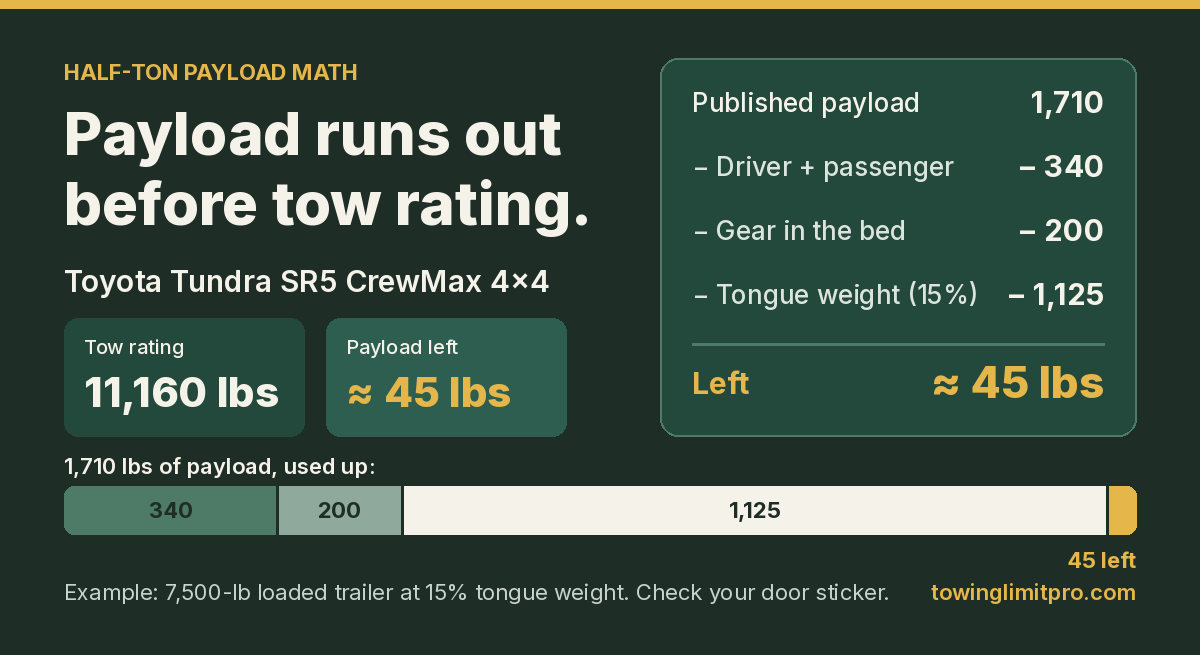
Now run the same trailer against a Toyota Tundra SR5 CrewMax 4×4 with the 5.5-ft bed, which Toyota lists at 1,710 lbs of payload:
1,710 − 340 − 200 − 1,125 = 45 lbs
One heavier passenger and the truck is over payload before the trailer leaves the driveway. The tow rating never flagged it — Toyota rates this truck to tow 11,160 lbs. The truck will still pull. But the math doesn’t care.
This is why the ranking matters — and why configuration matters more than nameplate.
If you’re wondering where your truck would land in this calculation, don’t guess.
Not sure if your truck is within safe limits? Towing Limit Pro helps you verify your real setup using your actual payload sticker, passengers, cargo, and trailer numbers.
- Remaining payload (what you actually have left)
- Realistic tongue weight estimate (loaded, not brochure)
- GVWR margin + a clear safety buffer
- Risk-zone warning if your setup is pushing limits
Tip: Use your truck’s yellow door sticker payload for the most accurate result.
Verdict: The Best Half-Ton for Towing in 2026
Chevy Silverado 1500 — Within limits. In Crew Cab 4×4 short-bed form with the 5.3L, the Silverado carries the most published payload here: 1,990 lbs, leaving about 325 lbs after the same load. That clears 300 lbs, but not by much. One more passenger or a full fresh-water tank eats most of it.
Ford F-150 — Within limits in the right configuration. Ford’s best case for a SuperCrew 4×4 with the 5.5-ft bed is 1,980 lbs, about 315 lbs of margin after the same load and within 10 lbs of the Silverado. Ford doesn’t break that figure out by engine or trim, so a well-optioned XLT will usually show less on its door sticker. Know your exact number before you commit to a trailer.
GMC Sierra 1500 — Borderline. GM Authority lists the 2026 Sierra Crew Cab 4×4 short bed with the 5.3L at 1,960 lbs, which leaves about 295 lbs — just under 300 lbs to work with. We couldn’t confirm that figure in GMC’s own 2026 documents, so check your door sticker before you count on it.
Ram 1500 — Borderline. With the 3.0L Hurricane in Crew Cab 4×4 form, the Ram’s 1,840-lb published payload sits behind the Silverado, F-150 and Sierra, leaving about 175 lbs. Against a mid-size trailer loaded to realistic weights, margins are tight but survivable with disciplined loading. Any deviation — heavier passengers, wetter tanks, extra gear — pushes this into risky territory. Know your exact door sticker number before you commit to a trailer.
Toyota Tundra — Borderline to Risky. Despite a strong tow rating, the Tundra’s payload in common CrewMax 4×4 configurations sits near the bottom of this class. Against the same loaded mid-size trailer, an SR5 CrewMax 4×4 keeps about 45 lbs — one heavier passenger and it goes negative. The tow rating says yes. The payload math says not without careful configuration.
If your trailer is under 6,000 lbs fully loaded — with everything inside — every truck here stays under its published payload with two adults and modest gear, though the Tundra keeps only about 270 lbs. The heavier the trailer, the faster configuration choices become decisive. There is no universally safe answer. There is only your door sticker, your loaded trailer weight, and the subtraction.
Know your real margin before you hook up.
Most half-ton trucks hit their payload limit long before they hit their tow rating limit — and most owners don’t realize it until they’re already committed. Verify your exact setup and know where you stand.
- Remaining payload (your real limit)
- Realistic tongue weight (loaded)
- GVWR margin + safety buffer
- Clear risk-zone indicator
Best results: use your yellow door-sticker payload number and your loaded trailer estimate (not dry weight).
FAQs
What is the difference between payload capacity and tow rating?
Payload capacity is the maximum weight your truck can carry — passengers, cargo in the cab and bed, and tongue weight from the trailer combined. Tow rating is the maximum weight the truck can pull behind it. The two numbers measure different things. For most half-ton trucks pulling travel trailers, payload is the binding constraint, because tongue weight and occupants consume available capacity faster than the tow rating is ever reached.
Does the manufacturer's dry weight tell me what my trailer actually weighs on the road?
No. Dry weight is measured with an empty fresh-water tank, no gear, and no passengers. A real road trip adds fresh water at 8.3 lbs per gallon, food, clothing, bikes, tools, and anything stored in the trailer's compartments. Loaded weight routinely runs 15 to 30 percent above the listed dry weight. Always use a realistic loaded estimate in your payload math — never the spec sheet number.
Does the F-150's advertised payload apply to most F-150s?
No. The F-150 holds the highest maximum payload in the class, but that figure applies to a specific and uncommon configuration: Regular Cab, 8-ft box, 2WD, with the 3.5L EcoBoost. A SuperCrew 4x4 — a common towing setup — carries significantly less payload than the advertised maximum: Ford's best case is 1,980 lbs, 460 lbs below the headline. Check your door sticker. The advertised number almost certainly does not apply to your truck.
How do I know if my truck is over payload before I leave the driveway?
Your door sticker lists your truck's maximum payload. Add up every item that counts against it: all passengers, all cargo in the cab and bed, and tongue weight from the trailer. If that sum exceeds the door sticker number, the truck is over payload. It will still drive. But you are outside the manufacturer's safety certification — stopping distances, tire load ratings, and suspension limits are all operating beyond their designed range.
Does a weight distribution hitch eliminate tongue weight from my payload calculation?
No. A weight distribution hitch redistributes tongue weight across multiple axles, moving some of that load to the tow vehicle's front axle and the trailer's axles. It does not eliminate tongue weight from your payload calculation. The load still exists — it is only spread differently. Whether you are running a weight distribution hitch or not, tongue weight remains a payload item and must be subtracted from your door sticker number.