
Quick Answer
The dry weight on a trailer’s spec sheet is not the weight you’re actually towing. Once you add food, water, gear, clothing, and full tanks, a trailer’s real weight is typically 15–30% higher than the number printed in the brochure.
The number that matters is loaded weight — and most people never calculate it.
The Number You’re Using Is Wrong
Here’s the uncomfortable truth: most towing decisions are made using a number that doesn’t exist once you leave the driveway.
Dry weight is a factory measurement taken with empty tanks, no gear, no passengers, and no real-world load. It’s a benchmark — not a towing weight. Yet it’s the number splashed across spec sheets, dealer listings, and online forums. And it’s the number most truck owners plug into their towing calculation without a second thought.
The result isn’t just imprecision. It’s a systematic underestimate of what you’re actually putting on your hitch.
Understanding the Two Numbers
Before any math happens, you need to understand what the numbers actually represent.
Dry Weight (UVW — Unloaded Vehicle Weight) is the manufacturer’s measured weight of the trailer with no occupants, no cargo, no fresh water, no propane, and no dealer-installed options. It’s measured under controlled conditions and reflects the lightest possible configuration of that trailer.
GVWR (Gross Vehicle Weight Rating) is the maximum allowable loaded weight — the ceiling. It’s the upper boundary of what the trailer was designed to carry.
The space between dry weight and GVWR is where your actual towing weight lives. And for most trailers, that space is significant.
How Much Does a Trailer Gain When Loaded?
Let’s work through a specific example using a Grand Design Reflection 150 Series 226RK — a popular mid-size fifth wheel alternative that also comes in a travel trailer configuration.
Trailer Specs (Grand Design Reflection 226RK)
- Dry Weight (UVW): 6,429 lbs
- GVWR: 9,995 lbs
- Hitch Weight (dry): 969 lbs
Note: dry weight does not equal loaded weight. These are two different numbers and only one of them is relevant when you’re calculating your real towing margin.
Here’s what realistic loading looks like:
| Item | Weight Added |
| Fresh water (50 gallons) | 417 lbs |
| Propane (two 30 lb tanks filled) | 60 lbs |
| Clothing and personal gear | 200 lbs |
| Kitchen supplies and food | 150 lbs |
| Outdoor gear (chairs, grill, bikes) | 180 lbs |
| Miscellaneous (tools, linens, etc.) | 100 lbs |
| **Total added weight** | **1,107 lbs** |
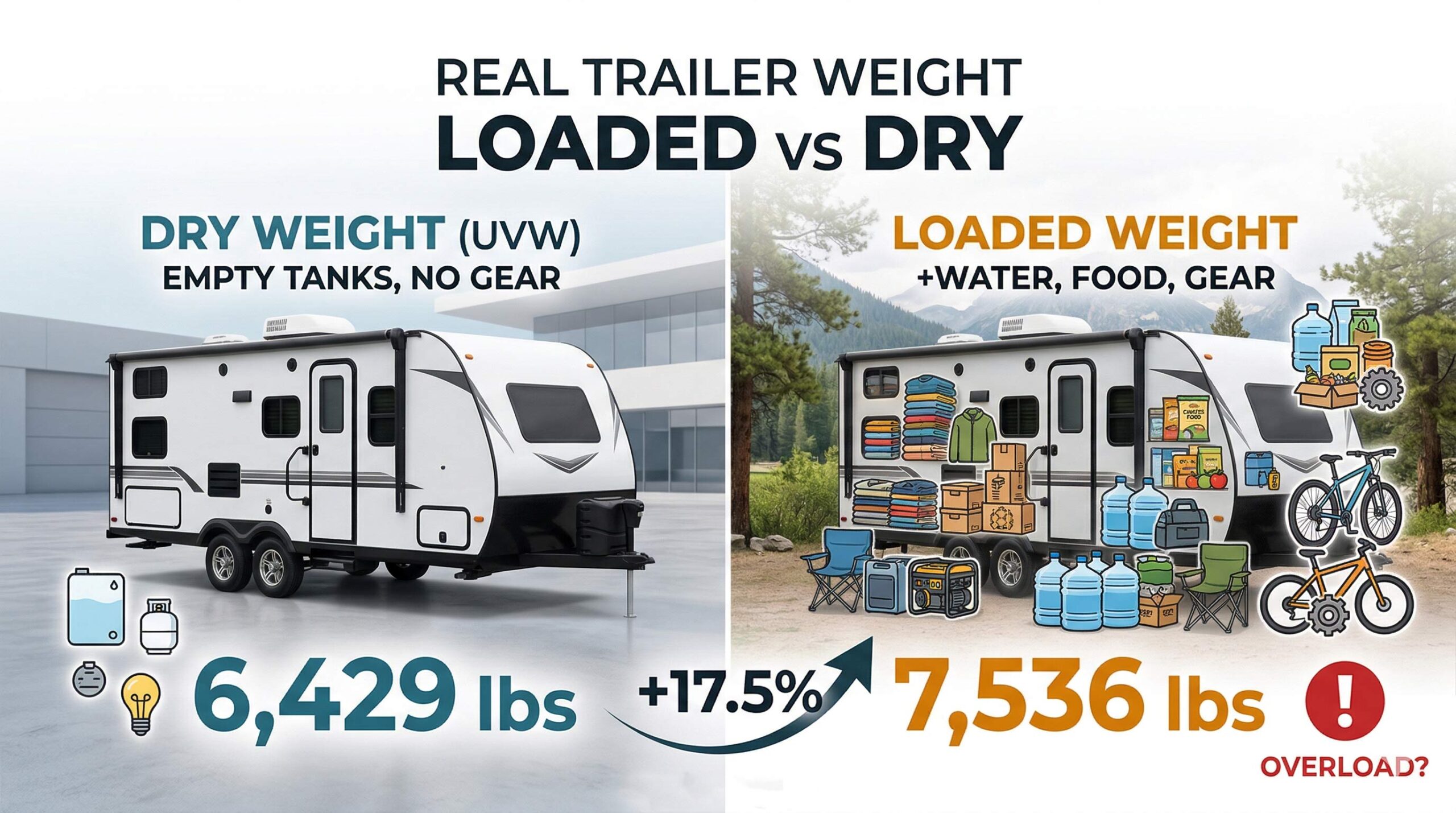
Loaded trailer weight: 6,429 + 1,107 = 7,536 lbs
That’s a 17.5% increase over dry weight. And this is a conservative load — full black and gray tanks, generator fuel, and additional gear can push this even higher.
Truck Specs: The Other Side of the Equation
For this example, we’re using a 2023 Chevy Silverado 1500 LTZ with the 5.3L V8 and a standard crew cab short bed configuration.
Important: These numbers must come from the door sticker — not the brochure, not the website, not the window sticker at the dealership. The door sticker (located on the driver’s door jamb) reflects your specific truck’s actual payload capacity based on how it was built. Towing packages, sunroofs, and optional equipment all reduce payload capacity from the advertised maximum.
- GVWR: 7,100 lbs
- Curb Weight: 5,546 lbs
- Payload Capacity (door sticker): 1,554 lbs
The advertised payload for this configuration is often listed higher in marketing materials. What the door sticker says is what counts.
Tongue Weight: The 12–15% Rule
Tongue weight — the downward force the trailer’s hitch applies to the truck’s receiver — should fall between 12% and 15% of the loaded trailer weight. This is the standard industry guideline.
At 15%:
> 7,536 lbs × 0.15 = 1,130 lbs tongue weight
At 12%:
> 7,536 lbs × 0.12 = 904 lbs tongue weight
This is a meaningful range. A poorly loaded trailer can push tongue weight above 15%, which overloads the rear axle. A trailer loaded too far back can drop below 10%, creating dangerous sway. For this calculation, we’ll use 15% as the conservative figure.
Real Trailer Weight Math, Step by Step
| Item | Weight (lbs) |
| Truck Payload Capacity (door sticker — not brochure) | 1,554 |
| minus Driver + Passenger | minus 370 |
| minus Gear / cargo in truck bed | minus 150 |
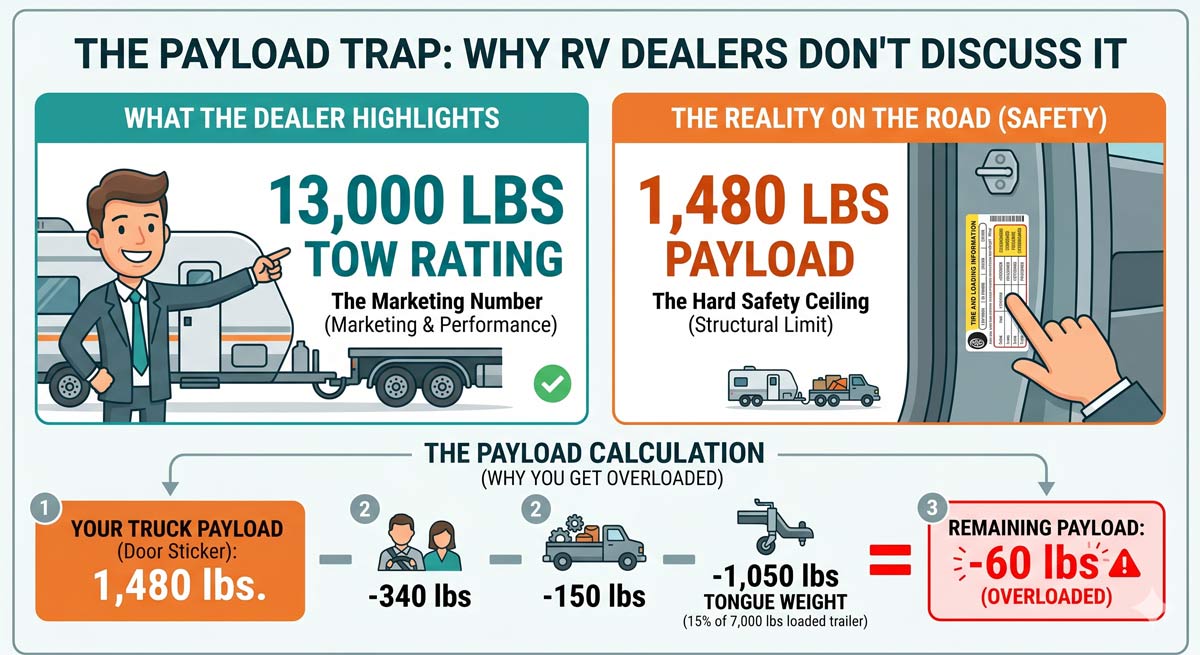
| minus Tongue weight (15% of loaded trailer weight) | minus 1,130 |
| = Remaining Payload Margin | **−96 lbs** |
Why the Margin Goes Negative
The margin is negative.
With a conservative load, two passengers, and minimal truck bed cargo, this truck is over payload by 96 pounds before a single extra item gets added. That’s not a borderline situation — that’s a vehicle operating outside its rated capacity.
And this is based on a loaded trailer weight that’s still 2,459 lbs below GVWR. The trailer has room to carry more. The truck’s payload does not.
This is the gap that dry-weight math hides. When you use the 6,429 lb dry weight and calculate a 15% tongue weight figure of 964 lbs instead of 1,130, the margin looks fine on paper. But that paper number only exists before you pack.
If you’re wondering where your truck would land in this calculation, don’t guess.
Not sure if your truck is within safe limits? Towing Limit Pro helps you verify your real setup using your actual payload sticker, passengers, cargo, and trailer numbers.
- Remaining payload (what you actually have left)
- Realistic tongue weight estimate (loaded, not brochure)
- GVWR margin + a clear safety buffer
- Risk-zone warning if your setup is pushing limits
Tip: Use your truck’s yellow door sticker payload for the most accurate result.
Why This Scenario Is More Common Than It Should Be
The Silverado 1500 LTZ is one of the most popular half-ton trucks in the country. The Grand Design Reflection is a well-reviewed, well-selling trailer. Neither is an unusual or extreme choice. This is an ordinary combination that fails payload math under ordinary loading conditions.
The problem isn’t the truck or the trailer — it’s using dry weight as a towing weight.
This scenario repeats across every half-ton truck platform. Payload capacity on half-ton trucks typically ranges from 1,400 to 2,000 lbs depending on configuration. Once you subtract occupants, truck cargo, and a realistic tongue weight from a loaded mid-size trailer, the margin gets tight or disappears entirely.
What to Actually Do
Step 1: Get the loaded weight estimate. Add realistic load to the dry weight. Use the figures above as a framework. At minimum, add water, propane, food, gear, and personal items.
Step 2: Calculate tongue weight from loaded weight. Not dry weight. Use 15% as your working figure.
Step 3: Read your door sticker. Open the driver’s door, find the placard, and write down the payload number printed there.
Step 4: Do the subtraction. Payload minus occupants minus truck bed cargo minus tongue weight. Whatever remains is your margin. If it’s negative, you’re overloaded.
Step 5: Verify at a CAT scale. After loading, weigh your truck solo and then with the trailer connected. Subtract the solo weight from the combined steer axle weight to confirm actual tongue weight. This eliminates estimation entirely.
Verdict: Dry-Weight Planning Fails the Math
The scenario described above — a well-configured half-ton towing a popular mid-size travel trailer with a realistic load — fails payload math. That’s not a knock on either product. It’s a math result.
The difference between a safe towing setup and an overloaded one isn’t the tow rating. Half-ton trucks are frequently rated to tow 10,000 to 13,000 lbs. The payload capacity — rarely above 2,000 lbs and often below 1,700 on loaded LTZ/Limited trim configurations — is the actual limiting factor. Tongue weight alone from a loaded 8,000 lb trailer at 15% is 1,200 lbs. That leaves less than 500 lbs for everything else inside and on the truck.
This is why payload is the number that matters. Not tow rating. Not dry weight. Payload.
Know your real margin before you hook up.
Most half-ton trucks hit their payload limit long before they hit their tow rating limit — and most owners don’t realize it until they’re already committed. Verify your exact setup and know where you stand.
- Remaining payload (your real limit)
- Realistic tongue weight (loaded)
- GVWR margin + safety buffer
- Clear risk-zone indicator
Best results: use your yellow door-sticker payload number and your loaded trailer estimate (not dry weight).
FAQs
What's the difference between dry weight and loaded weight on a trailer?
Dry weight (also called UVW, or Unloaded Vehicle Weight) is the factory-measured weight of the trailer with no water, no propane, no gear, and no occupants. Loaded weight is the actual weight of the trailer as you're towing it. The difference is typically 15–30% for most travel trailers, depending on how much water, food, and gear you're carrying. Dry weight is the starting point for estimation — not the number you use in your payload math.
Why is payload capacity more important than tow rating when deciding what to tow?
Tow rating tells you the maximum weight your truck's drivetrain and brakes are rated to pull. Payload capacity tells you the maximum weight your truck's suspension, frame, and axles can support — including passengers, cargo, and tongue weight. On most half-ton trucks, tow rating is rarely the binding constraint. Payload almost always is. A truck rated to tow 12,000 lbs may have a payload capacity of only 1,500 lbs, which gets consumed by tongue weight and occupants long before you approach the tow rating limit.
How do I find the actual payload capacity for my specific truck?
Open the driver's door and look at the placard on the door jamb. It will show your truck's specific payload capacity in pounds. This number is based on the actual options and configuration of your specific vehicle — not the maximum advertised figure for the trim level. Trucks with the same model and trim can have meaningfully different payload numbers depending on what options were installed. Never use the brochure number. Always use the door sticker.
How much does tongue weight affect my truck's payload capacity?
Tongue weight counts directly against your truck's payload. It's a downward force on your hitch, which is part of your truck's total weight. For a loaded trailer weighing 7,500 lbs, a 15% tongue weight is 1,125 lbs — that's nearly all of the available payload on many half-ton configurations before you add a single person or any truck bed cargo. This is why tongue weight calculation from loaded (not dry) trailer weight is one of the most critical steps in the math.
What happens if I'm over payload capacity?
Exceeding your truck's payload capacity means the frame, suspension, and axles are carrying more than they were engineered to support. Consequences include accelerated wear on rear springs, reduced braking effectiveness, degraded handling and sway control, and the possibility of component failure. It also puts you in a position where any sudden weight shift — a trailer sway event, a hard stop, a sharp turn — is handled by a truck with no mechanical margin left. Overloading doesn't always produce immediate failure, which is why it persists. The cost typically shows up as early component failure, increased brake wear, and increased accident risk — not an immediate breakdown.