
What’s the best EV for towing? Published tests don’t crown one truck. Each truck did best in a different test, and EV towing results depend far more on the trailer’s shape and your speed than on the trailer’s weight.
Below is our plain-language summary of what car magazines, YouTube testers and owners have actually measured, starting with planning mi/kWh by truck and trailer shape. Every figure links to its source. These are results from specific tests, not ratings.
These figures come from published tests and owner reports under the conditions listed with each one. Your results will differ with trailer shape, speed, temperature, wind, terrain and load. Treat them as estimates for planning, not ratings or guarantees. Always follow your truck’s manufacturer ratings and the numbers on your door-jamb sticker, and never exceed GVWR, GCWR, axle (GAWR) or hitch/tongue limits.
Short Answer
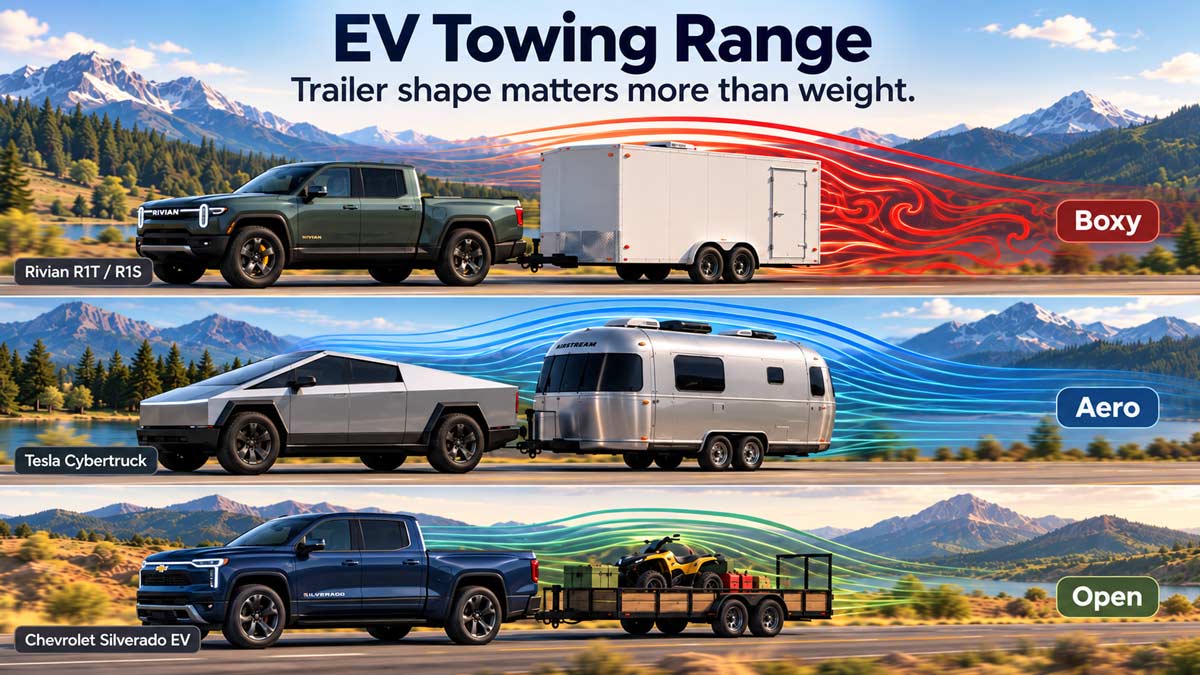
- Boxy campers and enclosed trailers at highway speed: in these tests, electric trucks landed at about 0.63 to 1.13 mi/kWh.
- Low (open) trailers or aero trailers like a Bowlus or Airstream: about 0.94 to 1.86 mi/kWh.
- Planning range depends on battery size. With boxy trailers it often landed near half of unladen range or less; with an aero Bowlus, MotorTrend saw drops of about a quarter to a third (MotorTrend).
EV Towing mi/kWh by Truck and Trailer Shape
This is our own summary of the tests linked below. Each range is the low-to-high spread we found for that truck and trailer type. Conditions differ from test to test, so use it to pick a starting point, not to rank trucks.
| Truck | Low / open trailer | Aero travel trailer | Boxy camper, toy hauler or enclosed |
|---|---|---|---|
| Chevy Silverado EV | about 0.94–1.45 | about 1.1 | about 0.7–1.13 |
| Ford F-150 Lightning | about 1.1–1.2 | no mi/kWh figure | about 0.7–1.0 |
| Rivian R1T | no mi/kWh figure | about 1.02–1.24 (owner-reported) | about 0.9 |
| Rivian R1S | no data | about 1.81 | no data |
| Tesla Cybertruck | about 1.34 | about 1.86 | about 0.8–1.1 |
| GMC Hummer EV | no data | no data | about 0.63 |
| GMC Sierra EV | no data | no data | about 0.7–0.8 (owner-reported) |
All figures are miles per kWh while towing, from the tests listed in the sections below. “No data” means none of the tests we collected covered that pairing. Three results don’t fit a shape column because the trailer type wasn’t stated: Rivian R1S at about 1.3 with 5,000 lbs, Rivian R1T at about 1.25 with about 2,000 lbs, and GMC Sierra EV at about 1.24 with about 3,500 lbs (details below). There is no battery-electric Ram 1500 in any of these tests.
Why shape matters: low trailers let the air flow over them, rounded aero trailers like a Bowlus or Airstream let it slip around, and a tall, flat front is the hardest thing to push. See our Airstream towing guide for more on aero trailers.
How Much Range You Give Up When Towing
Planning range depends on battery size, but the drop is big in every test we found:
- Rivian R1T, open car hauler, 5,650 lbs, about 75 mph: range was cut about in half, to about 110 miles, against 220 unladen (Car and Driver).
- Cybertruck, R1T and Lightning, Bowlus Volterra, 110-mile loop at a 50 mph average: MotorTrend says each truck ended near half its EPA combined range (MotorTrend).
Best EV for Towing: Who Did Best in Each Test
These tests can’t back a single best pick: trailers, speeds and weather differ, and only a few ran trucks side by side. Here’s who did best when they did:
- Same 29 ft camper, 6,100 lbs, 70 mph, 85°F: GMC Hummer EV 140 miles, Rivian R1T 110, F-150 Lightning 100 (Car and Driver).
- Same enclosed trailer just under 10,000 lbs, 65 mph, 48–52°F: F-150 Lightning 91 miles, Rivian R1T 85, both extrapolated (Consumer Reports).
- Same 7,420 lb enclosed trailer, 55 mph max, desert grades: F-150 Lightning 1.0 mi/kWh, Rivian R1T 0.9 (Edmunds).
- Same 11,000 lb trailer and load: Silverado EV 177-mile score, F-150 Lightning 130, Rivian R1T 100 (cold-weather run), Cybertruck 90 (below freezing). The scores include each truck’s own remaining-range guess, and the weather wasn’t the same (JerryRigEverything via InsideEVs; JerryRigEverything on YouTube).
- A Tesla Model 3 on a trailer, about 6,500 lbs, I-70 in Colorado: the Silverado EV did 472 miles round trip with one charging stop. The Cybertruck had to unhitch at the Glenwood Springs Supercharger (Out of Spec Reviews via InsideEVs).
- Bowlus Volterra aero trailer, just over 27 ft, about 3,200 lbs dry, same 103-mile route with a 600 ft climb: Cybertruck 1.86 mi/kWh, Rivian R1S 1.81 (run on a different day). A Model X SUV beat both at 2.39 (The Drive).
- Same 36 ft travel trailer, 7,770 lbs, 13-mile loop: Silverado EV and F-150 Lightning tied, each using 35 miles of indicated range (MotorTrend).
The truck-by-truck results are below.
Results by Truck
Chevy Silverado EV
The Silverado EV has a 205 kWh pack in several of these tests, and it posted the longest towed distances we found:
- 1.1 mi/kWh with a 20 ft Airstream, 4,500 lbs, 54 miles on I-75, against 2.2 without the trailer (Autoweek).
- 232 miles with a 6,500 lb enclosed car hauler, with 19 miles indicated left (TFL).
- 472 miles round trip with one charging stop, Denver to Grand Junction and back on I-70 with a Tesla Model 3 on a trailer, about 6,500 lbs, arriving with 14%, at 1.2 mi/kWh over the first 230 miles (Out of Spec Reviews via InsideEVs).
Takeaway: in these tests, the Silverado EV towed the farthest, and it topped the 11,000 lb test.
Ford F-150 Lightning
- MotorTrend, three trailers, 64–67 mph average: 115 miles extrapolated with a 3,140 lb, 17 ft R-Pod, 100 miles with a 5,260 lb, 28 ft 2 in camper and 90 miles with a 7,218 lb, 33 ft 11 in camper (MotorTrend). Unladen, the same truck went 255 miles on MotorTrend’s road trip.
- TFL, aluminum toy hauler, just over 6,000 lbs, I-25 Colorado: about 0.7 mi/kWh (worked out from about 86 miles on about 119 kWh), about 86 miles with about 9% left (TFL).
- Out of Spec, a Tesla Model 3 on a trailer, about 6,500 lbs, I-70 mountains, driven slower than the Silverado to save range: 1.1 mi/kWh on the first leg and 1.2 later (Out of Spec Reviews via InsideEVs).
Takeaway: the Lightning edged the R1T in both head-to-head enclosed-trailer tests (Consumer Reports and Edmunds), but trailed the Hummer and R1T with Car and Driver’s camper.
Rivian R1T and R1S
Rivian towing range in these tests depended a lot on the trailer:
- R1T, TFL, trailer about 2,000 lbs (type not stated), 56 mph average: 1.25 mi/kWh, 153 miles on 91% of the battery (TFL).
- R1S, trailer about 5,000 lbs (type not stated): 1.3 mi/kWh, 175.5 miles in theory (TFLEV via InsideEVs).
Takeaway: the R1T beat the Lightning with Car and Driver’s camper and lost to it in the two enclosed-trailer tests. Its strongest long-trip numbers are owner-reported, with Airstreams (see below).
Tesla Cybertruck
- Bowlus Volterra, 3,170 lbs, 65% highway at 70 mph (50 mph overall average): 160 miles, against 224 unladen in MotorTrend’s testing (MotorTrend).
- Platform trailer with a Model Y, about 5,000 lbs (tester estimate): about 1.34 mi/kWh, worked out from 749 Wh/mi (Notebookcheck).
- 28 ft toy hauler, about 8,000 lbs, 70 mph: about 0.8 mi/kWh (1,252 Wh/mi), 85 miles to 6% charge (TFL via InsideEVs).
- 33 ft travel trailer, about 7,500 lbs: 1.1 mi/kWh on a short 22-mile run, with TFL calling about 115 miles realistic on a full charge (TFL). Treat it as a rough sign only.
Takeaway: the Cybertruck posted the best truck mi/kWh with the Bowlus aero trailer, but in the Colorado test it had to unhitch to charge.
GMC Hummer EV
- TFL, toy hauler, 6,100 lbs: 0.63 mi/kWh, 123.2 miles driven on 195 kWh, with its 212.7 kWh pack (TFL).
Takeaway: the Hummer won Car and Driver’s three-truck camper test, but posted the lowest mi/kWh we found with a toy hauler.
GMC Sierra EV
Sierra EV towing range data is thin. We found one publication test and one owner report:
- Sierra EV Denali Max Range, race car on a trailer, about 3,500 lbs, Quebec hills: about 1.24 mi/kWh, worked out from 80.64 kWh per 100 miles. The indicated range dropped from 477 to 284 miles at hookup (Capital One Auto Navigator).
- 30 ft Grand Design Imagine: owner-reported, covered in the owners section below.
Takeaway: there’s too little Sierra EV data to compare it with the others.
Ram
None of the tests we collected include a battery-electric Ram 1500, so we have no Ram numbers to share. Stellantis said on Sept 12, 2025: “As demand for full-size battery-electric trucks slows in North America, Stellantis is reassessing its product strategy and will discontinue development of a full-size BEV pickup” (Stellantis).
Why Shape Beats Weight at Highway Speed
The clearest test we found comes from Aging Wheels, reported by The Autopian. A Silverado EV WT ran the same roughly 60-mile loop at 75 mph:
- Mostly empty flatbed: 1.45 mi/kWh
- Same flatbed with a plywood wall at the front, to act like an enclosed trailer: 0.72 mi/kWh
- Wall plus a 4,500 lb Polestar 2 on board: 0.71 mi/kWh
The same flatbed carrying a full-size Ford F-150, a tall load, dropped to 0.94 (The Autopian). Adding 4,500 lbs barely moved the number. Adding a wall cut it about in half. MotorTrend reached the same conclusion in its 2022 Lightning test, writing that “aerodynamics have a bigger impact on towing range than weight” (MotorTrend).
Weather and wind matter too:
- Wattreach’s owner data splits out 1.40 mi/kWh with a tailwind against 1.10 into a headwind, and 1.25 in mild weather (70–85°F) against 1.02 above 85°F (Wattreach).
- With a 36 ft 9 in Heartland Mallard about 11.5 ft tall and about 7,746 lbs, on The Autopian’s return leg, the Silverado EV got 0.7 mi/kWh at 60 mph in 90°F+ heat with a strong crosswind and the A/C on, then 0.9 later at 65 mph. The outbound leg in mild weather was 0.9 at up to 65 mph (The Autopian). Slowing down helps, but heat and wind can matter just as much.
- Cold hurts as well. In JerryRigEverything’s 11,000 lb test, the Rivian R1T ran in cold weather and the Cybertruck below freezing; their scores were 100 and 90 miles (InsideEVs; JerryRigEverything on YouTube).
What Owners Report
These are owner-reported numbers, with no scale tickets, but they show what longer trips look like.
- Rivian R1T Gen 2 + 23 ft 11 in Airstream: 1.24 mi/kWh weighted average over 5,262 miles. The page also shows 1.19 over 4,405 miles (Wattreach).
- Rivian R1T + Airstream bunkhouse: 1.02–1.07 on the first leg of a 500-mile trip (All Electric Family via InsideEVs); 1.18 and 1.15 on two 55 mph loops in 93°F heat (InsideEVs).
- GMC Sierra EV + 30 ft Grand Design Imagine, about 7,500 lbs (trailer GVWR, not measured): about 0.8 mi/kWh trip average and 0.7 on the hardest leg, about 62 mph, over 1,000+ miles from Orange County, CA to Bryce and Zion, in heat up to 117°F. The owner usually sees about 1.1 (Torque News).
- Recent owner logs: a Silverado EV with a 31 ft Airstream (about 7,500 lbs, owner-stated) reported about 1.2 mi/kWh over about 1,200 miles (Torque News, Oct 20, 2026); an F-150 Lightning with a 25 ft pontoon boat at a 60 mph cruise got 0.8 into headwinds and 1.0 in calmer conditions (Torque News, Oct 19, 2026).
How to Plan Towing With an EV
Towing with an EV takes more planning, because range drops so much with a trailer. Here’s how to turn the numbers above into a trip plan.
- Pick the closest match. Find the row above that’s closest to your trailer’s shape, your speed and the weather you expect. Shape first, then speed, then temperature.
- Use the low end. If the closest tests show 0.7 to 0.9, plan for 0.7.
- Turn it into miles. Multiply mi/kWh by the usable battery size. Wattreach does exactly that: 1.24 mi/kWh × 141 kWh usable is about 175 miles (Wattreach). The Hummer test shows the same idea at the other end: 0.63 mi/kWh gave 123.2 miles driven on 195 kWh (TFL).
- Keep a buffer. Plan your legs so you arrive with charge to spare. Out of Spec’s Silverado EV arrived with 14% (InsideEVs). In Consumer Reports’ test, the Lightning showed only 30 miles left at 27% charge (Consumer Reports), so a percentage can mean fewer miles than you expect while towing.
- Don’t trust the dash estimate at first. It needs time to learn the trailer. In Car and Driver’s R1T test, indicated range dropped from 270 to 103 miles when Tow mode was selected (Car and Driver).
Charging with a trailer attached is its own topic. We cover it in an upcoming post.
Before Range, Check the Weight
Range is only half the plan. Electric truck towing capacity is set by each manufacturer, and none of these tests change it. Check the ratings for your exact truck and the numbers on your door-jamb sticker. EV trucks are heavy, so payload goes fast once you add people, gear and tongue weight. A loaded toy hauler can put a lot on the hitch: TFL’s 8,000 lb Cybertruck test trailer carried about 1,100 lbs of tongue weight (InsideEVs).
- See what the Cybertruck can actually carry and tow.
- Learn how to read your door-sticker payload.
- Check your GCWR, the limit for truck, trailer and everything in them together.
Not sure if your truck is within safe limits? Towing Limit Pro helps you verify your real setup using your actual payload sticker, passengers, cargo, and trailer numbers.
- Remaining payload (what you actually have left)
- Realistic tongue weight estimate (loaded, not brochure)
- GVWR margin + a clear safety buffer
- Risk-zone warning if your setup is pushing limits
Tip: Use your truck’s yellow door sticker payload for the most accurate result.
The Bottom Line
So which EV tows best? In these tests, no single truck won everything. The Silverado EV went the farthest, the Hummer EV won Car and Driver’s camper test, the F-150 Lightning edged the R1T with enclosed trailers, and the Cybertruck posted the best truck mi/kWh with an aero Bowlus. With a boxy camper or enclosed trailer at highway speed, plan for about 0.63 to 1.13 mi/kWh. Low and aero trailers did better, about 0.94 to 1.86. Use the low end and keep a buffer. With boxy trailers, towing range often landed near half of unladen range or less; with an aero Bowlus, MotorTrend saw drops of about a quarter to a third (MotorTrend).
These figures come from published tests and owner reports under the conditions listed with each one. Your results will differ with trailer shape, speed, temperature, wind, terrain and load. Treat them as estimates for planning, not ratings or guarantees. Always follow your truck’s manufacturer ratings and the numbers on your door-jamb sticker, and never exceed GVWR, GCWR, axle (GAWR) or hitch/tongue limits.