
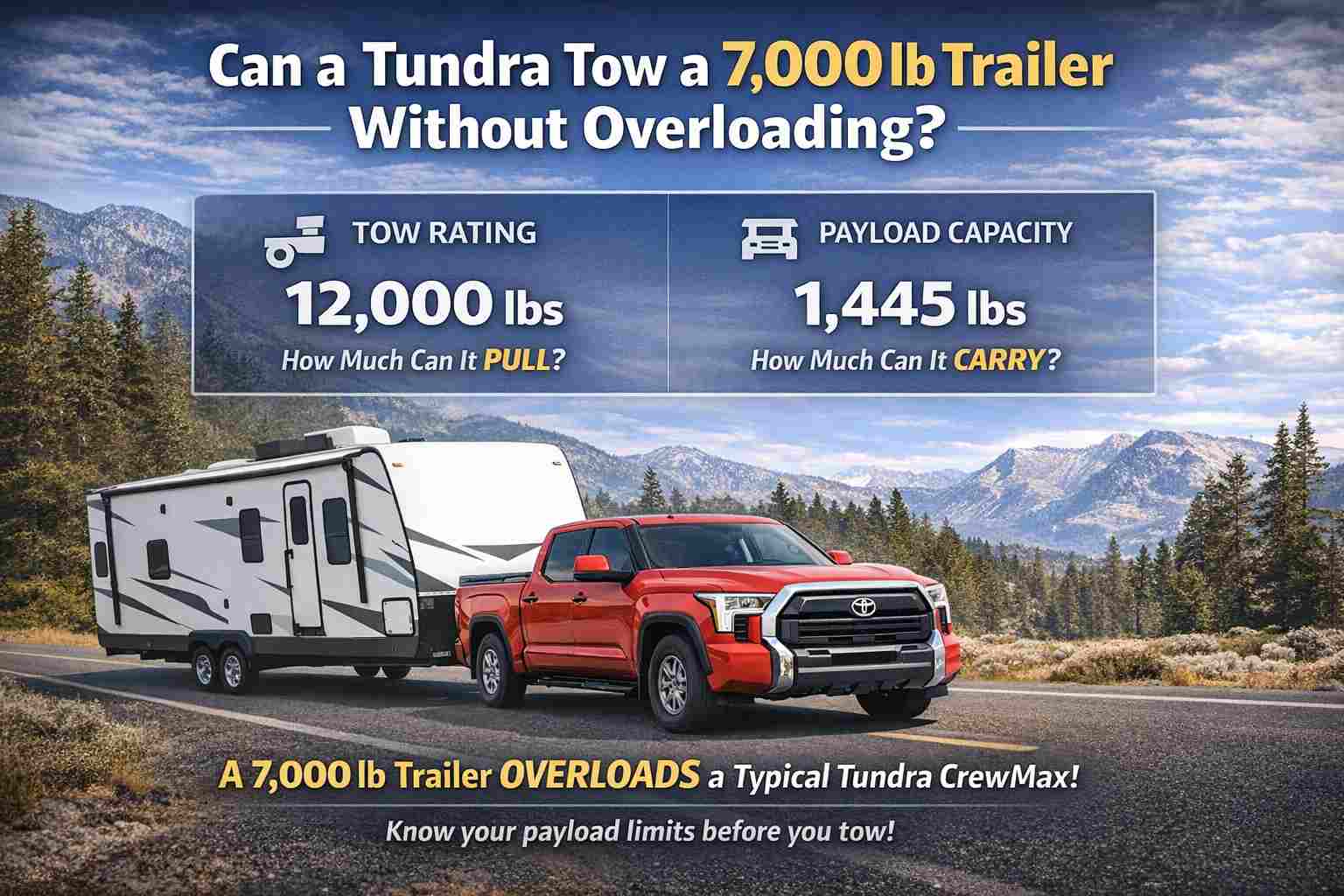
Quick Answer: Yes, barely — with almost no margin on a typical Tundra CrewMax 4×4 door sticker. A 2026 Toyota Tundra CrewMax SR5 4×4 has a payload rating of 1,710 lbs. With a 7,000 lb loaded trailer, two people, and 200 lbs of gear, the payload math leaves about 120 lbs. It works on paper, but with almost no margin, and a weight-distribution hitch eats most of what is left. See how the Tundra stacks up against the F-150 and Silverado with the same 7,000 lb trailer.
The Tundra’s Tow Rating vs. The Number That Actually Limits It
The 2026 Toyota Tundra is rated to tow up to 12,000 lbs. The SR5 CrewMax 4WD in this example is rated for 11,160 lbs. For most buyers, either number settles the question. A 7,000-pound travel trailer is well under the tow limit. Pull it and go.
But the tow rating is not the limit that gets Tundra owners into trouble. The limit that matters is on the door sticker — a small label on the driver’s door jamb that most owners have never read. It lists the payload capacity: the maximum combined weight of passengers, cargo, and trailer tongue weight. And for a typical Tundra CrewMax 4×4, that number is around 1,710 lbs. Against a 7,000-pound trailer, nearly all of that budget disappears.
This article runs the full math — and shows exactly how close a 7,000-pound travel trailer pushes a Toyota Tundra to its payload limit, and why nobody at the dealership ever mentions it.
Two Numbers, Two Different Limits
The confusion between tow rating and payload capacity is the most common — and most expensive — mistake truck owners make. Here is how they are different.
The tow rating is a function of the powertrain, cooling, brakes, frame strength, and hitch class. It answers one question: how much can the engine and driveline pull? Toyota engineers the Tundra’s powertrain to handle up to 12,000 pounds of pull at the hitch (11,160 for the SR5 CrewMax 4WD in this example). That is real. That limit exists.
The payload capacity is a function of the vehicle’s axle ratings, suspension system, tire load ratings, and GVWR. It answers a completely different question: how much can the suspension and axles carry? The answer for a 2026 Tundra CrewMax SR5 4×4 is approximately 1,710 lbs — and unlike the tow rating, it applies to everything the truck carries simultaneously: occupants, gear, and the tongue weight of any attached trailer.
Both limits apply at the same time. Staying under the tow rating does not exempt a truck from the payload limit. Most Ram, Ford, and Toyota owners only know one of these numbers.
2026 Toyota Tundra CrewMax SR5 4×4 — The Numbers
For this analysis the truck is a 2026 Toyota Tundra CrewMax SR5 in four-wheel-drive configuration with the twin-turbocharged V6 powertrain. Key specs:
GVWR: 7,210 lbs. Curb weight: approximately 5,500 lbs. Payload capacity (Toyota spec): 1,710 lbs. That 1,710 lbs is the total budget for passengers, bed cargo, and trailer tongue weight combined.
Important caveat: Toyota Tundra payload varies by configuration. A rear-wheel-drive Double Cab can carry more (Toyota lists up to 1,850 lbs). A top-trim CrewMax carries less: Toyota lists the Capstone at 1,420 lbs, and dealer-added accessories cut that further. The window sticker tow rating is the same. The door sticker is not. The only number that counts is the one on your specific vehicle’s door sticker.
The Trailer: 7,000 lbs Loaded
For this scenario, the trailer is loaded to 7,000 lbs — a realistic weight for a popular 28 to 30-foot class travel trailer on a family trip. Many trailers in this class have a dry weight between 5,500 and 6,200 lbs and a GVWR between 8,000 and 9,500 lbs.
A 7,000-lb loaded weight on a trailer with a 5,800-lb dry weight represents approximately 1,200 lbs of gear, water, and supplies — a conservative real-world loading. Fresh water tank at half capacity: 200 lbs. Food and groceries: 200 lbs. Clothing and personal items for a family of four: 200 lbs. Outdoor furniture, bikes, kayak paddles: 250 lbs. Miscellaneous: 350 lbs. Common. Real. Seven thousand pounds.
Why “Dry Weight” Belongs Only on the Factory Floor
Trailer manufacturers list dry weight because it is the only controlled, reproducible number they can certify. It is the weight of the trailer as it leaves production — no optional equipment added, no fluids, no dealer-installed accessories.
The moment that trailer enters real use, the dry weight is irrelevant. Water weighs 8.34 lbs per gallon. A 40-gallon fresh water tank at full capacity adds 334 lbs. A 50-gallon tank adds 417 lbs. None of this is in the dry weight. If you are running payload math based on dry weight, you are calculating a scenario that does not exist.
For payload calculations, use your realistic loaded weight estimate. If you do not know it precisely, a conservative estimate with margin built in is far better than using the factory dry weight.
Tongue Weight: The 15% Rule and Its Payload Impact
Tongue weight is the vertical force the trailer tongue exerts on the truck’s hitch ball. For a conventional travel trailer, the industry-accepted range is 10% to 15% of the loaded trailer weight. Too low and the trailer becomes prone to sway. Too high and the truck’s rear axle is overloaded.
At 15% of the loaded trailer weight — the conservative, safety-first end of the range — a 7,000-lb trailer produces 1,050 lbs of tongue weight. That 1,050 lbs sits on the Tundra’s rear hitch ball and counts directly against the truck’s 1,710-lb payload capacity. Before anyone sits down, before a single bag goes in the truck bed, the tongue weight has consumed 61.4% of the total payload budget.
The Real Payload Math
Here is the full calculation, starting from the Tundra’s door sticker payload and working down:
| Item | Weight | Remaining Payload |
| Starting Payload (Door Sticker) | 1,710 lbs | |
| − Tongue Weight (15% of 7,000 lbs) | 1,050 lbs | 660 lbs |
| − Driver + Passenger | 340 lbs | 320 lbs |
| − Gear in Truck Bed | 200 lbs | 120 lbs |
| REMAINING PAYLOAD | 120 lbs |
Positive 120 lbs. With a 7,000-lb trailer, two occupants, and a modest 200 lbs of bed gear, this Toyota Tundra stays just 120 lbs under its payload rating. Add a 75-lb weight-distribution hitch, which most owners run with a trailer this size, and the margin shrinks to about 45 lbs. The tow rating says 11,160 lbs. The payload math says you are right at the edge.
What “Overloaded” Actually Means on a Tundra
This is where most Tundra owners get into trouble. The truck pulls the 7,000-lb trailer without complaint. The transmission does not protest. The engine runs strong. Everything feels normal. That is the problem.
Overloading the payload does not produce an immediate, obvious symptom. It produces cumulative, invisible damage to suspension components, rear axle bearings, leaf springs or coils, and tires. Over time, premature wear appears. More immediately, braking distances increase — an overloaded rear axle shifts weight rearward, lightens front tire contact, and reduces overall braking authority. On a mountain descent with a 7,000-lb trailer at the rear of an overloaded Tundra, that reduced braking performance is not theoretical.
Not sure if your truck is within safe limits? Towing Limit Pro helps you verify your real setup using your actual payload sticker, passengers, cargo, and trailer numbers.
- Remaining payload (what you actually have left)
- Realistic tongue weight estimate (loaded, not brochure)
- GVWR margin + a clear safety buffer
- Risk-zone warning if your setup is pushing limits
Tip: Use your truck’s yellow door sticker payload for the most accurate result.
The Legal and Insurance Reality
Operating a vehicle in excess of its GVWR is a legal violation in most U.S. states. When the Tundra’s payload is exceeded, the total weight of the loaded vehicle — including tongue weight — exceeds the truck’s GVWR of 7,210 lbs. That is an overweight violation.
From an insurance standpoint, a truck involved in an accident while overloaded creates grounds for a coverage denial. Insurers can argue that the policyholder was operating the vehicle outside its design specification, contributing to the incident. The documentation trail from your truck’s door sticker and your trailer’s weight certificate creates a clear record of whether you were within spec on the day of the accident.
How to Make the 7,000 lb Trailer Work
The math is fixable — but it requires an honest look at what you are willing to change. Option one is the most immediately effective: reduce the loaded trailer weight. Arrive at your campsite and then fill the fresh water tank, rather than leaving fully loaded. That alone can drop the loaded trailer weight by 200 to 400 lbs, reducing tongue weight by 30 to 60 lbs and creating real payload margin.
Option two is to reduce occupants or bed gear. If the trip can be done with one person in the Tundra, eliminating a second passenger frees up a meaningful portion of the payload margin. Option three — the cleanest long-term solution — is to identify a higher-payload Tundra configuration. Some Tundra 4×4 configurations with a different cab and bed combination carry meaningfully more payload. The tow rating does not change. The door sticker does.
For Tundra owners who consistently run near or over the payload limit, the practical long-term answer is a three-quarter-ton truck. A Ram 2500, Ford F-250, or Chevy Silverado 2500 in base configuration typically offers 2,800 to 3,200 lbs of payload — a margin that comfortably handles a 7,000-lb travel trailer with room to spare.
Verdict: A 7,000 lb Trailer Leaves a Typical Tundra CrewMax Almost No Margin
A 2026 Toyota Tundra CrewMax SR5 4×4 with a 1,710-lb payload rating can only just carry the combined load of a 7,000-lb trailer’s tongue weight, two occupants, and standard bed gear. The math lands at about 120 lbs, or about 45 lbs with a weight-distribution hitch. The answer to “can a Tundra tow a 7,000-lb trailer without overloading?” is: yes, but only just. One extra passenger, a full fresh water tank, or a heavier load in the bed puts it over.
The fix is specific and achievable: reduce loaded trailer weight to approximately 6,400 lbs or below (producing a tongue weight of 960 lbs), and keep bed gear light. At that loading, the margin grows to about 210 lbs (about 135 lbs with a weight-distribution hitch). Or check your specific Tundra’s door sticker — if your number is below about 1,590 lbs, this trailer puts you over.
Know your real margin before you hook up.
Most half-ton trucks hit their payload limit long before they hit their tow rating limit — and most owners don’t realize it until they’re already committed. Verify your exact setup and know where you stand.
- Remaining payload (your real limit)
- Realistic tongue weight (loaded)
- GVWR margin + safety buffer
- Clear risk-zone indicator
Best results: use your yellow door-sticker payload number and your loaded trailer estimate (not dry weight).
Frequently Asked Questions
What is the towing capacity of a 2026 Toyota Tundra?
The 2026 Toyota Tundra is rated to tow up to 12,000 lbs when properly equipped. However, tow rating and payload capacity are two separate limits that apply simultaneously. A 7,000-lb trailer is under the Tundra's tow rating but can exceed the payload limit depending on configuration.
How much payload does a Toyota Tundra CrewMax have?
A 2026 Toyota Tundra CrewMax SR5 4x4 has approximately 1,710 lbs of payload capacity per Toyota specs. Payload varies significantly by cab style, drive configuration, and options. A lower-trim 2WD Double Cab will have a higher payload number. Check your specific door sticker for the number that applies to your truck.
Can I increase the Toyota Tundra's payload capacity?
No. Payload capacity is determined by the truck's axle ratings, suspension, tires, and GVWR. It cannot be increased through aftermarket upgrades. Adding stiffer springs or air bag helpers may improve ride quality under load but does not legally increase the payload capacity stamped on your door sticker.
How do I calculate tongue weight for my trailer?
Multiply your loaded trailer weight by 15% for a conservative calculation. Example: 7,000 lbs × 0.15 = 1,050 lbs. This number is then subtracted from your truck's door sticker payload capacity, along with all occupant and cargo weights, to determine your remaining payload margin.
Is it dangerous to exceed payload capacity?
Yes. Exceeding payload capacity places the suspension, rear axle, and tires under loads beyond their engineered design. This increases braking distance, creates wear on suspension components, elevates the risk of tire failure under sustained load, and may contribute to trailer sway. Beyond the mechanical risk, it can void your warranty and create insurance liability in the event of an accident.