
Quick Answer
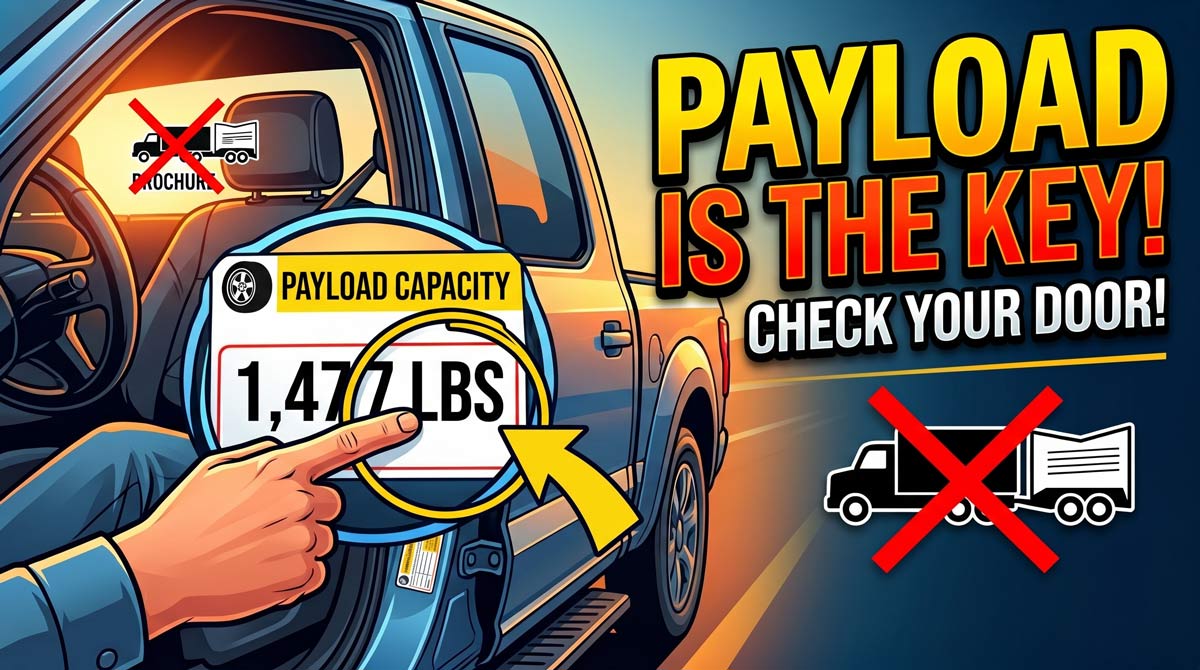
The number printed on your driver’s door jamb sticker is your truck’s actual payload limit — calculated from your specific truck’s measured curb weight after it left the assembly line. Every pound of passenger, gear, and tongue weight counts against it.
The door sticker payload number is the only number that matters for safe towing. Not the brochure. Not the window sticker. Not what the dealer quoted.
The Contradiction Most Truck Owners Miss
Your truck’s tow rating gets all the attention. It’s in every ad, every dealer conversation, every forum argument. The door sticker gets ignored.
That’s exactly backward.
Tow rating tells you the maximum a truck is mechanically engineered to pull. Payload tells you whether your specific truck — with your specific passengers, your specific gear, and your specific tongue weight — is still legal and structurally safe when you leave the driveway. The tow rating is theoretical. The payload sticker is real.
Most people learn this difference after they’re already overloaded.
What the Door Sticker Actually Shows
Open your driver’s door and look at the jamb. There’s a white or yellow label — the Tire and Loading Information placard. Three numbers matter for towing:
- GVWR (Gross Vehicle Weight Rating): The maximum allowable total weight of your truck fully loaded — passengers, cargo, and tongue weight included.
- Curb Weight: What your truck weighed when it left the factory — standard equipment and fluids, no passengers, no cargo.
- Payload Capacity: GVWR minus curb weight. This is your working budget.
Here’s what dealers routinely skip: two trucks with identical trim levels can have different payloads. Ford, GM, Ram, and Toyota weigh each truck individually. If yours got a heavier axle or an upgraded package, your payload number is lower than your buddy’s “same” truck. The brochure shows a range. The door sticker shows your number.
Real example — 2023 Chevy Silverado 1500 LT Crew Cab 4WD (door sticker, not brochure):
- GVWR: 7,100 lbs
- Curb Weight: 5,623 lbs
- Payload Capacity: 1,477 lbs
That 1,477 lbs is the ceiling for everything — driver, passengers, gear in the cab, bed cargo, and the tongue weight pressing down from whatever is hooked up behind.
The Trailer: Keystone Cougar Half-Ton 22MLS
For this walkthrough, we’re using a Keystone Cougar Half-Ton 22MLS — a popular half-ton-rated travel trailer.
- Dry Weight: 5,185 lbs
- GVWR: 7,495 lbs
- Tongue Weight (calculated at GVWR): 1,124 lbs (15%)
Dry weight does not equal loaded weight. The gap between dry and GVWR here is 2,310 lbs — that’s the manufacturer’s allowance for fresh water, food, clothing, tools, and gear before you pull out of the driveway.
Dry vs Loaded Weight: Why the Gap Matters
This gap matters more than most tow calculations account for. Loaded trailers routinely exceed dry weight by 15–30%. A trailer that weighs 5,185 lbs dry can easily sit at 6,500–6,800 lbs loaded for a real trip. If you base your tongue weight on dry weight, you’re calculating against a number that doesn’t exist once the trailer is packed.
Always use the trailer’s GVWR for worst-case planning. If your math only works at dry weight, you don’t have a real margin — you have optimism.
Tongue Weight Against Your Door Sticker
Tongue weight should run 12–15% of your trailer’s loaded weight. At 15% of GVWR:
- Loaded trailer weight: 7,495 lbs
- 15% of 7,495 = 1,124 lbs
That 1,124 lbs lands on the rear of your truck and comes directly off your payload capacity.
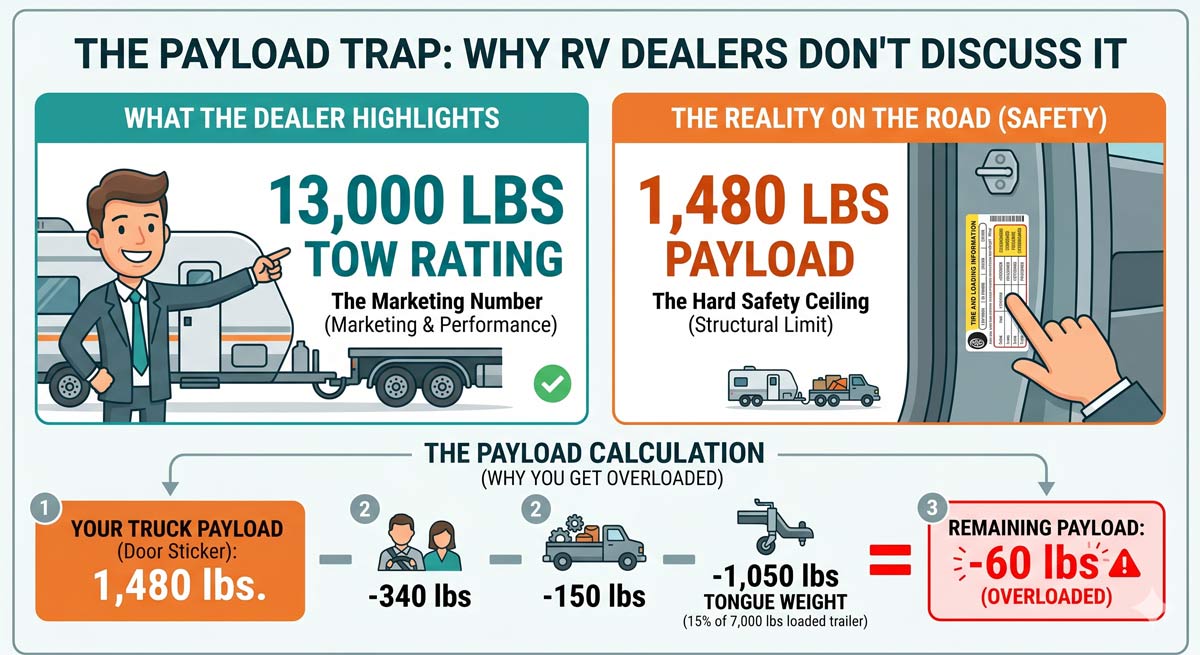
Door-Sticker Payload Math: Silverado + Cougar 22MLS
| Item | Weight (lbs) |
| Truck Payload Capacity (door sticker — not brochure) | 1,477 |
| minus Driver + Passenger | minus 380 |
| minus Gear / cargo in truck bed | minus 150 |
| minus Tongue weight (15% of loaded trailer weight) | minus 1,124 |
| **= Remaining Payload Margin** | **−177 lbs** |
Over Capacity Before Anything Extra
Negative 177 pounds. This Silverado is over capacity before you’ve added a fifth wheel pin box, a weight distribution hitch head, or anything extra the kids threw in the back seat.
The truck’s tow rating? Technically fine. The Silverado’s tow rating covers this trailer’s weight. The brochure would call this a match.
The door sticker says otherwise.
If you’re wondering where your truck would land in this calculation, don’t guess.
Not sure if your truck is within safe limits? Towing Limit Pro helps you verify your real setup using your actual payload sticker, passengers, cargo, and trailer numbers.
- Remaining payload (what you actually have left)
- Realistic tongue weight estimate (loaded, not brochure)
- GVWR margin + a clear safety buffer
- Risk-zone warning if your setup is pushing limits
Tip: Use your truck’s yellow door sticker payload for the most accurate result.
Verdict: Trust the Door Sticker, Not the Brochure
A 2023 Silverado 1500 LT Crew Cab 4WD towing a Keystone Cougar Half-Ton 22MLS loaded near GVWR is over payload capacity. The numbers don’t leave room for interpretation. To make this combination work, you’d need to significantly reduce tongue weight by carrying a lighter load in the trailer, eliminate cab gear and passenger weight, or select a trailer with a lower GVWR. The truck isn’t the wrong tool — the load configuration is wrong for the truck’s actual payload.
Payload is the constraint. The door sticker is where the math starts.
Know your real margin before you hook up.
Most half-ton trucks hit their payload limit long before they hit their tow rating limit — and most owners don’t realize it until they’re already committed. Verify your exact setup and know where you stand.
- Remaining payload (your real limit)
- Realistic tongue weight (loaded)
- GVWR margin + safety buffer
- Clear risk-zone indicator
Best results: use your yellow door-sticker payload number and your loaded trailer estimate (not dry weight).
Frequently Asked Questions
What is the difference between payload capacity and tow rating?
Tow rating is the maximum weight a truck can pull — an engineering specification based on the drivetrain, brakes, and frame. Payload capacity is the maximum weight a truck can carry in and on the vehicle, including passengers, cab gear, bed cargo, and tongue weight. A truck can have a 12,000-lb tow rating and only 1,477 lbs of payload. Both limits apply simultaneously. Whichever you hit first ends the math, and payload almost always gets hit first.
Why does my door sticker show a different payload than the brochure?
Manufacturers weigh each truck individually and calculate payload as GVWR minus measured curb weight. Two trucks with the same trim and engine can have different payloads because of option packages, axle upgrades, or slight differences in how they were assembled. The brochure shows the best-case number. The door sticker shows your specific truck's number. Always use the sticker — the brochure is marketing.
Does dry weight equal what my trailer weighs when I'm towing?
No — and this is one of the most common calculation errors in towing. Dry weight is the manufacturer's baseline with no water, no gear, and no passengers. A loaded trailer can exceed dry weight by 1,000–2,500 lbs depending on how it's packed. Use the trailer's GVWR to calculate worst-case tongue weight and plan from there. If your margin only works at dry weight, you're not operating with a real margin.
What if my payload math comes out negative?
That means the planned combination exceeds your truck's structural and legal capacity. The options are: reduce tongue weight by loading the trailer lighter or choosing a different trailer, remove passengers or bed cargo, or select a truck with more payload. There is no workaround that makes a negative margin safe — excess rear-axle load degrades steering response, braking distance, and tire integrity.
Does a weight distribution hitch give me more payload?
No. A weight distribution hitch redistributes tongue weight across all axles to improve handling and level the truck's stance. It does not change your truck's GVWR or payload rating. The same tongue weight that exceeds your payload before attaching a WD hitch still exceeds your payload after. The hitch helps with load balance — it does not create new capacity.