
Quick Answer
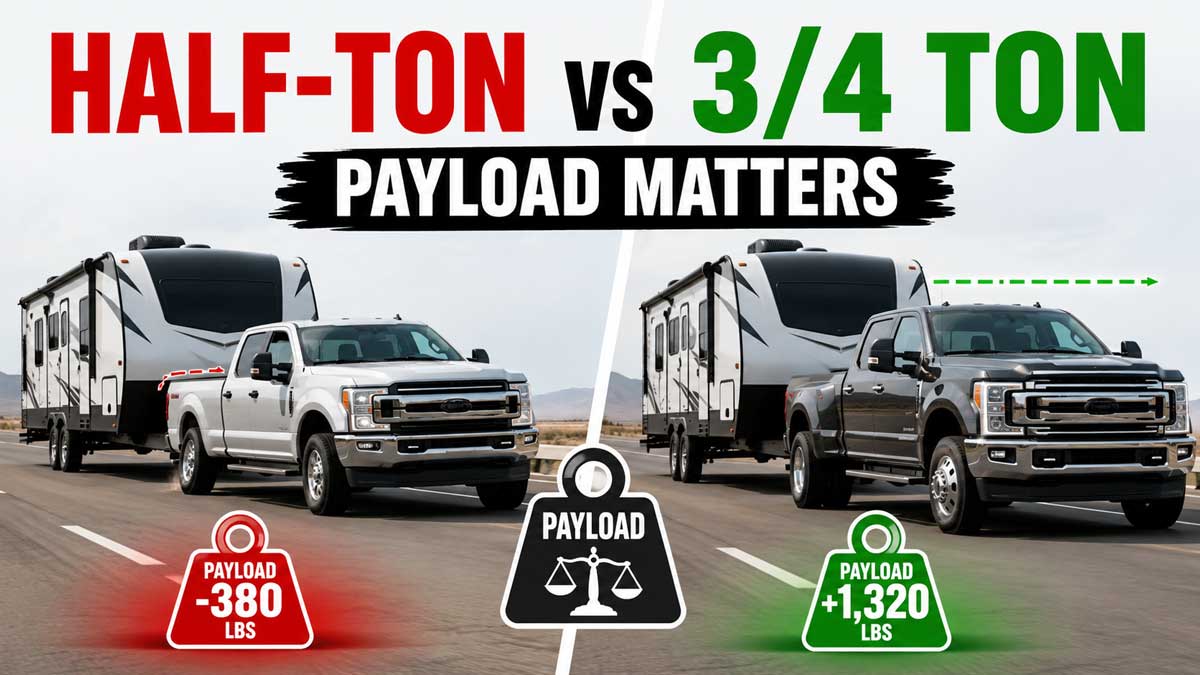
The real difference between a half-ton and a 3/4-ton truck isn’t the tow rating — it’s the payload capacity. A typical half-ton carries 1,200–1,600 lbs of payload; a typical 3/4-ton carries roughly 2,200–3,600 lbs. At a 7,000+ lb trailer, that gap determines whether the math works or doesn’t.
The tow rating gets the headlines. The payload number makes the call.
Why Tow Rating Is the Wrong Question
Most buyers comparing these two truck classes walk into a dealership asking the wrong question. They want to know which truck can tow more. The question they should be asking is which truck has enough payload left — after people and gear — to safely absorb the tongue weight of the trailer they’re considering.
If you’ve wondered how many pounds a half-ton really is, the name and the truck are very different things.
The tow rating is a marketing number. The payload sticker on the door jamb is the engineering number. One is printed for brochures. The other was calculated to keep your axles, springs, and tires within spec under real load. Those two numbers rarely tell the same story, and the gap between them is exactly where half-ton owners get in trouble.
F-150 vs F-250: Door-Sticker Payload
For this comparison, two of the most common configurations sold in North America: the Ford F-150 XLT crew cab 4WD and the Ford F-250 XLT crew cab 4WD.
All weights below come from the door jamb sticker — not the brochure, not the manufacturer website. The door sticker is the only number that matters for weight compliance. The brochure lists what the truck can do in an optimized configuration. Your door sticker lists what your specific truck can do.
Ford F-150 XLT Crew Cab 4WD (common real-world build):
- GVWR: 7,050 lbs
- Curb weight: ~5,570 lbs
- Payload capacity: ~1,480 lbs
Ford F-250 XLT Crew Cab 4WD, 6.7L diesel (common real-world build):
- GVWR: 10,000 lbs
- Curb weight: ~7,800 lbs
- Payload capacity: ~2,200 lbs
Two caveats worth noting upfront: A max-payload F-150 (regular cab, short bed, 2WD, minimal options) can reach 2,000+ lbs payload. A heavily optioned diesel F-250 crew cab can drop below 1,900 lbs, while a gas F-250 is lighter and usually carries several hundred pounds more. Configuration matters more than class. These numbers represent typical real-world builds — run your own door sticker before drawing conclusions about your specific truck. The same subtraction applies to newer designs, as our Cybertruck towing capacity breakdown shows.
The Test Trailer
The trailer running through both trucks here is a common 28-foot travel trailer in the 7,000–8,000 lb GVWR range — a segment aggressively marketed to half-ton buyers despite being marginal for many half-ton configurations.
Representative trailer specs:
- Dry weight (manufacturer figure): 6,100 lbs
- GVWR (maximum rated loaded weight): 7,700 lbs
- Advertised tongue weight: 770 lbs (10% of GVWR)
That dry weight figure is what dealers quote on the lot. The GVWR is what the trailer can weigh when you leave for a trip with full tanks, loaded gear, food, and supplies.
Dry vs Loaded Trailer Weight
A 6,100 lb dry weight does not mean you’ll tow 6,100 lbs. Loaded trailers routinely run 15–30% above dry weight once water tanks, provisions, tools, bikes, and accumulated gear are factored in. Items that go in rarely come back out between trips.
At 15% above dry weight, that 6,100 lb trailer reaches 7,015 lbs loaded. At 20%, it’s 7,320 lbs. At its full GVWR of 7,700 lbs, every system on the tow vehicle is handling its rated maximum.
This is the number the dry weight obscures. If your towing math was based on dry weight, the calculation was optimistic before you backed out of the driveway.
Tongue Weight: The 12–15% Rule
Tongue weight should fall between 12–15% of loaded trailer weight. The industry commonly advertises 10% of GVWR, but real-world tongue weight on loaded trailers frequently runs higher — especially when weight distribution is uneven or tanks are full.
At 15% of 7,700 lb loaded GVWR:
15% × 7,700 = 1,155 lbs tongue weight
That 1,155 lbs doesn’t stay on the hitch ball. It transfers directly into the truck’s payload capacity — the same pool that absorbs your driver, passenger, and anything stowed in the bed. Tongue weight doesn’t go somewhere separate. It’s payload.
Half-Ton Payload Math (F-150)
| Item | Weight (lbs) |
| Truck Payload Capacity (door sticker — not brochure) | 1,480 |
| minus Driver + Passenger | minus 340 |
| minus Gear / cargo in truck bed | minus 200 |
| minus Tongue weight (15% of 7,700 lb GVWR) | minus 1,155 |
| = Remaining Payload Margin | **−215 lbs** |
3/4-Ton Payload Math (F-250)
| Item | Weight (lbs) |
| Truck Payload Capacity (door sticker — not brochure) | 2,200 |
| minus Driver + Passenger | minus 340 |
| minus Gear / cargo in truck bed | minus 200 |
| minus Tongue weight (15% of 7,700 lb GVWR) | minus 1,155 |
| = Remaining Payload Margin | **505 lbs** |
Where the Half-Ton Math Breaks
The F-150 is over by 215 lbs. Not close — over. That’s before accounting for any real-world variation in tongue weight, a third passenger, or an extra bag in the bed. The truck is beyond its rated capacity in a typical towing configuration.
The F-250 has 505 lbs of margin. That’s workable — not unlimited, but workable.
The difference between these two trucks on this specific trailer is 720 lbs of structural reality, encoded in the GVWR on each door jamb sticker. That number isn’t an opinion. It’s the engineering limit the manufacturer calculated and stamped into the door frame.
If you’re wondering where your truck would land in this calculation, don’t guess.
Not sure if your truck is within safe limits? Towing Limit Pro helps you verify your real setup using your actual payload sticker, passengers, cargo, and trailer numbers.
- Remaining payload (what you actually have left)
- Realistic tongue weight estimate (loaded, not brochure)
- GVWR margin + a clear safety buffer
- Risk-zone warning if your setup is pushing limits
Tip: Use your truck’s yellow door sticker payload for the most accurate result.
Verdict: When You Actually Need a 3/4-Ton
F-150 on this trailer: Risky. The math is negative under a standard two-person configuration with normal gear. A heavier-than-advertised tongue weight reading — which is common on loaded trailers — pushes the violation deeper. This isn’t a scenario you can resolve by packing lighter. The tongue weight alone accounts for most of the payload consumption.
F-250 on this trailer: Safe, with conditions. The 505 lb margin is real, but it assumes a build with approximately 2,200 lbs payload. Heavily optioned F-250 crew cabs can come in below 1,900 lbs payload from the factory. At 1,900 lbs: 1,900 − 340 − 200 − 1,155 = 205 lbs remaining. That clears, but without much buffer. Whether your F-250 passes this math depends on your door sticker, not the truck class.
The 3/4-ton upgrade is the right call for this trailer. But the upgrade gives you a larger pool to work from — it doesn’t guarantee you’re within spec. Configuration determines the outcome. The door sticker determines the math.
Know your real margin before you hook up.
Most half-ton trucks hit their payload limit long before they hit their tow rating limit — and most owners don’t realize it until they’re already committed. Verify your exact setup and know where you stand.
- Remaining payload (your real limit)
- Realistic tongue weight (loaded)
- GVWR margin + safety buffer
- Clear risk-zone indicator
Best results: use your yellow door-sticker payload number and your loaded trailer estimate (not dry weight).
FAQs
Q: My F-150 has a 12,000 lb tow rating. Why isn't a 7,700 lb trailer safe to tow?
Tow rating and payload capacity govern different things. The tow rating reflects the truck's structural and drivetrain limit for pulling force — it's tested with minimal occupants and no bed cargo. Payload capacity is the total weight your truck's frame, axles, springs, and tires can carry, including tongue weight, passengers, and everything in the bed. These two numbers don't combine or offset each other. Operating within tow rating while exceeding payload capacity is still an overloaded truck, by the engineering definition stamped on the door jamb.
Q: The dealer showed me a dry weight of 6,100 lbs. Why does your math use 7,700?
Dry weight is the trailer as it left the factory — no water, no gear, no occupant belongings. GVWR is the maximum the trailer's frame, axles, and tires are rated to handle when fully loaded. Once you account for fresh water tanks, provisions, clothes, tools, and the gear that never comes back out between trips, the realistic towing weight sits well above dry. Running towing calculations on dry weight is optimistic math. The GVWR is the conservative, load-rated figure that reflects what the trailer can actually weigh — which is the number that determines tongue weight and payload consumption.
Q: Can a 3/4-ton truck fail this same payload math?
Yes. The 3/4-ton class provides a larger payload pool, not an unlimited one. A diesel F-250 crew cab 4WD typically lands near 2,200 lbs payload (gas versions carry more), but an F-250 loaded with luxury packages, heavy aftermarket accessories, or a gooseneck prep package can drop below 1,900 lbs from the factory. Running the same subtraction at 1,900 lbs leaves roughly 205 lbs of margin — technically within spec, but without room for any variation. The 3/4-ton upgrade is the right call on trailers in this GVWR range, but it doesn't eliminate the need to verify your specific door sticker. The class describes the category. The sticker describes your truck.
Q: Is there a trailer GVWR range where a half-ton reliably passes this math?
Generally, trailers under 6,000 lb GVWR with tongue weights under 800 lbs are manageable for half-ton trucks with payload ratings in the 1,400–1,600 lb range — assuming two occupants and minimal bed cargo. As GVWR approaches 7,000 lbs, even a relatively light configuration begins consuming most of the available payload in tongue weight alone. The specific crossover point depends on your truck's door sticker payload, not the class. A max-payload half-ton (regular cab, 2WD, stripped) rated at 2,000 lbs payload has meaningfully different math than a crew cab 4WD rated at 1,480 lbs. Run the subtraction with your actual number.
Q: Does towing an overloaded truck affect insurance coverage?
Potentially, yes. Some personal and commercial auto insurance policies include provisions allowing the insurer to limit or deny claims when a vehicle is documented to have been operating outside its rated capacity at the time of an incident. The specifics depend on the policy language and jurisdiction. This is a separate consideration from the mechanical consequences of overloading — it's worth reviewing your policy terms if you regularly tow near or at your truck's rated payload capacity. Operating within the manufacturer's rated limits is the clearest baseline for both mechanical and liability purposes.