
Quick Answer
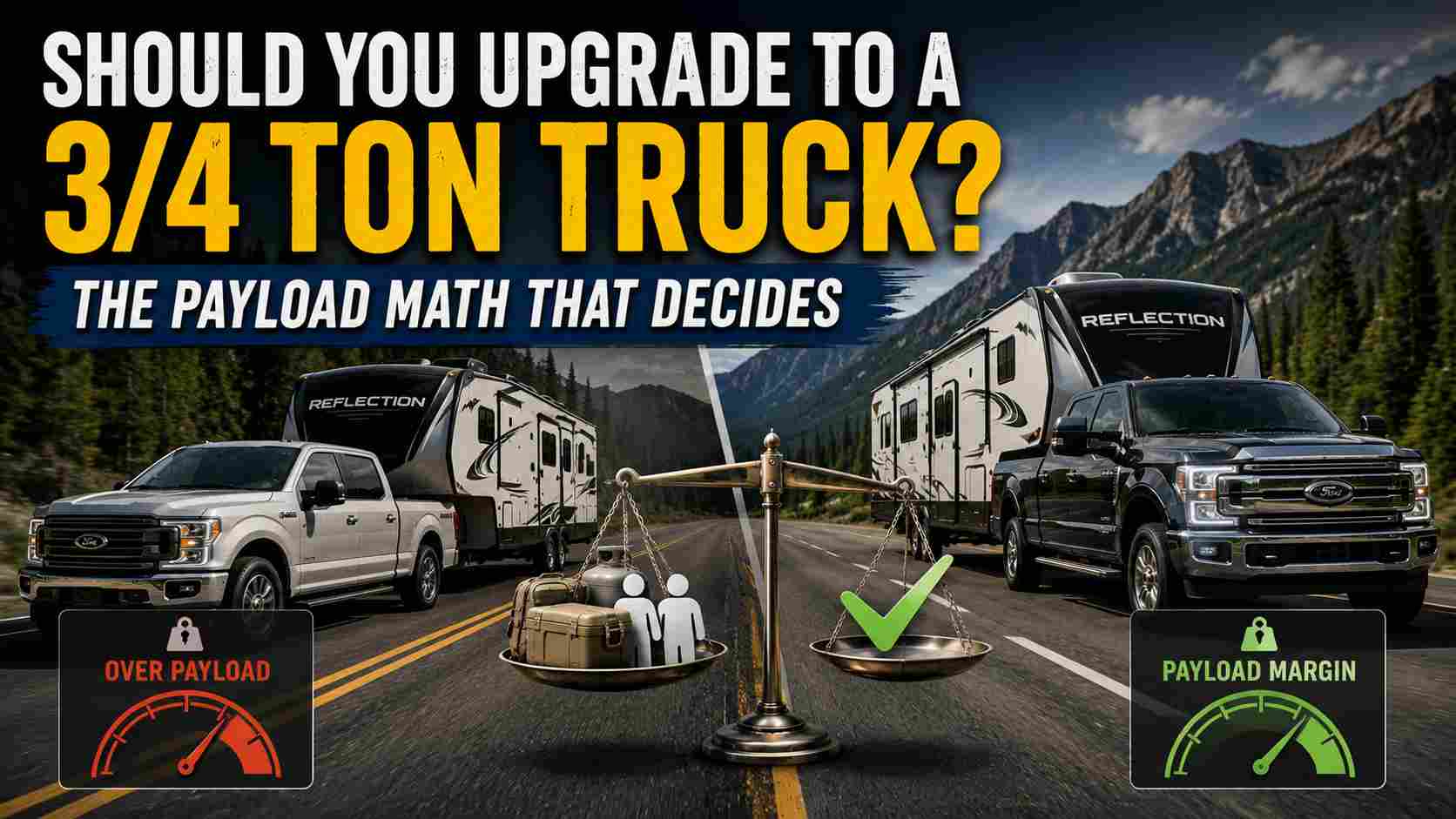
Maybe — but only if the math says so, not the salesman. A $20,000 truck upgrade fixes a payload deficit. It does not fix a tow rating fear. Before you trade in, you need to know exactly how many pounds short your current truck actually is.
| If your real payload deficit is under 300 lbs, a new truck is the most expensive fix you can buy. |
The Question Most Half-Ton Owners Are Asking Wrong
You felt it on the last trip. The rear end squatting under tongue weight. The brakes working harder than they should. The steering going light at highway speed. You started Googling 3/4 ton trucks before you got home.
Here is what almost nobody does before swiping $20,000 across a dealership desk: they don’t run the math. They feel the symptoms, assume the truck is the problem, and skip straight to the upgrade.
Sometimes the truck is the problem. Sometimes it isn’t. The only number that tells you which one you’re dealing with is on the door jamb of the truck you already own.
The Half-Ton You’re Trying to Replace
Let’s use a real configuration — the kind of truck this question gets asked about constantly. A 2022 Ford F-150 XLT SuperCrew 4×4 with the 3.5L EcoBoost and the Max Tow Package.
On paper, this truck looks like it tows anything. The tow rating is around 13,200 lbs. That’s the marketing number. The number a salesman will quote you. The number on the brochure.
The number that actually limits you is on the door sticker — also called the Tire and Loading Information label. Not the brochure.
For this build, a typical door sticker payload comes in around 1,750 lbs. Some trims of this same truck land closer to 1,500 lbs. Some land closer to 2,000 lbs. The variance is wide, and the only number that matters is the one printed on your specific vehicle.
Start with how much a half-ton truck weighs, empty and loaded.
The Trailer That’s Pushing You Toward the Upgrade
Now consider the trailer that started this whole conversation. We’ll use the Grand Design Reflection 280RS — a 32-foot travel trailer that’s exactly the size most half-ton owners are stretching toward.
Dry weight on the spec sheet: roughly 7,795 lbs. Dry tongue weight: roughly 875 lbs. GVWR: 9,995 lbs.
Dry weight is not the weight you’ll actually tow.
Once you load water, propane, batteries, food, bedding, and gear, most travel trailers gain 15% to 30% over dry weight. For a trailer like the 280RS, a realistic loaded weight is around 9,200 lbs.
The 12–15% Tongue Weight Rule
Tongue weight is the downward force the trailer applies to the rear of your truck at the hitch. The industry standard for a stable, safe travel trailer setup is 12% to 15% of the loaded trailer weight.
At 15% of a 9,200 lb loaded trailer, tongue weight lands at 1,380 lbs.
That’s not gear. That’s not passengers. That’s not the tool kit in the bed. That is what the trailer alone applies to the rear axle of your truck before you’ve put anything else in it.
The Real Payload Math — F-150 XLT Towing the Reflection 280RS
Source: door sticker — not brochure. Numbers here are illustrative and must be replaced with your specific vehicle’s actual sticker reading.
| Item | Weight (lbs) |
| Truck Payload Capacity (door sticker — not brochure) | 1,750 |
| − Driver + 1 passenger | − 340 |
| − Gear / cargo in truck bed (generator, chairs, tools) | − 250 |
| − Tongue weight (15% of 9,200 lb loaded trailer) | − 1,380 |
| = Remaining Payload Margin | − 220 |
Remaining payload: negative 220 lbs.
The F-150 isn’t close to the limit. It’s 220 lbs past it. That’s the entire weight of a fully grown adult sitting on top of an already-maxed-out truck.
That’s not a tow rating problem. The tow rating still says this truck can pull 13,200 lbs. The hitch can handle it. The drivetrain can handle it. The frame can handle it.
The suspension, the axles, and the tires — the components payload is actually measuring — cannot.
If you’re wondering where your truck would land in this calculation, don’t guess. The door sticker number on your specific vehicle will produce a different result than the one above — sometimes by hundreds of pounds in either direction.
Not sure if your truck is within safe limits? Towing Limit Pro helps you verify your real setup using your actual payload sticker, passengers, cargo, and trailer numbers.
- Remaining payload (what you actually have left)
- Realistic tongue weight estimate (loaded, not brochure)
- GVWR margin + a clear safety buffer
- Risk-zone warning if your setup is pushing limits
Tip: Use your truck’s yellow door sticker payload for the most accurate result.
Now Run the Same Math on a 3/4 Ton
Let’s compare to a 2023 Ford F-250 XLT SuperCrew 4×4 with the 6.7L Power Stroke diesel. Same trim level. Same cab configuration. Different truck class.
A typical door sticker payload for this build comes in around 3,200 lbs. Gas versions land closer to 3,800 lbs because diesel engines add roughly 700 lbs of curb weight, which subtracts directly from payload. Your sticker is the only one that counts.
| Item | Weight (lbs) |
| Truck Payload Capacity (door sticker — not brochure) | 3,200 |
| − Driver + 1 passenger | − 340 |
| − Gear / cargo in truck bed | − 250 |
| − Tongue weight (15% of 9,200 lb loaded trailer) | − 1,380 |
| = Remaining Payload Margin | 1,230 ✓ |
Same trailer. Same gear. Same family in the truck. The F-250 isn’t just over the line — it has 1,230 lbs of margin left to spare.
That’s the difference a payload class change makes. It’s not engine power. It’s not the brochure. It’s the suspension, axles, and tires.
When the $20K Upgrade Is Mathematically Justified
Here’s the framework no truck salesman is going to walk you through. The upgrade makes financial sense in exactly three scenarios.
Scenario 1: Your payload deficit is more than 500 lbs and the trailer is non-negotiable. You bought the trailer. You love the trailer. You’re not selling it. In that case, the truck class change is the only path to legal, safe operation.
Scenario 2: You’re at the edge but planning to upgrade trailers later anyway. If your next trailer is going to be even heavier, the half-ton was already a dead end. Skipping a year of misery and going straight to a 3/4 ton is rational.
Scenario 3: You tow more than 8,000 miles per year. The wear on suspension, brakes, and drivetrain on an overloaded half-ton accelerates fast. The cost of running a maxed truck for three years can quietly exceed the gap to a 3/4 ton.
When the $20K Upgrade Is the Wrong Move
And the scenarios where the upgrade is the expensive answer to the wrong question.
Deficit under 300 lbs: You can recover that margin by changing what’s in the truck. Leave the generator at home. Move the tool box to the trailer’s pass-through storage where it loads the axles, not the tongue. Drop one passenger from the truck cab to the trailer once you’re parked. Three hundred pounds is a packing problem, not a truck problem.
You haven’t weighed anything: If you’ve never run your setup across a CAT scale, you don’t actually know your real numbers. You know estimates. Real scale weights have moved hundreds of half-ton owners back from the brink of an unnecessary upgrade.
The trailer is replaceable: Travel trailers depreciate fast. Sometimes the math says sell the trailer, not the truck. A trailer 800 lbs lighter solves the payload problem for $0 if you trade laterally instead of upgrading vertically.
What Overloading a Half-Ton Actually Costs
This isn’t a fear section. It’s a math section. Overloading a half-ton consistently produces three measurable consequences.
First, accelerated wear. Rear shocks, leaf springs, rear brake pads, and rear tires all wear faster than the manufacturer rated them for. Replacement intervals tighten by 30% to 50%.
Second, insurance and liability exposure. If you’re involved in an accident while operating over GVWR or rear axle weight rating, your insurance carrier can deny the claim. Personal injury attorneys read door stickers fluently.
Third, handling degradation. An overloaded rear end shifts weight off the front steering wheels. Trailer sway becomes harder to correct. Braking distances extend. None of this matters until the day it matters all at once.
Verdict: Upgrade or Fix the Load?
Upgrading to a 3/4 ton is justified when the math says you’re more than 500 lbs short and the trailer is staying. It’s wrong when you’ve never weighed your real setup, when the deficit is small enough to pack around, or when the cheaper move is a different trailer.
This is a math problem before it’s a truck problem. Run the numbers on the truck you already own before you sign on a new one. If you are still shopping, start with the 2026 half-ton trucks ranked by payload.
Know your real margin before you hook up.
Most half-ton trucks hit their payload limit long before they hit their tow rating limit — and most owners don’t realize it until they’re already committed. Verify your exact setup and know where you stand.
- Remaining payload (your real limit)
- Realistic tongue weight (loaded)
- GVWR margin + safety buffer
- Clear risk-zone indicator
Best results: use your yellow door-sticker payload number and your loaded trailer estimate (not dry weight).
Frequently Asked Questions
How do I know if my half-ton truck is actually overloaded?
Pull onto a CAT scale with your trailer connected and your normal load in the truck. Compare the rear axle weight to the Rear Gross Axle Weight Rating (RGAWR) on your door sticker. Compare the total truck weight to your GVWR. If either is over, you're overloaded — regardless of what your tow rating says.
Will a weight distribution hitch increase my payload capacity?
No. A weight distribution hitch redistributes tongue weight forward and improves handling, but it does not change the legal payload capacity on your door sticker. Tongue weight still counts against payload, even with a WDH installed. This is the single most common misconception in towing.
What's the real payload difference between an F-150 and an F-250?
A typical F-250 has roughly 1,200 to 2,000 lbs more payload than a comparable F-150 trim. The gap is widest when comparing gas F-250s to half-tons. Diesel F-250s give back about 700 lbs of payload to the heavier engine, so the gap narrows — but it's still substantial.
Can a half-ton tow a 30-foot travel trailer?
Sometimes — but only if the loaded trailer weight plus tongue weight plus passengers plus cargo stays under the truck's door sticker payload number. Trailer length is the wrong variable to focus on. A short, heavy trailer can overload a half-ton faster than a long, light one. Payload decides, not length.
Is the tow rating on my truck door the same as payload?
No. Tow rating tells you what your hitch and drivetrain can pull behind the truck. Payload tells you what the truck's suspension, axles, and tires can carry — including tongue weight from that trailer. Tow rating is almost always the larger, more impressive number. Payload is almost always the limit you actually hit first.