
Correction (October 2026): An earlier version of this article used a GVWR of 8,000 lbs and a payload of about 1,157 lbs, and called a 7,000 lb trailer “Risky.” Those figures don’t match Tesla’s published specs. Tesla’s owner’s manual lists GVWR from 8,598 to 9,169 lbs for current trims, depending on trim and tires, and 8,199 lbs for the Long Range (discontinued Sept 2025, older trucks only). We have corrected the numbers, the math and the verdict below, and added the Dual Motor AWD, now the base trim.
Check payload on your own truck.
Enter the numbers from your door-jamb sticker and Towing Limit Pro shows how much payload, tow rating and GCWR room you have left. Works offline once your vehicle profiles are saved.
Quick Answer
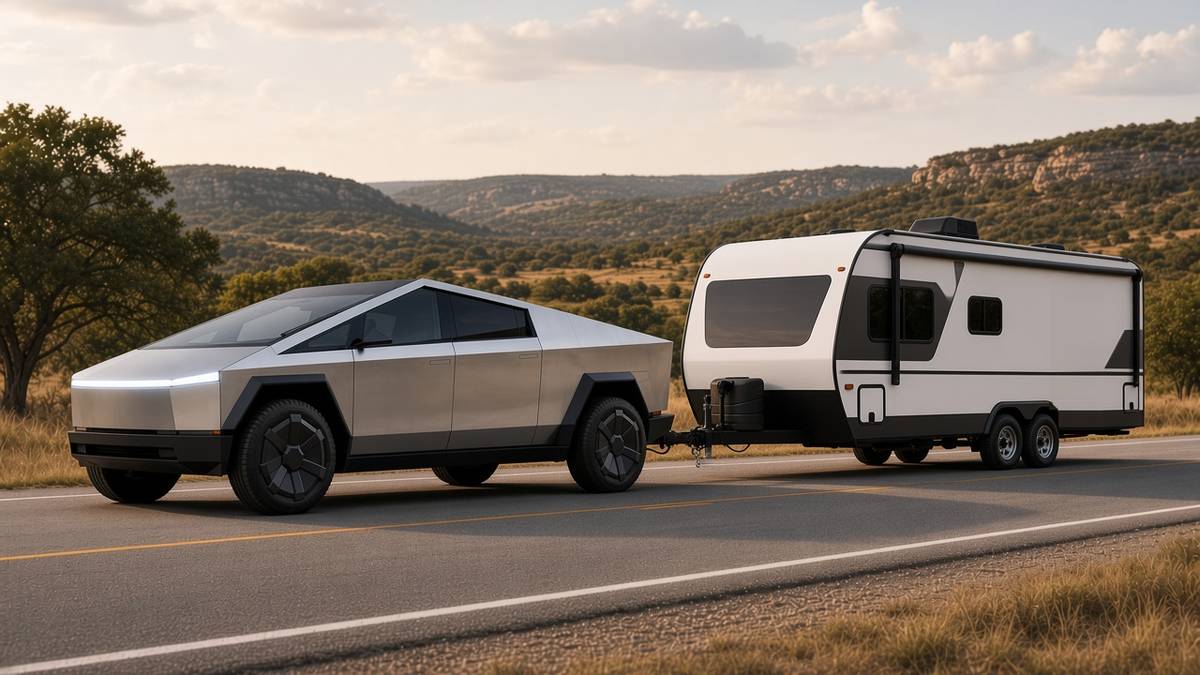
The Tesla Cybertruck’s GVWR is 8,598 to 9,169 lbs on current trims (Dual Motor AWD, Premium AWD and Cyberbeast), depending on trim and tires, according to Tesla’s owner’s manual. Older Long Range (RWD) trucks, discontinued in September 2025, are rated 8,199 lbs. Published payload is 2,000 to 2,500 lbs — on par with or above the best 2026 half-ton crew cabs in our comparisons. With a 7,000 lb loaded travel trailer, two adults and normal gear, a Premium AWD on all-season tires keeps +535 lbs of payload, a Cyberbeast keeps +335 lbs and a Dual Motor AWD keeps +341 lbs (Tesla lists 2,006 lbs; check your door sticker). All three are Within on payload.
The catch isn’t payload — it’s tongue weight. Tesla caps tongue weight at 1,100 lbs on the 11,000 lb-rated Premium AWD and Cyberbeast and at 750 lbs on the 7,500 lb-rated Dual Motor AWD (and the older Long Range). That limits how heavy a travel trailer you can actually pull. With our 7,000 lb test trailer, the Dual Motor AWD is Over on tongue weight.
Cybertruck GVWR by Trim
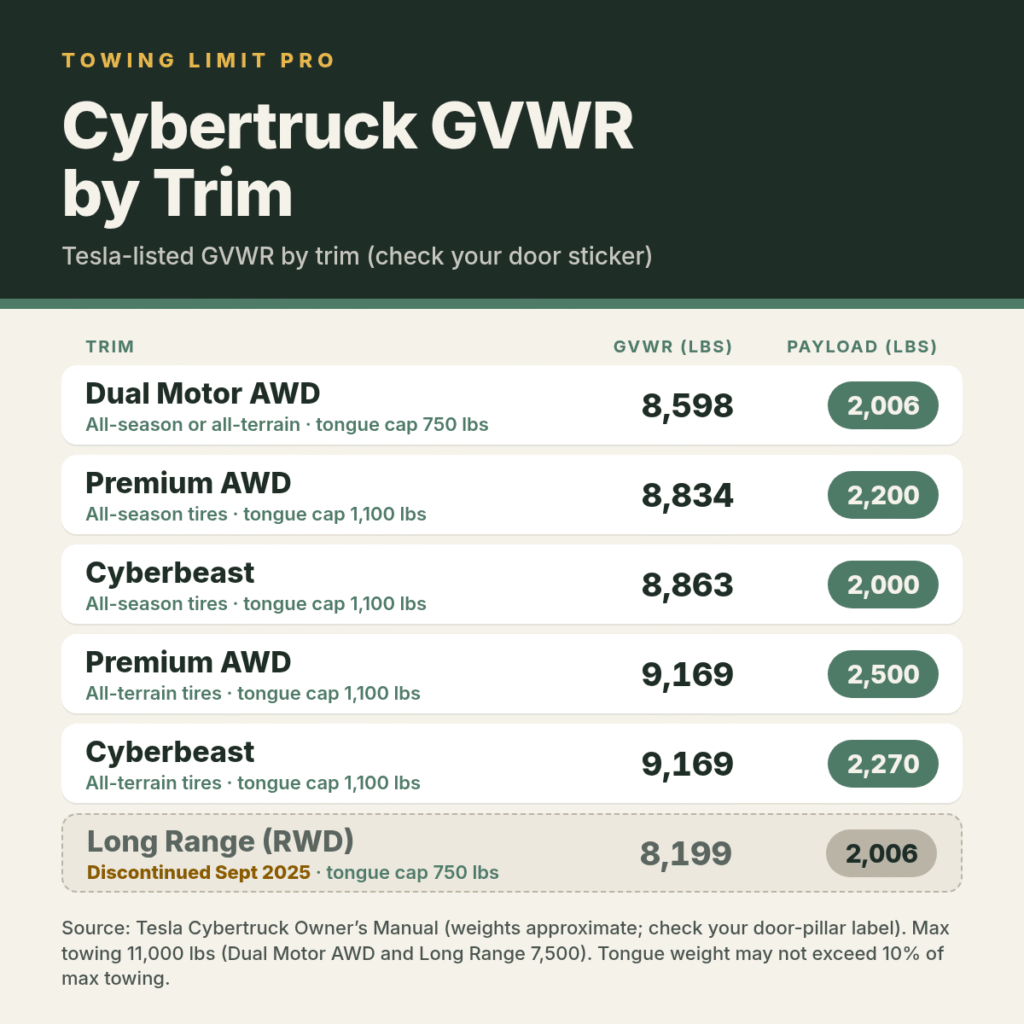
GVWR (gross vehicle weight rating) is the most a Cybertruck is allowed to weigh with people, cargo and the trailer’s tongue weight on board. Subtract curb weight and what is left is payload. Here are Tesla’s numbers:
| Cybertruck trim | Curb weight | Payload | GVWR | Max towing | Max tongue weight |
|---|---|---|---|---|---|
| Dual Motor AWD (current base trim; all-season or all-terrain) | 6,537 lbs | 2,006 lbs* | 8,598 lbs | 7,500 lbs | 750 lbs |
| Premium AWD, all-season tires | 6,634 lbs | 2,200 lbs | 8,834 lbs | 11,000 lbs | 1,100 lbs |
| Premium AWD, all-terrain tires | 6,669 lbs | 2,500 lbs | 9,169 lbs | 11,000 lbs | 1,100 lbs |
| Cyberbeast, all-season tires | 6,863 lbs | 2,000 lbs | 8,863 lbs | 11,000 lbs | 1,100 lbs |
| Cyberbeast, all-terrain tires | 6,898 lbs | 2,270 lbs | 9,169 lbs | 11,000 lbs | 1,100 lbs |
| Long Range (RWD), discontinued Sept 2025, older trucks only | 6,118 lbs | 2,006 lbs | 8,199 lbs | 7,500 lbs | 750 lbs |
Source: Tesla Cybertruck Owner’s Manual, “Dimensions, Weights, and Cargo Capacity” and “Towing a Trailer.” Tesla notes weights are approximate and can vary slightly with options, and that tongue weight must not exceed 10% of the maximum towing capacity. Current trims per tesla.com/cybertruck. Long Range discontinued September 2025 (electrive.com, Sept 17, 2025).
Two details stand out. All-terrain tires raise GVWR, so the all-terrain versions carry more payload than the all-season versions despite weighing a bit more. And the Cybertruck is heavy — every version weighs over 6,100 lbs empty — but its GVWR is high enough that payload still lands above 2,000 lbs.
Your truck’s exact GVWR is printed on the Vehicle Certification label on the driver’s door pillar. Earlier trucks and different builds may differ from the current manual, so read your own door sticker before you hitch up.
Tow Rating vs Payload vs Tongue Weight
Three separate limits have to work at the same time:
- Tow rating (7,500 or 11,000 lbs) is the heaviest trailer the truck is rated to pull.
- Payload (2,000–2,500 lbs) is everything the truck carries: people, gear, hitch hardware and tongue weight.
- Tongue weight limit (750 or 1,100 lbs) is the most downward force Tesla allows on the hitch. Tesla says it must not exceed 10% of the maximum towing capacity.
Most half-tons run out of payload first. On the Cybertruck, the tongue weight cap often arrives first. Here’s why payload — not tow rating — usually decides.
The Trailer: 7,000 lbs Loaded
We use the same 7,000 lb loaded travel trailer in every TLP matchup: a mid-size family bunkhouse with water, propane, food and gear aboard. Dry weight on the dealer sticker is lower and leaves out everything you pack. Here’s how to estimate loaded vs dry trailer weight.
We plan tongue weight at 15% of loaded weight, which is 1,050 lbs here. Loaded travel trailers often land between 10% and 15%. That stays under the Cybertruck’s 1,100 lb cap — barely.
- Driver + passenger: 340 lbs
- Gear in the cab and bed (cooler, tools, chairs, firewood): 200 lbs
- Weight-distribution hitch head and bars: 75 lbs (an example; check your hitch’s spec)
- Tongue weight at 15% of a 7,000 lb loaded trailer: 1,050 lbs
We keep the weight-distribution hitch line so the math matches our other matchups. Check Tesla’s towing guidance and your hitch maker’s instructions for what is approved on your truck.
Cybertruck Payload Math With a Travel Trailer
| Item | Premium AWD (all-season) | Cyberbeast (all-season) | Dual Motor AWD (current base trim) | Long Range (discontinued Sept 2025, older trucks only) |
|---|---|---|---|---|
| Published payload | 2,200 | 2,000 | 2,006* | 2,006 |
| Driver + passenger | −340 | −340 | −340 | −340 |
| Cab and bed gear | −200 | −200 | −200 | −200 |
| WD hitch hardware | −75 | −75 | −75 | −75 |
| Tongue weight (15% of 7,000) | −1,050 | −1,050 | −1,050 | −1,050 |
| Remaining payload | +535 lbs | +335 lbs | +341 lbs | +341 lbs |
| Tongue weight vs Tesla cap | 1,050 of 1,100 ✔ | 1,050 of 1,100 ✔ | 1,050 of 750 ✘ | 1,050 of 750 ✘ |
| Trailer vs tow rating | 7,000 of 11,000 ✔ | 7,000 of 11,000 ✔ | 7,000 of 7,500 ✔ | 7,000 of 7,500 ✔ |
| Verdict | Within | Within | Over (tongue weight) | Over (tongue weight) |
How we label the result: Within means 300+ lbs of payload left, Near means 0–299 lbs left, and Over means the truck is past its payload rating before it leaves the driveway, or past Tesla’s tongue-weight cap (marked “Over (tongue weight)”). 300 lbs sounds like a lot until you add one more passenger, a full fresh-water tank that shifts tongue weight forward, or a bed full of firewood.
The all-terrain versions do even better on payload: +835 lbs for the Premium AWD and +605 lbs for the Cyberbeast. The Dual Motor AWD (and the older Long Range) has enough payload, +341 lbs (Tesla lists 2,006 lbs; check your door sticker), but this trailer puts 300 lbs more on the hitch than Tesla’s 750 lb cap allows. The trailer itself is 500 lbs under their 7,500 lb tow rating, so tongue weight, not the tow rating, is what rules it out.
Not sure if your truck is within safe limits? Towing Limit Pro helps you verify your real setup using your actual payload sticker, passengers, cargo, and trailer numbers.
- Remaining payload (what you actually have left)
- Realistic tongue weight estimate (loaded, not brochure)
- GVWR margin + a clear safety buffer
- Risk-zone warning if your setup is pushing limits
Tip: Use your truck’s yellow door sticker payload for the most accurate result.
The Real Cybertruck Towing Limit: Tongue Weight
Because Tesla sets a hard cap on tongue weight, the trailer’s tongue percentage decides how heavy you can go:
| Cybertruck | Tongue cap | Max loaded trailer at 15% tongue | At 12% tongue | At 10% tongue |
|---|---|---|---|---|
| Premium AWD / Cyberbeast | 1,100 lbs | about 7,330 lbs | about 9,160 lbs | 11,000 lbs |
| Dual Motor AWD (current base trim) | 750 lbs | 5,000 lbs | 6,250 lbs | 7,500 lbs |
| Long Range (discontinued Sept 2025, older trucks only) | 750 lbs | 5,000 lbs | 6,250 lbs | 7,500 lbs |
That is why the 11,000 lb rating is realistic mainly for trailers with lighter tongues, like many car haulers and utility trailers. A loaded travel trailer with front storage and full tanks often runs 12–15% on the tongue, which puts the practical ceiling around 7,300–9,200 lbs for the 11,000 lb trucks and around 5,000–6,250 lbs for the 7,500 lb Dual Motor AWD (and older Long Range). Here’s why tongue weight is the number that catches people.
The only way to know your real percentage is to weigh it. A tongue scale or a certified truck scale gives you the number to plan with.
Cybertruck Towing: What Tesla’s Manual Adds
For Cybertruck towing, Tesla rates the Premium AWD and Cyberbeast at 11,000 lbs with a maximum tongue weight of 1,100 lbs, and the Dual Motor AWD (and older Long Range) at 7,500 lbs with 750 lbs. Tesla says to load the trailer so tongue weight is approximately 10% of total trailer weight without going over those caps, and its maximum towing capacity assumes the truck stays under GVWR. Passengers and cargo in the truck can lower the tongue weight it can handle.
That 10% guidance and our 15% planning number give different answers for the Dual Motor AWD with the 7,000 lb trailer above. At about 10%, tongue weight is about 700 lbs, 50 lbs under Tesla’s 750 lb cap, with about +691 lbs of payload left. At 15%, it is 1,050 lbs, 300 lbs over the cap. We keep 15% as our conservative planning number because loaded travel trailers often land between 10% and 15%. Weigh your actual tongue weight, and stay within Tesla’s ratings and the numbers on your door-jamb sticker.
The manual also lists a few setup steps that apply to Cybertruck towing:
- Trailer Mode turns on when you plug in the trailer’s 4-pin or 7-pin connector. The trailer brakes only work while it is on.
- Built-in trailer brake controller: Tesla says to set Trailer Brake Gain each time you connect a trailer.
- Tire pressure when towing: 50 psi on 18″ or 20″ all-season tires, 65 psi on 20″ all-terrain tires. These replace the door-label pressures.
- Ball mount: not included. The hitch receiver takes a 2-inch ball mount.
Tesla also notes that towing significantly decreases range. To see how the Cybertruck compared with other electric trucks in published towing tests, read our guide to the best EV for towing.
Source: Tesla Cybertruck Owner’s Manual, “Towing a Trailer” and “Dimensions, Weights, and Cargo Capacity.”
Verdict: Can a Cybertruck Tow a Travel Trailer?
- Premium AWD and Cyberbeast: Within with a 7,000 lb loaded trailer (+535 and +335 lbs on all-season tires). Keep tongue weight under 1,100 lbs, which caps a 15%-tongue travel trailer at about 7,300 lbs loaded.
- Dual Motor AWD (current base trim): Over with this trailer. Payload is fine (+341 lbs; Tesla lists 2,006 lbs; check your door sticker), but 1,050 lbs of tongue weight exceeds its 750 lb cap. At 15% tongue, keep loaded trailers to about 5,000 lbs.
- Long Range (discontinued Sept 2025, older trucks only): same result as the Dual Motor AWD. Over with this trailer because of the 750 lb tongue cap; about 5,000 lbs loaded at 15% tongue.
This is a reversal of our earlier verdict. The original version understated GVWR, which made payload look like the problem. With Tesla’s published figures, payload is healthy and tongue weight is the limit to watch.
See how the Cybertruck’s numbers stack up against the half-tons in our truck comparisons.
Want to run your own numbers? Towing Limit Pro does this subtraction with your door-sticker payload, your passengers and your loaded trailer. The calculator works offline at the campground, and when you have signal the built-in AI assistant can explain the result in plain English and answer follow-up towing questions.
Most half-ton trucks hit their payload limit long before they hit their tow rating limit — and most owners don’t realize it until they’re already committed. Verify your exact setup and know where you stand.
- Remaining payload (your real limit)
- Realistic tongue weight (loaded)
- GVWR margin + safety buffer
- Clear risk-zone indicator
Best results: use your yellow door-sticker payload number and your loaded trailer estimate (not dry weight).
FAQs
What is the Cybertruck GVWR?
For current trims, Tesla’s owner’s manual lists 8,598 lbs for the Dual Motor AWD, 8,834 lbs for the Premium AWD on all-season tires, 8,863 lbs for the Cyberbeast on all-season tires and 9,169 lbs for the Premium AWD and Cyberbeast on all-terrain tires. Older Long Range (RWD) trucks, discontinued in September 2025, are rated 8,199 lbs. Your truck’s exact figure is on the door-pillar certification label.
What is the Cybertruck payload capacity?
Tesla lists 2,000 to 2,500 lbs depending on trim and tires: Dual Motor AWD 2,006 (Tesla lists 2,006 lbs; check your door sticker), Premium AWD 2,200 (all-season) or 2,500 (all-terrain), Cyberbeast 2,000 (all-season) or 2,270 (all-terrain). The discontinued Long Range (older trucks only) is also listed at 2,006.
What is the Cybertruck’s maximum tongue weight?
1,100 lbs for the 11,000 lb-rated Premium AWD and Cyberbeast, and 750 lbs for the 7,500 lb-rated Dual Motor AWD and the older Long Range. Tesla says tongue weight must not exceed 10% of the maximum towing capacity.
Can a Cybertruck tow 11,000 lbs?
The Premium AWD and Cyberbeast are rated for it, but only if tongue weight stays at or under 1,100 lbs — about 10% of an 11,000 lb trailer — and the truck stays under GVWR. The Dual Motor AWD is rated for 7,500 lbs. Many loaded travel trailers carry more than 10% on the tongue.
Why did this article change?
The earlier version used an 8,000 lb GVWR and 1,157 lb payload that don’t match Tesla’s published specs. We rebuilt the math using the owner’s manual figures.