
Quick Answer
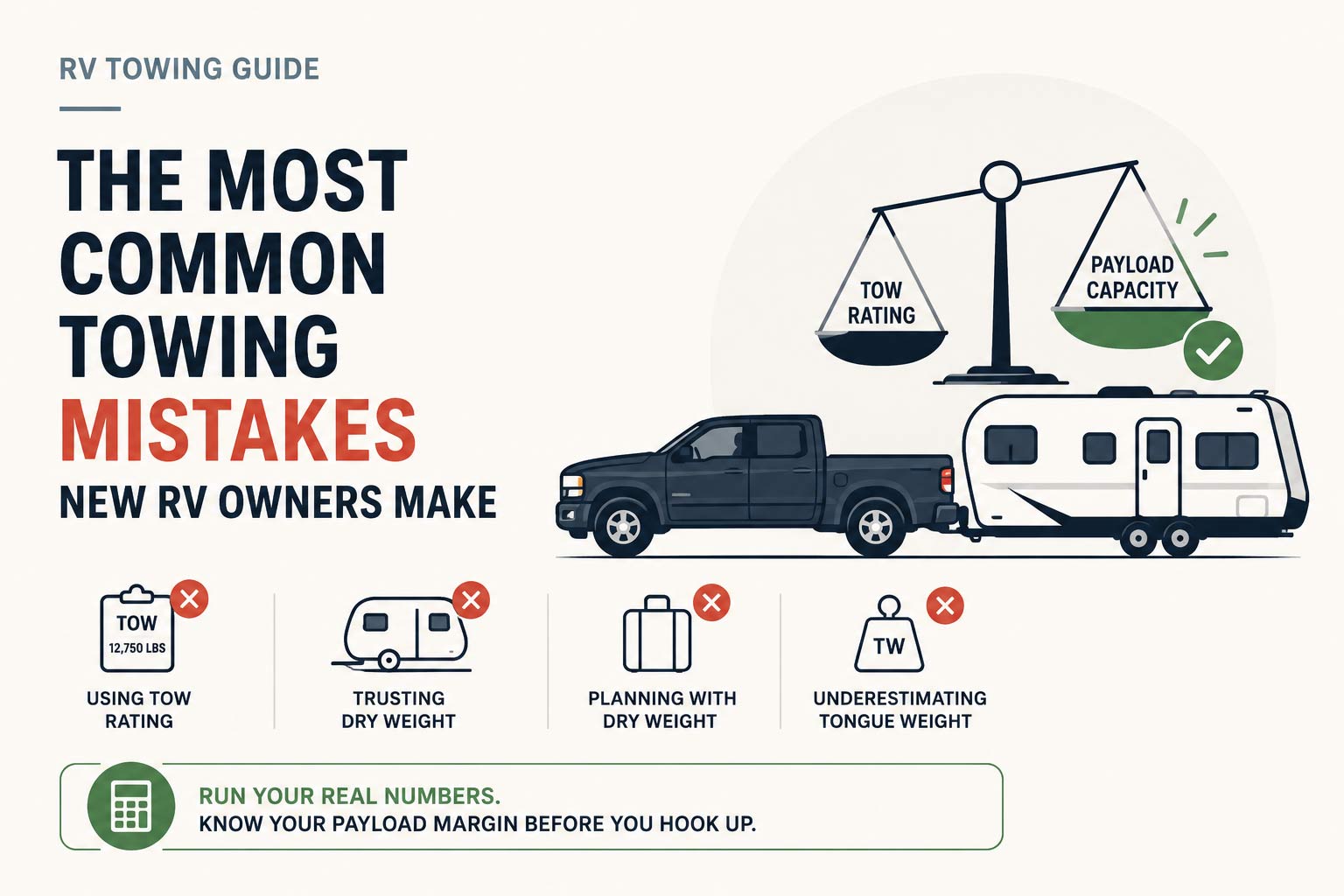
The mistakes that get new RV owners in trouble aren’t about forgetting to level the trailer or running the wrong hitch height — they’re about using the wrong numbers from the start. Tow rating, dry weight, and brochure specs are the three figures most buyers rely on. None of them are the ones that matter most.
The number that determines whether your truck can legally and safely tow your trailer is the payload capacity on your door sticker — not the tow rating, not the brochure, and not the window sticker.
Why Matching the Tow Rating Isn’t Enough
You matched the trailer weight to the truck’s tow rating. The dealer said you were fine. You probably weren’t.
Tow rating is a marketing number. Payload capacity is a certified engineering limit. Confusing one for the other is the most common — and most expensive — towing mistake new RV owners make. The others are variations on the same theme.
Mistake 1: Using Tow Rating Instead of Payload Capacity
The tow rating on a 2024 Ram 1500 Crew Cab 4×4 with the Max Tow Package can reach 12,750 lbs. That number is real. It’s also almost irrelevant for how most half-ton setups actually perform on the road.
The number that actually governs your setup is on the door sticker — not the brochure, not the manufacturer’s website, not the window label. On a typical 2024 Ram 1500 Crew Cab 4×4, that door sticker payload reads around 1,460 lbs. Here’s what those numbers look like:
- GVWR: 7,100 lbs
- Curb weight: 5,640 lbs
- Payload (door sticker — not brochure): 1,460 lbs
That 1,460 lbs is everything: passengers, cargo in the cab, gear in the bed, and tongue weight from the trailer. It doesn’t grow based on what tow package you ordered. It doesn’t change based on how well the trailer’s tow rating matches the truck’s.
Payload is the ceiling. Tow rating is a different measurement entirely — it reflects drivetrain capability, not the truck’s structural weight capacity. Running over payload while remaining within tow rating is still running over payload.
Mistake 2: Trusting Dry Weight
The Grand Design Reflection 150 Series 260RD lists a dry weight of 5,489 lbs and a GVWR of 7,715 lbs. Most buyers see 5,489, confirm it’s well under the truck’s tow rating, and consider the math done.
That dry weight means nothing once you load the trailer for a real trip. Dry weight is the trailer as it left the factory floor — no water in the tank, no food, no gear, no clothing, no bikes on the rack. Here are the actual specs:
- Dry weight: 5,489 lbs
- GVWR: 7,715 lbs
- Tongue weight (unloaded, at 15%): approximately 823 lbs
That GVWR of 7,715 lbs is the maximum the trailer can legally weigh when loaded. The gap between dry and GVWR — 2,226 lbs — is the trailer’s own payload allowance. Most RV shoppers never look at that number. Most dealers don’t mention it.
Dry weight does not equal loaded weight. This needs to be the assumption going into every purchase decision.
Mistake 3: Treating Dry Weight as Your Planning Number
Loaded trailers routinely exceed dry weight by 15–30%. A trailer with a 5,489 lb dry weight doesn’t go on a real trip at 5,489 lbs. It goes on a trip with water in the tank, full propane, a week’s worth of food, clothing, tools, camp chairs, loaded storage bays, and whatever extra gear accumulated before departure.
A realistic loaded weight for a trailer like the 260RD is 6,700–6,900 lbs depending on the trip. That loaded weight — not the dry weight — is what drives your tongue weight calculation. And tongue weight is what comes directly out of your truck’s payload.
If you plan your towing setup using dry weight, every number downstream is wrong.
Mistake 4: Underestimating What Tongue Weight Actually Costs You
The tongue weight rule is straightforward: tongue weight should be 12–15% of your trailer’s actual loaded weight. Most buyers either skip this calculation entirely or run it against dry weight, which produces a number that doesn’t reflect the real setup.
At 15% of a realistic loaded weight of 6,800 lbs:
> 6,800 × 0.15 = 1,020 lbs of tongue weight
That 1,020 lbs comes directly out of your truck’s payload capacity the moment you hook up. It’s not a soft estimate you can nudge downward — it’s a physical load pressing on your rear axle.
At 12% (the lower end of the safe range):
> 6,800 × 0.12 = 816 lbs of tongue weight
Even at the minimum, that’s more than half your truck’s payload capacity consumed before a single person sits in the cab.
The Real Math: What Happens When All Four Mistakes Stack
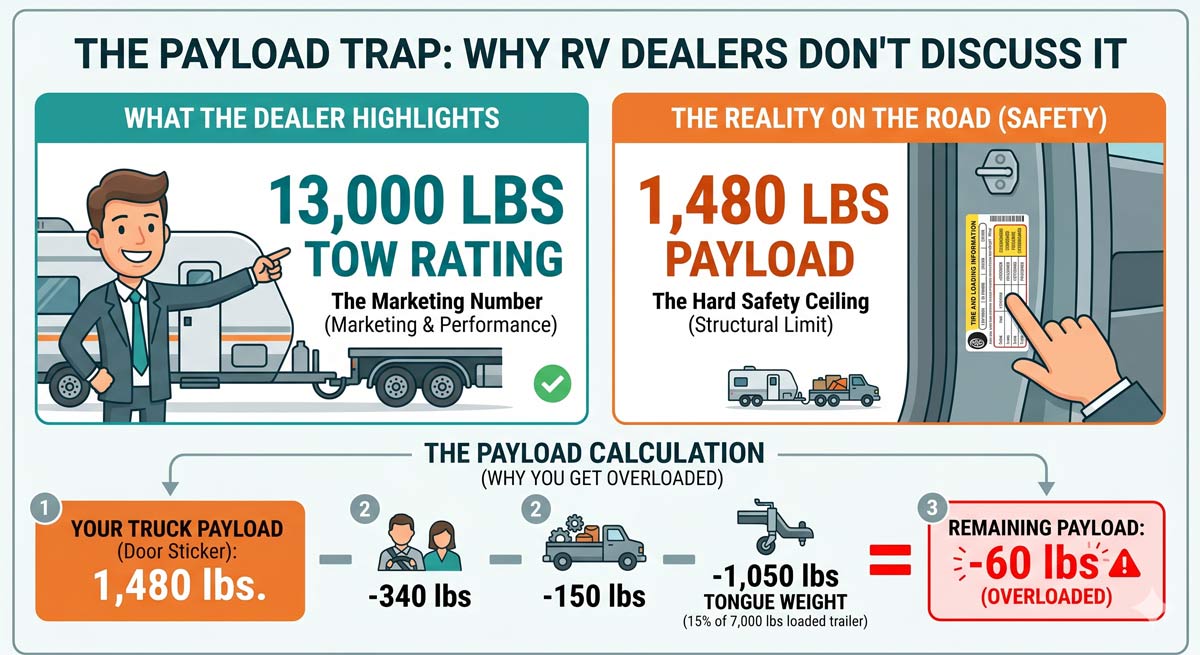
Here’s what the actual calculation looks like when you run these mistakes as a combined scenario — 2024 Ram 1500 Crew Cab 4×4 paired with a Grand Design Reflection 260RD loaded to 6,800 lbs:
| Item | Weight (lbs) |
| Truck Payload Capacity (door sticker — not brochure) | 1,460 |
| minus Driver + Passenger | minus 340 |
| minus Gear / cargo in truck bed | minus 200 |
| minus Tongue weight (15% of 6,800 lb loaded trailer weight) | minus 1,020 |
| = Remaining Payload Margin | **−100 lbs** |
Over Payload Before Leaving the Driveway
The margin is negative. This is not a borderline number — it’s a deficit. This truck is over its certified payload limit before it leaves the driveway.
The trailer weighs less than 7,000 lbs. The truck is rated to tow 12,750 lbs. Both numbers look fine on paper. The payload math says otherwise by 100 lbs — and that’s before accounting for any extra items in the cab or additional gear loaded into the bed.
This is a standard crew cab half-ton paired with a mid-size travel trailer. This combination is sold every weekend at RV dealerships across the country.
If you’re wondering where your truck would land in this calculation, don’t guess.
Not sure if your truck is within safe limits? Towing Limit Pro helps you verify your real setup using your actual payload sticker, passengers, cargo, and trailer numbers.
- Remaining payload (what you actually have left)
- Realistic tongue weight estimate (loaded, not brochure)
- GVWR margin + a clear safety buffer
- Risk-zone warning if your setup is pushing limits
Tip: Use your truck’s yellow door sticker payload for the most accurate result.
Verdict: Ram 1500 + Reflection 260RD Is Over Payload
This specific combination — 2024 Ram 1500 Crew Cab 4×4 with a Grand Design Reflection 260RD loaded to a realistic 6,800 lbs — runs a negative payload margin under normal loading conditions. The verdict is Risky.
The fix is not automatically a different truck. In some setups, reducing loaded trailer weight, trimming cab occupancy, or eliminating bed cargo brings the margin back into positive territory. But you have to run the actual numbers to find out where you land. The mistake — in every case — is skipping that calculation and assuming tow rating plus dry weight equals a safe setup. It doesn’t.
Know your real margin before you hook up.
Most half-ton trucks hit their payload limit long before they hit their tow rating limit — and most owners don’t realize it until they’re already committed. Verify your exact setup and know where you stand.
- Remaining payload (your real limit)
- Realistic tongue weight (loaded)
- GVWR margin + safety buffer
- Clear risk-zone indicator
Best results: use your yellow door-sticker payload number and your loaded trailer estimate (not dry weight).
FAQs
What's the difference between tow rating and payload capacity?
Tow rating reflects how much weight a truck's drivetrain can pull — determined by engine output, transmission, axle ratio, and braking capability. Payload capacity is the certified limit for everything the truck carries: passengers, in-cab gear, bed cargo, and tongue weight from the trailer. You can be within tow rating and over payload simultaneously. Payload is the constraint that governs whether the setup is within certified limits.
Why can't I just use dry weight when comparing a trailer to my truck?
Dry weight is the trailer as it left the factory — no water, no fuel, no gear, no food, no personal cargo. A trailer loaded for an actual trip routinely weighs 15–30% more than its dry weight. That difference flows directly into your tongue weight calculation, which reduces your truck's available payload. Planning against dry weight means every downstream number in your setup is optimistic by hundreds of pounds.
How does tongue weight affect my payload budget?
Tongue weight is the downward force the trailer places on your truck's rear hitch and axle — and it comes entirely out of your payload allowance. At 15% of loaded trailer weight, tongue weight alone can consume 60–75% of a half-ton truck's certified payload before a single passenger sits down. This is the mechanism by which a trailer that seems within tow rating still overloads the truck: tow rating and payload are measuring different things, and tongue weight only appears in the payload calculation.
Does it matter which specific door sticker I look at?
Yes — every truck in the same model line can carry a different payload capacity. Cab size, bed length, drivetrain configuration, options packages, and factory-installed equipment all affect curb weight, which determines payload. Two Ram 1500s that look identical on the lot can have different payload ratings if they were built to different specs. The number on your specific truck's door sticker is the only figure that applies to your setup.
What are my options if the payload math shows a deficit?
First, verify the inputs — recalculate using your actual door sticker payload and a realistic loaded trailer weight, not dry weight. If the deficit remains, the adjustable variables are: reducing loaded trailer weight by cutting gear or traveling lighter, reducing cab occupancy, removing cargo from the truck bed, or switching to a trailer with a meaningfully lower loaded weight. If none of those options return a positive margin, the setup requires a truck with higher certified payload to operate within limits. The math tells you which variable to change — it doesn't always require a new truck.