
Quick Answer
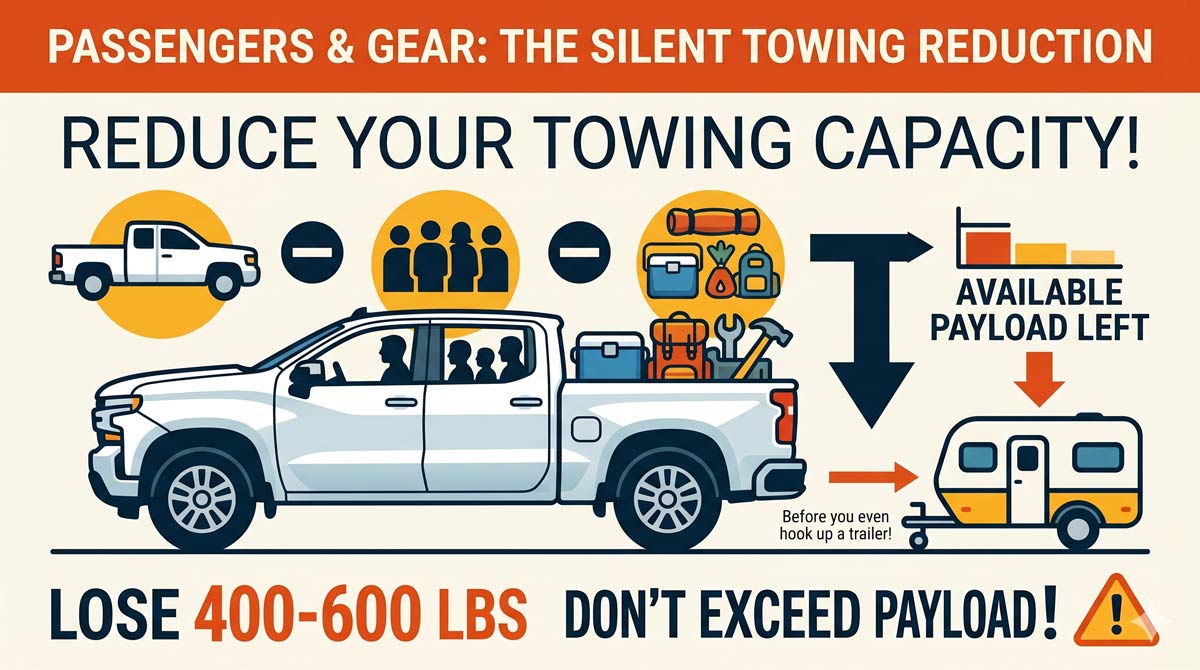
Every person and pound of gear in your truck eats directly into your payload capacity — the same budget that covers tongue weight. Add two passengers, a week’s worth of camping gear, and a full fuel tank, and you can lose 400–600 lbs of payload before you ever hook up a trailer.
Your payload sticker is the ceiling. Passengers and cargo are the first things subtracted from it.
The Number Nobody Subtracts First
Most towing conversations start with the trailer. How much does it weigh? What’s the tongue weight? Can my truck handle it?
Those are the right questions — but they’re being asked in the wrong order.
Before tongue weight enters the equation, your payload budget is already shrinking. The people riding with you, the tools in your bed, the gear behind the rear seat — every one of those pounds reduces what’s left for the trailer. And if you’re running close to your limit before the tongue weight even shows up, you’re already in trouble.
Here’s the uncomfortable part: the tow rating on the window sticker assumes a stripped configuration. Base driver only. No passengers. No cargo. Your real-world tow capacity is lower than advertised the moment you load up the cab.
The Truck: Silverado 1500 LTZ
For this breakdown, we’re using a 2023 Chevy Silverado 1500 LTZ with a 5.3L V8, 4WD, crew cab, short bed.
These numbers come from the door sticker — not the brochure, not the configurator, not the marketing sheet. The door sticker is the only number that legally matters.
- GVWR: 7,100 lbs
- Curb Weight: 5,538 lbs
- Payload Capacity (door sticker): 1,562 lbs
That 1,562 lbs is your total budget. It must cover everything: passengers, gear, tongue weight, and any cargo in the bed. Not just the trailer. Everything.
The Trailer: Keystone Cougar Half-Ton 22RBS
For this scenario, we’re pairing the Silverado with a 2024 Keystone Cougar Half-Ton 22RBS, a popular mid-size travel trailer marketed specifically at half-ton trucks.
- Dry Weight (UVW): 5,799 lbs
- GVWR: 7,700 lbs
- Dry Tongue Weight (listed): 855 lbs
One critical note: dry weight does not equal loaded weight. The dry weight is the trailer as it sits at the factory — no water, no propane, no food, no gear, no personal belongings. Nobody actually tows a trailer that way.
How Much Weight Camping Gear Adds
When you fill the freshwater tank (typically 40–50 gallons = 334–417 lbs), load the kitchen, pack the clothes, and add two bikes on a rack, you’re adding weight fast.
Loaded trailers routinely exceed their dry weight by 15–30%. On a 5,799 lb dry trailer, that means real-world loaded weight could land anywhere from 6,669 lbs to 7,539 lbs — pushing against or exceeding the 7,700 lb GVWR.
For this math, we’ll use a conservative loaded estimate of 6,900 lbs. That’s only 19% over dry — modest by camping standards.
Tongue Weight on the Cougar 22RBS
Tongue weight should run 12–15% of total loaded trailer weight.
At 6,900 lbs loaded:
- 12% = 828 lbs
- 15% = 1,035 lbs
We’ll calculate at 15% — the upper-range standard, and the number you should plan around, not the minimum.
Tongue weight at 15% of 6,900 lbs = 1,035 lbs
That single number already accounts for most of the Silverado’s payload budget. But it’s not the first thing being subtracted.
The Real Math: Passengers and Gear Come First
This is the table that changes how you think about towing. Payload subtraction doesn’t start with the trailer — it starts the moment you put people and gear in the truck.
| Item | Weight (lbs) |
| Truck Payload Capacity (door sticker — not brochure) | 1,562 |
| minus Driver + 1 Passenger | minus 360 |
| minus Two kids (rear seat) | minus 180 |
| minus Gear in cab and bed (tools, bags, food, dog) | minus 250 |
| minus Tongue weight (15% of 6,900 lb loaded trailer) | minus 1,035 |
| **= Remaining Payload Margin** | **−263 lbs** |
Over Payload Before the Trailer Moves
The margin is negative 263 lbs.
This truck, in this configuration, with this trailer, is over its payload capacity before it leaves the driveway.
And nothing about this scenario is extreme. Four people in the cab is a normal family trip. 250 lbs of gear is light for a week-long camping trip. A 6,900 lb loaded trailer is below the GVWR for this unit. Everything here is conservative.
Yet the truck is overloaded.
This is exactly how payload violations happen. Not from reckless decisions or wrong equipment — but from the accumulation of normal, reasonable things that nobody added up in advance.
Remove the two kids, cut the cab gear to 100 lbs, and the margin comes back to roughly +27 lbs. Still dangerously thin. Still one extra bag of ice away from violation.
The point isn’t that this truck can’t tow this trailer. It’s that it can’t tow it while fully loaded with four people and real-world gear. The passengers and cargo aren’t an afterthought — they’re the first subtraction, and they quietly consume hundreds of pounds before tongue weight is ever calculated.
If you’re wondering where your truck would land in this calculation, don’t guess.
Not sure if your truck is within safe limits? Towing Limit Pro helps you verify your real setup using your actual payload sticker, passengers, cargo, and trailer numbers.
- Remaining payload (what you actually have left)
- Realistic tongue weight estimate (loaded, not brochure)
- GVWR margin + a clear safety buffer
- Risk-zone warning if your setup is pushing limits
Tip: Use your truck’s yellow door sticker payload for the most accurate result.
Verdict: Passengers and Gear Push It Over
A 2023 Silverado 1500 LTZ towing a Keystone Cougar 22RBS with a full crew and standard camping gear is over payload capacity. Not borderline — over. Even trimming the passenger and gear load brings you to a margin so thin that any deviation from your planned load pushes you back into violation. This combination requires either a lighter trailer, a truck with a higher payload rating (check the door sticker before you buy), or a deliberate decision to reduce what you’re carrying in the cab and bed. The trailer choice isn’t wrong. The truck choice isn’t wrong. The math is just honest about what four people and camping gear cost before the tongue ever loads the hitch.
Know your real margin before you hook up.
Most half-ton trucks hit their payload limit long before they hit their tow rating limit — and most owners don’t realize it until they’re already committed. Verify your exact setup and know where you stand.
- Remaining payload (your real limit)
- Realistic tongue weight (loaded)
- GVWR margin + safety buffer
- Clear risk-zone indicator
Best results: use your yellow door-sticker payload number and your loaded trailer estimate (not dry weight).
Frequently Asked Questions
Does tow rating account for passengers and cargo?
No. Tow rating is calculated in a base configuration — typically with only a driver. Every passenger and pound of gear you add to the truck reduces your available payload, which directly reduces how much tongue weight you can carry, which changes what you can safely tow. Tow rating is a ceiling under ideal conditions, not a real-world number.
Does the dry weight on the trailer spec sheet reflect what I'll actually be towing?
No. Dry weight — also called UVW or Unloaded Vehicle Weight — is the trailer as it leaves the factory with no water, propane, food, or personal gear. Loaded trailers routinely exceed their dry weight by 15–30%. Always calculate tongue weight based on a realistic loaded estimate, not the dry figure. For planning, add at least 1,000–1,500 lbs to the listed dry weight as a starting point.
Why does it matter which seat my passengers sit in?
For payload purposes, it doesn't matter — all passenger weight counts against your truck's payload capacity regardless of seating position. However, weight distribution in the truck does affect handling, rear sag, and how the hitch sits at the coupler. More weight over the rear axle changes the effective tongue weight load. Run the total numbers first, then think about distribution.
What's the difference between payload capacity and tow rating?
Payload capacity is how much weight your truck can carry — in the cab and bed combined. Tow rating is how much the truck can pull behind it. They're separate numbers, but they're connected: tongue weight (the downward force of the trailer on the hitch) counts against your payload. A truck can have a 10,000 lb tow rating and only 1,200 lbs of payload. Exceed the payload with tongue weight plus passengers and gear, and it doesn't matter what the tow rating says — you're over a structural limit.
How do I find my truck's actual payload capacity?
Open the driver's side door and look for the yellow or white sticker on the door jamb. It will say something like "The combined weight of occupants and cargo should never exceed XXX lbs." That number is your payload capacity for that specific truck. It varies by trim, configuration, and options — which is why the door sticker is the only source that matters. Brochures and configurators show a range; the sticker shows your truck.