
Quick Answer
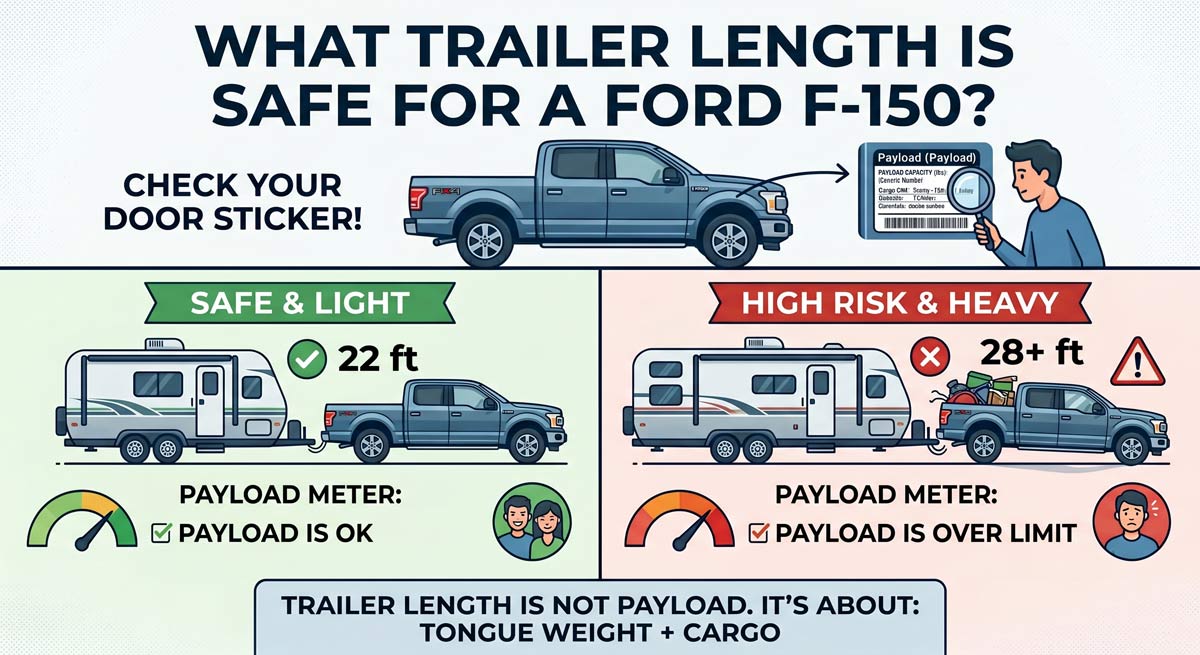
The safe trailer length for a Ford F-150 depends on payload — not tow rating — and most F-150 owners are closer to their payload limit than they realize. A 24–26 foot travel trailer is often where half-ton margins get tight, and anything above 28 feet needs careful math before you hook up.
Trailer length is a proxy. Loaded weight and tongue weight are what actually matter.
Why Trailer Length Is the Wrong Question
You’ve probably seen the tow rating — 13,000 lbs for some F-150 trims — and assumed length is the only question left. That’s exactly the assumption that puts trucks over their limits on a summer Friday afternoon.
The number that decides whether your F-150 is safe isn’t in the brochure. It’s on the door sticker, and it’s almost always smaller than you’d expect.
Truck Specs: What the Door Sticker Says
Ford publishes wide payload ranges for the F-150 because the number varies by trim, cab configuration, engine, and options. A fully loaded crew cab Lariat with 4WD and a moonroof can have a payload well under 1,400 lbs. A stripped work truck might push 2,000 lbs.
For this analysis, we’ll use a common real-world F-150 configuration: a 2023 F-150 XLT SuperCrew 4×4 with the 3.5L EcoBoost.
Door sticker payload: 1,480 lbs
That’s the number. Not the brochure. Not Ford’s marketing range. The sticker inside the driver’s door jamb — the one that’s specific to your VIN. Your truck may differ. These numbers always come from the door sticker, not the spec sheet.
- GVWR: 7,050 lbs
- Curb weight: 5,570 lbs
- Payload capacity: 1,480 lbs
Trailer Specs: Dry Weight Is Not Loaded Weight
Here’s where trailer shopping misleads almost everyone.
A 26-foot travel trailer might be advertised with a dry weight of 5,900 lbs. That number reflects the trailer as it left the factory — empty water tanks, no food, no gear, no clothes, no tools, no propane.
Nobody tows a trailer that way.
For this example, we’ll use a realistic mid-size trailer: a 26-foot travel trailer with the following specs from the manufacturer label:
- Dry weight: 5,900 lbs
- GVWR: 7,700 lbs (the manufacturer’s maximum loaded weight)
- Tongue weight (at GVWR): 770–1,155 lbs (10–15% range)
Trailer specs used here come from the manufacturer’s label. Always verify against your specific trailer’s documentation.
Dry vs. Loaded Weight: The Gap Nobody Accounts For
The advertised dry weight and your actual towing weight are not the same number. Loaded trailers routinely exceed dry weight by 15–30%, and many families push even further.
Using the 5,900 lb dry weight example:
- 15% load increase: 5,900 × 1.15 = 6,785 lbs loaded
- 30% load increase: 5,900 × 1.30 = 7,670 lbs loaded — that’s essentially at GVWR already
For this scenario, we’ll model a moderately loaded trailer at 6,700 lbs. That’s realistic for a couple taking a week-long trip with full water tanks, a week of food and clothing, tools, and outdoor gear. It’s not the heavy end — it’s the everyday end.
If your trailer’s GVWR is 7,700 lbs, you have headroom on paper. But your truck’s payload is the constraint that actually matters.
Tongue Weight Rule: 12–15% of Loaded Trailer Weight
Tongue weight is the downward force the trailer hitch puts on the back of your truck. It counts directly against your payload.
The standard recommendation is 12–15% of loaded trailer weight. At 15%, the math is straightforward:
6,700 lbs × 0.15 = 1,005 lbs of tongue weight
That 1,005 lbs lands on your truck’s rear axle and counts against your 1,480 lb payload capacity. And you haven’t even added yourself, a passenger, or a single item in the truck bed yet.
F-150 Payload Math by Trailer Length
This is where the numbers meet the road. Using a door sticker payload of 1,480 lbs:
| Item | Weight (lbs) |
| Truck Payload Capacity (door sticker — not brochure) | 1,480 |
| minus Driver + Passenger | minus 340 |
| minus Gear / cargo in truck bed | minus 150 |
| minus Tongue weight (15% of 6,700 lb loaded trailer) | minus 1,005 |
| **= Remaining Payload Margin** | **−15 lbs** |
You’re over payload before you leave the driveway.
Where the F-150 Goes Over Payload
At a 26-foot trailer loaded to 6,700 lbs, this F-150 configuration is over its payload limit by 15 lbs — and that’s before accounting for any extra gear, heavier passengers, or a hitch ball and weight-distribution head that add another 50–80 lbs.
The tow rating says this truck can pull the trailer. The payload math says it can’t do it legally or safely with two people and a weekend’s worth of gear.
This is not a worst-case scenario. This is a Tuesday.
If you drop tongue weight to 12% of loaded weight — 804 lbs — the margin opens to 186 lbs. That’s borderline. Any extra cargo closes it fast.
If you’re wondering where your truck would land in this calculation, don’t guess.
Not sure if your truck is within safe limits? Towing Limit Pro helps you verify your real setup using your actual payload sticker, passengers, cargo, and trailer numbers.
- Remaining payload (what you actually have left)
- Realistic tongue weight estimate (loaded, not brochure)
- GVWR margin + a clear safety buffer
- Risk-zone warning if your setup is pushing limits
Tip: Use your truck’s yellow door sticker payload for the most accurate result.
What About Shorter Trailers?
Let’s run the same math on a 22-foot trailer — the kind frequently marketed to half-ton buyers.
A realistic 22-footer might have a dry weight of 4,800 lbs and load to 5,500 lbs for a moderate trip.
Tongue weight at 15%: 5,500 × 0.15 = 825 lbs
| Item | Weight (lbs) |
| Truck Payload Capacity (door sticker — not brochure) | 1,480 |
| minus Driver + Passenger | minus 340 |
| minus Gear / cargo in truck bed | minus 150 |
| minus Tongue weight (15% of 5,500 lb loaded trailer) | minus 825 |
| **= Remaining Payload Margin** | **165 lbs** |
That’s a functional margin — but not a comfortable one. One extra passenger, a heavier load, or a few toolbox items in the bed and you’re at zero.
This is what “safe” looks like for a half-ton: thin margins, carefully managed, with nothing extra and a lighter-than-average load.
Verdict: Safe F-150 Trailer Length
Risky at 26 feet. Borderline at 22 feet. Safe only under specific, controlled conditions.
A Ford F-150 can tow a 24–26 foot travel trailer without blowing a tire or losing control on the highway. That’s not the question. The question is whether it can do it within its rated payload capacity, with real people and real gear, loaded the way actual owners load their trailers. For most F-150 configurations in the 1,400–1,500 lb payload range, the answer is no — not with a 26-footer, and barely with a 22-footer.
The F-150 configurations that handle 26-foot trailers safely tend to have higher payloads — think a base Regular Cab 4×2 work truck with a payload at or above 1,900 lbs. If your door sticker is under 1,600 lbs, a 26-foot trailer loaded for a real trip is likely over your limit.
Trailer length is a starting point for narrowing down options. Loaded weight and tongue weight are what determine whether your specific truck can safely tow a specific trailer on a specific trip.
Know your real margin before you hook up.
Most half-ton trucks hit their payload limit long before they hit their tow rating limit — and most owners don’t realize it until they’re already committed. Verify your exact setup and know where you stand.
- Remaining payload (your real limit)
- Realistic tongue weight (loaded)
- GVWR margin + safety buffer
- Clear risk-zone indicator
Best results: use your yellow door-sticker payload number and your loaded trailer estimate (not dry weight).
FAQs
What trailer length can a Ford F-150 safely tow?
There's no universal answer — it depends on your F-150's payload capacity, which you'll find on the door sticker, not the brochure. A truck with 1,900+ lbs of payload has more room for a longer trailer than one with 1,400 lbs. Most real-world F-150 configurations can handle a loaded 22-foot trailer with thin margins, and struggle with 26-foot trailers once you account for passengers and gear.
Why does tow rating not tell me how long a trailer I can tow?
Tow rating measures what the drivetrain, brakes, and hitch can handle — it's an engineering limit on pulling force. Payload is the limit on how much weight can be added to the truck: passengers, gear, and tongue weight all count against it. A truck can have a 13,000 lb tow rating and a 1,480 lb payload. It's the payload that runs out first. Millions of truck owners focus on tow rating and never check payload — that's why overloaded half-tons are common.
Does dry weight matter when deciding if a trailer is safe for my F-150?
Dry weight is the starting point, but it's not what your truck actually carries. Loaded trailers routinely weigh 15–30% more than the advertised dry weight once you add water, food, clothing, tools, and gear. A 5,900 lb dry weight trailer can easily be a 6,700–7,000 lb trailer in real use. Always calculate tongue weight and payload based on estimated loaded weight, not dry weight.
What is the tongue weight limit for a Ford F-150?
Most F-150 configurations have a tongue weight limit of around 1,300–1,500 lbs depending on hitch class and configuration — check your owner's manual for your specific truck. But tongue weight also counts against your payload capacity, so the binding constraint is usually payload first. Even if your hitch can handle 1,300 lbs of tongue weight, that much tongue weight on a 1,480 lb payload truck leaves almost nothing for people and cargo.
What F-150 trim or configuration is best for towing longer trailers?
The highest-payload F-150 configurations tend to be Regular Cab or SuperCab 4x2 models with the base engine and minimal options — these can hit 2,000+ lbs of payload. Once you add a SuperCrew cab, 4WD, and popular option packages, payload often drops into the 1,400–1,600 lb range. If trailer length and size are priorities, check the door sticker on the specific truck before purchasing — payload varies by VIN, not just trim level.