
Quick Answer
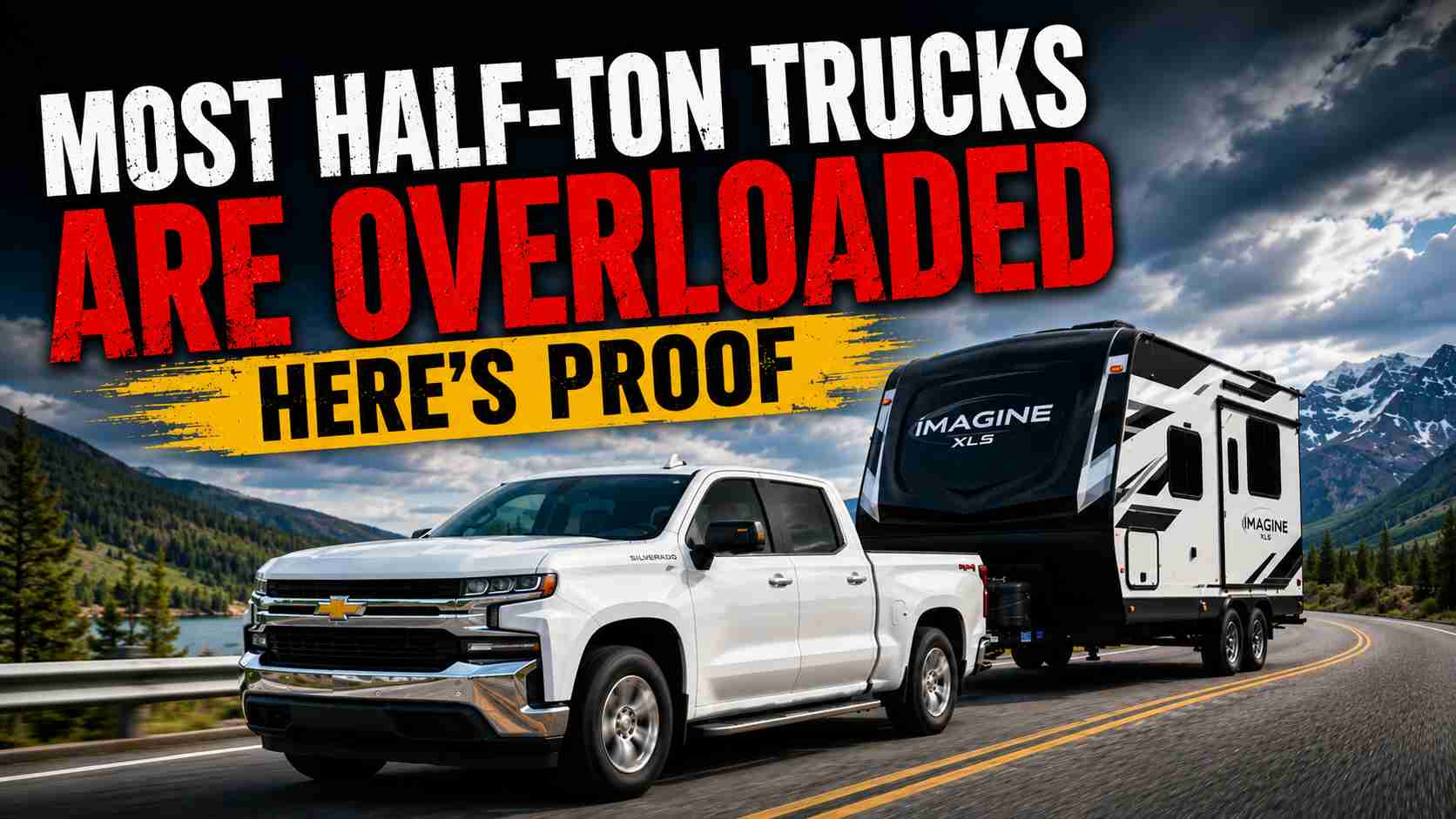
Most half-ton trucks pulling travel trailers marketed as “half-ton compatible” are operating over their certified payload capacity. The math on a typical crew cab configuration produces a negative margin before accounting for anything beyond two adults and minimal bed cargo.
The number on your door sticker is not a suggestion — it is a certified structural limit.
Why So Many Half-Tons Run Overloaded
Nobody buys a truck expecting it to be the wrong tool for the job. But across the country, half-ton trucks are routinely loaded beyond their certified payload limits — not by reckless drivers, but by owners who checked the tow rating, looked up the trailer’s dry weight, and concluded everything was fine.
The tow rating is not the limit that fails first. Payload is. And the overwhelming majority of half-ton buyers have never looked at the one number that actually determines whether their rig is legal and structurally safe.
The Truck: Chevrolet Silverado 1500 Crew Cab 4WD
The Silverado 1500 is one of the best-selling vehicles in North America. Most buyers choose crew cab, four-wheel drive, and a mid-to-upper trim level. Those choices carry a cost that never appears in a showroom window: significantly reduced payload capacity.
From the door sticker — not the brochure, not the manufacturer website, not the tow guide:
- GVWR: 7,100 lbs
- Curb weight: 5,560 lbs
- Certified payload capacity: 1,540 lbs
That 1,540-lb figure is what the truck’s chassis, suspension, and frame are rated to carry. It includes tongue weight from any trailer. It includes every person, every piece of gear, and everything loaded into the bed.
A base 2WD regular cab Silverado can carry over 2,200 lbs. The crew cab 4WD configuration most buyers choose carries roughly 600 lbs less before the trailer is even connected. That gap is the options package — the heavier cab, the 4WD drivetrain, the sunroof, the larger wheels. Every pound of added truck is a pound subtracted from payload.
The Trailer: Grand Design Imagine XLS 21BHE
The Imagine XLS is explicitly marketed as a half-ton compatible travel trailer. It is a reasonable mid-size family unit — two slides, a bunkhouse, dedicated sleeping areas — priced and positioned for the half-ton buyer who wants a full-featured trailer without stepping into heavier territory.
From the manufacturer’s specification sheet:
- Dry weight: 5,226 lbs
- GVWR: 7,700 lbs
- Tongue weight (dry): approximately 700 lbs
That 700-lb dry tongue weight looks manageable against a 1,540-lb payload budget. It looks within reach. It is not the number that matters.
Dry weight does not equal loaded weight. It never does.
Imagine XLS 21BHE: Dry vs Loaded Weight
A travel trailer leaves the factory empty. No water in the fresh tank. No food in the cabinets. No clothing, no tools, no bedding, no equipment in the pass-through storage. The dry weight is a factory baseline, not a travel weight.
Loaded trailers routinely exceed their dry weight by 15 to 30 percent. A 5,226-lb dry trailer carrying a family for a week can reach 6,500 to 6,800 lbs without approaching the 7,700-lb GVWR ceiling. That is a realistic, conservative loading scenario — and it is nowhere near the dry spec number used to market the trailer.
Every pound added to the trailer increases the tongue weight proportionally. The 700-lb dry tongue weight becomes something else entirely once the trailer is stocked and loaded.
Tongue Weight: The 12–15% Rule
Tongue weight should run between 12 and 15 percent of the loaded trailer weight. At the low end, trailer sway risk increases. At 15 percent, the trailer is properly loaded and the hitch geometry is working as intended.
At a loaded trailer weight of 7,700 lbs — the GVWR — the math is:
- 12% tongue weight: 924 lbs
- 15% tongue weight: 1,155 lbs
Use 15 percent. It represents proper loading and the honest upper bound for this calculation. If your actual loaded trailer weight is below GVWR, recalculate at that number — but do not assume dry weight is your loaded weight.
Silverado 1500 + Imagine XLS 21BHE: Payload Math
| Item | Weight (lbs) |
| Truck Payload Capacity (door sticker — not brochure) | 1,540 |
| minus Driver + Passenger | minus 360 |
| minus Gear / cargo in truck bed | minus 150 |
| minus Tongue weight (15% of loaded trailer weight) | minus 1,155 |
| **= Remaining Payload Margin** | **-125 lbs** |
Over the Certified Payload Limit
This configuration is 125 lbs over the certified payload limit.
One of the most popular trucks in the country. A trailer explicitly marketed for half-ton use. Two adults, modest bed cargo, and tongue weight loaded to the recommended 15 percent. Over capacity.
Add a toolbox, a receiver-mounted bike rack, a third passenger, or a dog — the deficit grows. If the trailer carries closer to its full GVWR, the tongue weight climbs and the margin deteriorates faster. The scenario above is not a worst-case. It is the median.
This is why the claim holds up: it is not that some half-ton owners are overloaded. It is that most half-ton owners, in typical crew cab 4WD configurations paired with trailers the industry markets as compatible, are operating beyond their door sticker payload limit every time they pull out of the driveway. For a documented case, see this real example of an F-150 overloaded by 1,200 lbs.
If you’re wondering where your truck would land in this calculation, don’t guess.
Not sure if your truck is within safe limits? Towing Limit Pro helps you verify your real setup using your actual payload sticker, passengers, cargo, and trailer numbers.
- Remaining payload (what you actually have left)
- Realistic tongue weight estimate (loaded, not brochure)
- GVWR margin + a clear safety buffer
- Risk-zone warning if your setup is pushing limits
Tip: Use your truck’s yellow door sticker payload for the most accurate result.
Verdict: Overloaded by Any Realistic Measure
This combination — Silverado 1500 Crew Cab 4WD paired with the Grand Design Imagine XLS 21BHE loaded to realistic travel weight — is overloaded by any objective measure. The door sticker says 1,540 lbs. The actual chassis load exceeds that figure before anything beyond two adults and 150 lbs of bed cargo is factored in.
The tow rating is not the issue. The GCWR is not the issue. The payload ceiling on the door sticker is the number that gets crossed first, and it is crossed routinely by owners who read the marketing materials, ran the tow rating comparison, and assumed they were within spec. A 3/4-ton truck in this same scenario — with a typical door sticker payload of 2,200 to 2,800 lbs — carries this load within margin and has room to spare. The typical crew cab half-ton most buyers own does not.
Know your real margin before you hook up.
Most half-ton trucks hit their payload limit long before they hit their tow rating limit — and most owners don’t realize it until they’re already committed. Verify your exact setup and know where you stand.
- Remaining payload (your real limit)
- Realistic tongue weight (loaded)
- GVWR margin + safety buffer
- Clear risk-zone indicator
Best results: use your yellow door-sticker payload number and your loaded trailer estimate (not dry weight).
Frequently Asked Questions
Why does my tow rating say 10,000 lbs but my truck is still over the limit at a 7,700-lb trailer?
Tow rating and payload capacity are two separate limits measured in completely different ways. Tow rating reflects engine, transmission, and braking capability — how heavy a trailer the drivetrain can move. Payload capacity is a structural limit on the chassis, frame, springs, and axles — how much total weight can bear down on the truck. A half-ton can have a 10,000-lb tow rating and a 1,540-lb payload limit simultaneously. Once tongue weight plus passengers plus bed cargo exceeds the payload figure on the door sticker, the structural limit is breached regardless of what the tow rating says. Payload is the limit that fails first in most real towing scenarios.
What is the difference between dry weight and loaded weight, and which one should I use for calculations?
Dry weight is the trailer as it comes off the assembly line — no water, no supplies, no personal gear of any kind. Loaded weight is what the trailer actually scales at when you leave for a trip. For most travel trailers, loaded weight runs 15 to 30 percent above dry weight once fresh water, food, clothing, tools, and equipment are added. A 5,226-lb dry trailer can easily reach 6,500 to 6,800 lbs under typical family loading. Always calculate tongue weight from your estimated loaded weight. If you are not sure what your trailer weighs loaded, use the GVWR as the upper-bound figure for planning purposes — that is what the trailer is certified to carry at maximum.
Does my door sticker payload number change if I add accessories or modify my truck?
The number printed on the door sticker is fixed at the time of manufacture, but your actual remaining payload decreases any time you add weight to the truck. Aftermarket bumpers, bed liners, toolboxes, leveling kits, and upgraded wheels all add curb weight that was not present when the sticker was printed. The payload figure represents the difference between GVWR and the as-built curb weight at the factory. Every accessory added after that point reduces your real-world payload margin — the sticker does not update, but the math does. Weigh your truck as currently configured if you want the accurate number.
How does tongue weight count against my payload capacity?
Tongue weight is the downward force the trailer hitch applies to the truck's frame through the hitch receiver. Because that load physically presses down on the rear of the truck, it is included in the total weight the chassis must support — exactly like cargo in the bed. At 15 percent of a 7,700-lb loaded trailer, that is 1,155 lbs acting on the truck's rear axle before a single person is seated. Tongue weight is not a separate budget from payload. It is payload, and it is often the single largest item in the calculation.
Can any half-ton truck tow this trailer safely and within spec?
A half-ton truck with a high payload specification — typically a regular cab, 2WD, minimal-options work configuration — may carry a door sticker payload of 1,900 to 2,200 lbs. In that configuration, the same math could produce a slim positive margin depending on actual loaded tongue weight. But that is not the truck most buyers purchase. The crew cab, 4WD, fully optioned half-ton that dominates retail sales typically carries 1,400 to 1,600 lbs of payload. Verify your specific door sticker before concluding your truck is an exception to the pattern. The sticker is the only number that is authoritative for your specific truck.