
Quick Answer
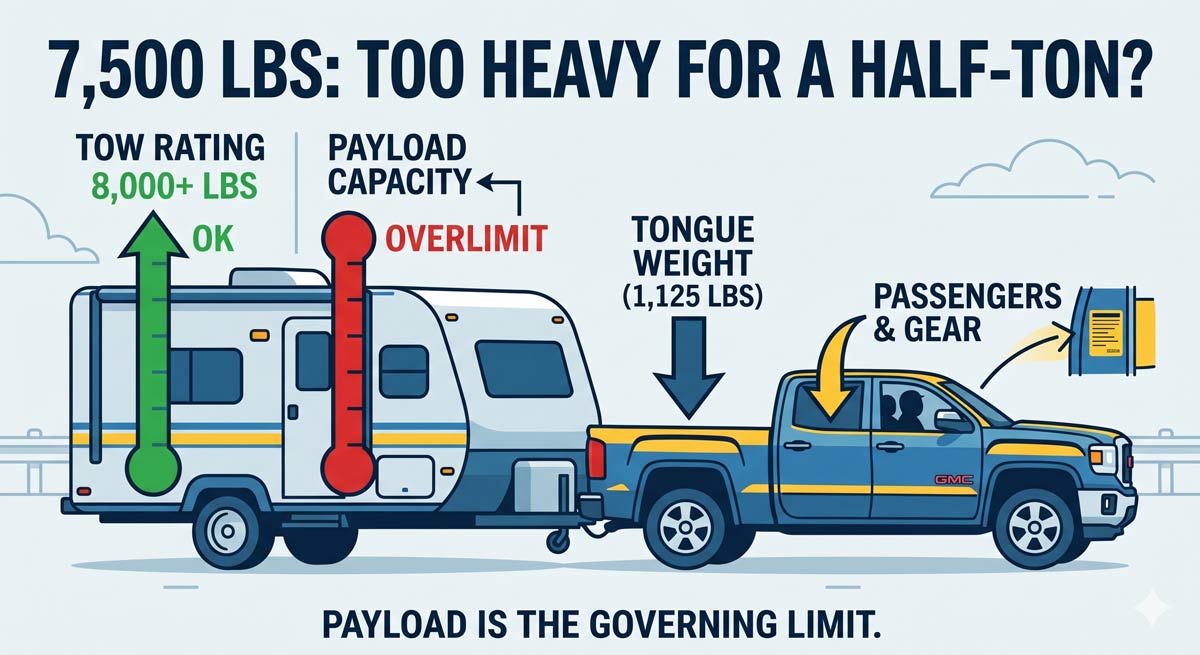
For most half-ton configurations, a loaded trailer at 7,500 lbs sits at or beyond the practical payload limit of the truck — not the tow rating, the payload. Whether it’s “too heavy” depends entirely on what your door sticker says, not what the brochure advertises.
A 7,500 lb trailer is manageable on paper. On the scale, it often isn’t.
Why a 7,500 lb Trailer Looks Safe on Paper
Truck buyers walk out of dealerships convinced their half-ton can handle anything under 10,000 lbs. The tow rating says so. The sales sheet says so. Then the scale at the weigh station says something different.
A 7,500 lb trailer is not an extreme number. It’s a mid-size travel trailer, a realistic load for a truck that was sold specifically on its towing capability. But tow ratings are not the governing limit in real-world towing. Payload is — and for half-tons, payload is where the math collapses.
The Truck: GMC Sierra 1500 SLT
For this calculation, we’re using a 2024 GMC Sierra 1500 Crew Cab Short Bed SLT 4WD with the 5.3L V8 — a common, mid-trim configuration that represents what most buyers actually drive off the lot.
Specs from the door sticker — not the brochure:
- GVWR: 7,100 lbs
- Curb weight: 5,560 lbs
- Payload capacity (door sticker): 1,540 lbs
That 1,540 lbs sounds workable. It won’t be by the end of this calculation.
One important note: payload varies by trim level, cab configuration, bed length, and installed options. The only number that matters is the yellow sticker on your driver’s door jamb. Every truck is different. Never use a brochure figure or a dealer quote — they are not your truck’s number.
The Trailer: Keystone Cougar 22MLS
The trailer in question: a Keystone Cougar 22MLS — a travel trailer marketed squarely at the half-ton segment.
- Dry weight: 5,890 lbs
- GVWR: 7,995 lbs
- Dry tongue weight: approximately 884 lbs (15% of dry trailer weight)
These are manufacturer-published figures. They represent an empty trailer — no water, no gear, no food, no supplies, no anything.
That is never how you tow.
From Dry Weight to Real Loaded Weight
Dry weight is the factory floor weight. The moment you fill the fresh water tank, load the kitchen, pack the clothing, add the bikes, and throw in the gear bag, you’re adding hundreds — sometimes well over a thousand — pounds to that number.
Loaded trailers routinely exceed their dry weight by 15 to 30 percent. A trailer with a 5,890 lb dry weight could realistically weigh between 6,800 and 7,650 lbs on the road. For this calculation, we’ll use 7,500 lbs as the loaded weight — a reasonable mid-range figure for how this trailer actually gets used on a trip.
That number sits comfortably below the 7,995 lb GVWR. It also sits well above the dry weight. And every pound of loaded trailer weight drives the tongue weight higher.
Tongue Weight on a 7,500 lb Trailer
The standard for tongue weight is 12 to 15 percent of the loaded trailer weight. For stability, most towing professionals recommend staying near the higher end of that range. At 15%, the math is direct:
> 7,500 lbs × 0.15 = 1,125 lbs of tongue weight
That 1,125 lbs sits entirely within your truck’s payload capacity. It does not come out of the tow rating. It comes out of the same 1,540 lbs that has to cover the driver, the passenger, the cargo in the bed, and every other pound the truck carries before it moves.
Sierra 1500 Payload Math at 7,500 lbs
| Item | Weight (lbs) |
| Truck Payload Capacity (door sticker — not brochure) | 1,540 |
| minus Driver + Passenger | minus 340 |
| minus Gear / cargo in truck bed | minus 150 |
| minus Tongue weight (15% of loaded trailer weight at 7,500 lbs) | minus 1,125 |
| **= Remaining Payload Margin** | **-75 lbs** |
A Deficit, Not a Margin
That is not a margin. That is a deficit.
Before this Sierra 1500 leaves the driveway — with two average-weight adults and a modest 150 lbs of gear in the bed — the truck is already 75 lbs over its payload capacity. And this is with a loaded trailer weight of 7,500 lbs. Not the GVWR. Not a worst-case scenario. A realistic towing day.
There is no buffer. There is no room to adjust. The truck is structurally and legally over its payload limit before the trailer has moved an inch. Swap in a heavier passenger, add a passenger in the back seat, or bring more gear, and the deficit grows further.
If you’re wondering where your truck would land in this calculation, don’t guess.
Not sure if your truck is within safe limits? Towing Limit Pro helps you verify your real setup using your actual payload sticker, passengers, cargo, and trailer numbers.
- Remaining payload (what you actually have left)
- Realistic tongue weight estimate (loaded, not brochure)
- GVWR margin + a clear safety buffer
- Risk-zone warning if your setup is pushing limits
Tip: Use your truck’s yellow door sticker payload for the most accurate result.
Verdict: Too Heavy for Most Half-Tons
Risky. A 7,500 lb loaded trailer exceeds what most half-ton trucks can safely carry in their payload budget once real-world occupants and cargo are accounted for. This Sierra 1500 SLT configuration ends up 75 lbs in the red before the engine starts. A lighter trim level or different cab configuration might show more payload headroom — some Sierra 1500s are rated closer to 1,800 lbs — but that variation is exactly why the door sticker is the only number that matters. Your neighbor’s truck, the brochure spec, and the dealer’s quote are irrelevant to your truck’s actual limit. The tow rating clears 7,500 lbs without issue. The payload doesn’t. These are two separate limits, and in real-world towing, payload runs out first.
Know Your Real Margin Before You Hook Up
Know your real margin before you hook up.
Most half-ton trucks hit their payload limit long before they hit their tow rating limit — and most owners don’t realize it until they’re already committed. Verify your exact setup and know where you stand.
- Remaining payload (your real limit)
- Realistic tongue weight (loaded)
- GVWR margin + safety buffer
- Clear risk-zone indicator
Best results: use your yellow door-sticker payload number and your loaded trailer estimate (not dry weight).
FAQs
Is 7,500 lbs within a half-ton's tow rating?
Usually, yes. Most half-ton trucks are rated to tow between 8,000 and 13,000 lbs depending on configuration. But tow rating is not the governing limit for real-world towing safety — payload is. A truck can be rated to tow 10,000 lbs while only having 1,500 lbs of payload capacity. The tongue weight, passengers, and bed cargo all have to fit within that payload number regardless of the tow rating. These are two independent limits, and crossing one while clearing the other still means you're overloaded.
What's the difference between tow rating and payload capacity?
Tow rating is the maximum weight the truck can pull behind it. Payload capacity is the maximum weight the truck can carry — in the bed, in the cab, and from the tongue of a trailer. Tongue weight from a trailer counts against payload, not against tow rating. This is the most common misunderstanding in half-ton towing, and it's the reason trucks that clear their tow rating by thousands of pounds can still be over their payload limit before the trip starts.
Why doesn't the trailer's dry weight represent what I'm actually towing?
Dry weight is the trailer as it leaves the factory — empty, with nothing loaded inside. The moment you prepare a trailer for a trip, that number climbs. Fresh water alone can add over 200 lbs. Add food, gear, clothing, tools, and supplies, and a trailer with a 5,890 lb dry weight can easily reach 7,000 to 7,500 lbs before you leave the driveway. Because tongue weight is calculated as a percentage of the loaded trailer weight, using dry weight in that calculation produces a number that is significantly lower than what your truck is actually supporting.
Does the number of passengers affect how much trailer I can tow?
Yes, directly. Every person in the cab counts against the truck's payload before the trailer is even factored in. Two adults at 170 lbs each removes 340 lbs from the payload ceiling immediately. A third passenger in the back seat, child safety seats, or additional luggage inside the cab tightens the margin further. Payload is a total weight budget for everything the truck carries — people, gear, and tongue weight together. The calculation doesn't separate them.
What are the real consequences of exceeding payload capacity while towing?
Overloading payload affects braking distance, suspension geometry, steering response, and tire load ratings simultaneously. A truck that feels stable at highway speed may be dangerously slow to stop in an emergency situation. Beyond safety, exceeding the payload rating while towing can void manufacturer warranty coverage on suspension and related components if damage occurs. The payload sticker is a structural and legal limit, not a conservative suggestion — and exceeding it while pulling a 7,500 lb trailer compounds the consequences at every level.