
Quick Answer
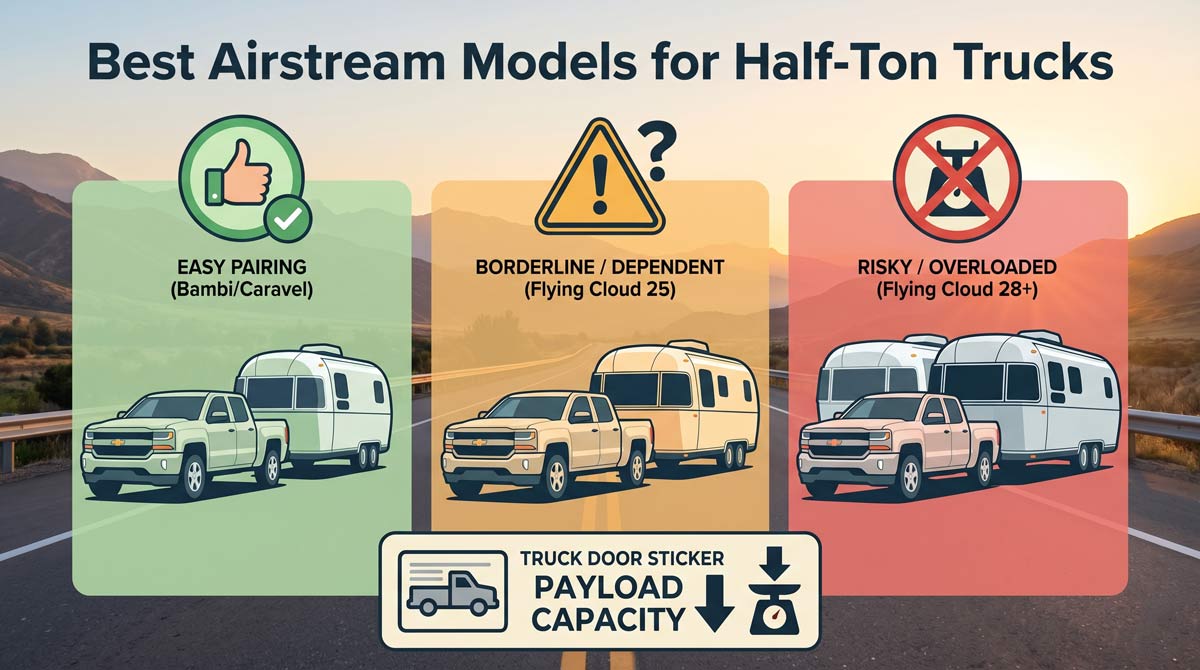
The Airstream Bambi and Caravel fall within reach for most half-ton trucks. The Flying Cloud 25FB is borderline. The Flying Cloud 28RB and heavier models will exceed payload budgets on most half-ton configurations before the trip starts.
Your truck’s tow rating will clear most Airstreams. Your payload capacity is the number that actually determines which ones you can legally tow.
The Airstream Brand Has a Half-Ton Reputation — But That Reputation Belongs to Specific Models
Every year, buyers match a half-ton truck to an Airstream using the manufacturer tow rating and walk away convinced the math works. The tow rating does work. The payload is where the calculation breaks down. A trailer that weighs 7,600 lbs at GVWR is well within a half-ton’s tow rating — and it can still overload a half-ton truck by 400 lbs once tongue weight, passengers, and cargo are factored in.
Airstream’s aluminum construction is a genuine advantage over comparable fiberglass trailers at the same length. But aluminum doesn’t make every Airstream a half-ton trailer. It makes the short ones viable and the long ones risky.
The Truck: Silverado 1500 LT
The calculations in this article use a 2023 Chevrolet Silverado 1500 LT, Crew Cab, 4WD, 5.3L V8. All figures come from the door sticker — not from Chevrolet’s website, brochures, or any third-party database. The door sticker is the only number that applies to your specific truck.
- GVWR: 7,100 lbs
- Curb weight: 5,420 lbs
- Payload capacity (door sticker): 1,680 lbs
Silverado 1500 payload varies considerably by configuration. A different cab size, drivetrain, or option package can shift payload by 200–400 lbs in either direction. The only number that matters for your truck is the one printed on your door sticker.
Trailer Specs: Airstream Flying Cloud 25FB
This article uses the Airstream Flying Cloud 25FB as the primary example — it sits in the middle of Airstream’s lineup and is the model most frequently paired with half-ton trucks by buyers who assume the brand name guarantees compatibility.
- Dry weight: 6,174 lbs
- GVWR: 7,600 lbs
- Tongue weight (dry, per Airstream): 768 lbs
Dry weight does not equal loaded weight. The 6,174 lb figure is the trailer as it ships from the factory — no water in the tanks, no food, no gear, no clothing. That number increases substantially the moment the trailer is loaded for actual use.
Flying Cloud 25FB: Dry vs Loaded Weight
Loaded trailers routinely exceed their published dry weight by 15–30%. For a Flying Cloud 25FB with a 6,174 lb dry weight, a realistic loaded weight for a weekend trip falls in the 7,100–7,400 lb range — approaching GVWR. This article uses 7,200 lbs as the loaded weight assumption: conservative for a full trip, realistic for two people with normal gear.
The figure Airstream dealers typically quote — and the figure that appears in online tow guides — is the dry weight. It is the least accurate number you can use when calculating whether your specific truck can tow the trailer.
Airstream Tongue Weight: The 12–15% Rule
Tongue weight should be 12–15% of your loaded trailer weight. Using 15% provides the most conservative and therefore most protective estimate.
15% of 7,200 lbs = 1,080 lbs
Airstream’s published dry tongue weight for the Flying Cloud 25FB is 768 lbs. That figure applies to an empty trailer. Once the trailer is loaded to the 7,200 lb assumption used here, tongue weight rises in proportion. Using the dry tongue weight figure in your payload calculation is one of the most common ways half-ton owners underestimate the actual load on their truck.
Silverado 1500 + Airstream Flying Cloud 25FB: Payload Math
| Item | Weight (lbs) |
| Truck Payload Capacity (door sticker — not brochure) | 1,680 |
| minus Driver + Passenger | minus 340 |
| minus Gear / cargo in truck bed | minus 150 |
| minus Tongue weight (15% of loaded trailer weight) | minus 1,080 |
| **= Remaining Payload Margin** | **110 lbs** |
How Thin the 25FB Margin Gets
110 lbs. That is the margin remaining after two passengers, modest bed cargo, and the tongue weight from a conservatively loaded Flying Cloud 25FB. 110 lbs is one heavy duffel bag in the bed away from zero. It is one additional passenger away from negative.
If your Silverado 1500 carries less than 1,680 lbs on its door sticker — and many do — this margin does not exist before the calculation even starts.
If you’re wondering where your truck would land in this calculation, don’t guess.
Not sure if your truck is within safe limits? Towing Limit Pro helps you verify your real setup using your actual payload sticker, passengers, cargo, and trailer numbers.
- Remaining payload (what you actually have left)
- Realistic tongue weight estimate (loaded, not brochure)
- GVWR margin + a clear safety buffer
- Risk-zone warning if your setup is pushing limits
Tip: Use your truck’s yellow door sticker payload for the most accurate result.
Verdict: Which Airstreams Fit a Half-Ton
Here is how the primary Airstream models compare against a Silverado 1500 at 1,680 lbs payload, using the same calculation method applied above.
The Bambi 22FB (GVWR: 5,500 lbs; loaded tongue weight at 15%: approximately 765 lbs) leaves roughly 425 lbs of margin after two passengers and 150 lbs of bed cargo. That is workable for most half-ton configurations and provides real buffer against real-world loading variance. The Caravel 22FB lands in nearly the same position — slightly different dimensions, essentially the same payload math. These are the two models where the Airstream half-ton reputation is earned.
The Flying Cloud 25FB, as calculated above, leaves 110 lbs. Borderline. Configuration-dependent. High sensitivity to any deviation from the assumed numbers — a heavier passenger, more gear, or a truck with less than 1,680 lbs payload, and the margin is gone.
The Flying Cloud 28RB (GVWR: 8,800 lbs; loaded tongue weight at 15%: approximately 1,170 lbs) leaves roughly 20 lbs after the same two passengers and bed cargo. That is not a margin. That is the edge of the calculation, and it assumes the trailer loads precisely to estimate. Any additional weight makes the math negative.
The Airstream brand is not synonymous with half-ton compatibility. The Bambi and Caravel earn that description. The Flying Cloud 25 requires careful configuration matching. The Flying Cloud 28 and heavier models do not fit within most half-ton payload budgets. The math makes that determination — not the brand name, not the aluminum construction, and not the tow rating.
Know your real margin before you hook up.
Most half-ton trucks hit their payload limit long before they hit their tow rating limit — and most owners don’t realize it until they’re already committed. Verify your exact setup and know where you stand.
- Remaining payload (your real limit)
- Realistic tongue weight (loaded)
- GVWR margin + safety buffer
- Clear risk-zone indicator
Best results: use your yellow door-sticker payload number and your loaded trailer estimate (not dry weight).
FAQs
Can any half-ton truck tow an Airstream?
Some half-ton trucks can tow some Airstream models within spec — but not all trucks and not all models. The Bambi and Caravel series are the strongest candidates because their lower GVWR keeps tongue weight within most half-ton payload budgets. Larger models like the Flying Cloud 28RB exceed the payload capacity of most half-ton trucks before a single passenger is added. The determining variable is your truck's specific payload figure from the door sticker, not the model's general published tow rating.
What's the difference between Airstream's dry weight and the actual loaded weight?
Dry weight is what Airstream publishes — the trailer as it ships, with empty tanks and no cargo. Loaded weight is what the trailer actually weighs on a trip. For the Flying Cloud 25FB, that gap can be 1,000–1,300 lbs once water tanks, food, supplies, and personal items are added. Loaded trailers routinely exceed their dry weight by 15–30%. Using dry weight to estimate tongue weight and payload consumption produces a number that is significantly too low — and that gap is where overloading happens.
Why does payload matter more than tow rating when towing an Airstream?
Tow rating is the maximum weight a truck's drivetrain is rated to pull. Payload is the maximum additional weight the truck's chassis, axles, and suspension can carry — which includes passengers, cargo in the bed, and the tongue weight transferred from the trailer hitch. For most half-ton trucks paired with mid-size Airstream models, the tow rating is not the binding constraint. Payload is. A truck can be fully within its tow rating and still be axle-overloaded if payload has been consumed by tongue weight, passengers, and gear.
How do I calculate realistic tongue weight for an Airstream trailer?
Use 12–15% of your loaded trailer weight — not the dry tongue weight Airstream publishes in its spec sheets. For a Flying Cloud 25FB loaded to 7,200 lbs, the correct tongue weight estimate is 864–1,080 lbs depending on which end of the range you apply. Airstream's published dry figure of 768 lbs is accurate for an empty trailer and unreliable for a loaded one. The difference between these two numbers is often what pushes a half-ton configuration into overloaded territory.
Which Airstream models fit a half-ton truck with less than 1,500 lbs of payload?
Below 1,500 lbs of payload, the Bambi 19 and Bambi 16 become the realistic targets. Their lower GVWRs produce lower tongue weights at 15%, preserving enough margin for two passengers and moderate cargo. For trucks with payload under 1,400 lbs, every pound of bed cargo and every additional occupant counts toward a fixed limit. Verify the full calculation for your specific truck and trailer configuration before committing — the margin at this payload level is narrow enough that no assumption holds without the math behind it.