
Quick Answer
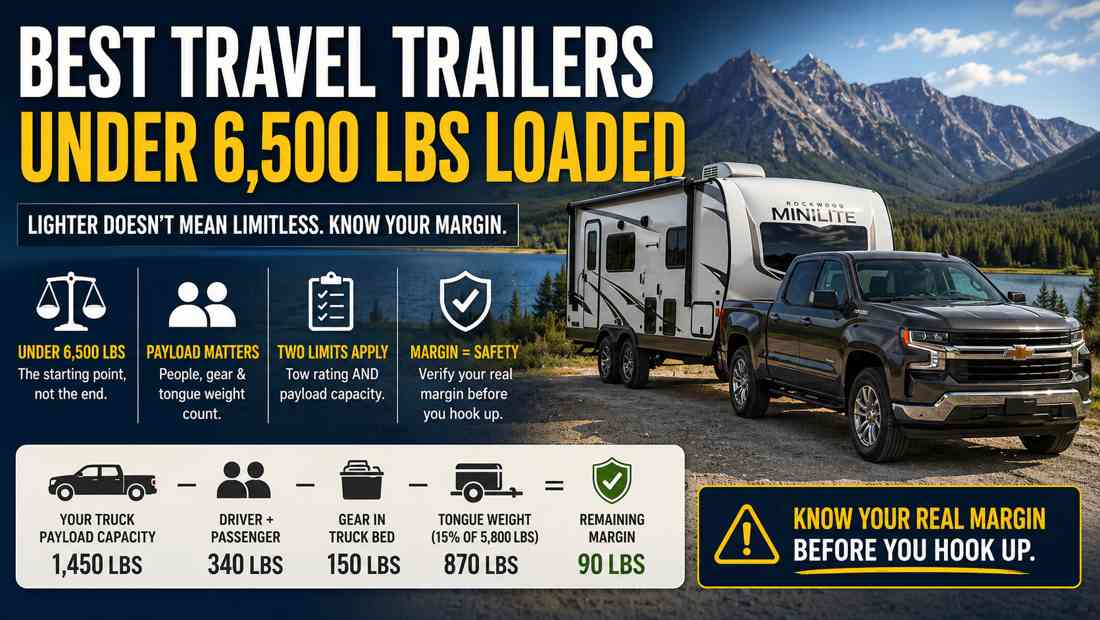
Travel trailers with a loaded weight under 6,500 lbs represent the most payload-compatible segment for half-ton trucks — but the weight class alone does not make a combination safe. Tongue weight from a 6,400 lb loaded trailer still consumes 960 lbs of your truck’s payload capacity, and most half-ton configurations have less remaining margin than buyers assume. “Under 6,500 lbs loaded” is the starting point for the math, not the end of it.
The Trailer You Thought Was Safe
You did the right thing. You shopped for a lighter trailer. You stayed under 6,500 lbs. You picked something marketed specifically at half-ton owners. And now you’re wondering why the numbers still feel tight.
Here’s the part the brochure skipped: tow rating and payload capacity are two different limits, both apply simultaneously, and choosing a lighter trailer does not automatically solve the payload problem.
Truck Specs: Start With the Door Sticker
For this walkthrough, we’re using a 2024 Chevrolet Silverado 1500 with the 5.3L V8 in LT trim — one of the most common half-ton configurations in the travel trailer market.
These numbers come from the door sticker, not the brochure. The brochure publishes the highest possible payload across all configurations of that model. Your door sticker reflects the actual truck in your driveway, with its specific options, trim level, and as-built weight. Those numbers are different. Always use the sticker.
- GVWR: 7,100 lbs
- Curb weight: 4,650 lbs
- Payload capacity: 1,450 lbs
That 1,450 lbs covers everything — passengers, gear in the bed, and tongue weight from the trailer. There is no separate towing bucket. It all comes from the same number.
Trailer Specs: A Realistic Under-6,500 lb Unit
We’re using a Forest River Rockwood Mini Lite 2109S — a mid-size travel trailer actively marketed to half-ton owners and a frequent entry on “best lightweight trailer” lists.
- Dry weight (UVW): 4,244 lbs
- GVWR: 6,195 lbs
- Realistic loaded estimate: 5,800 lbs
The 5,800 lb figure represents a fully packed trailer with water, gear, food, and supplies — not the GVWR ceiling, not the dry weight floor. Dry weight does not equal loaded weight, and planning to the factory dry weight is one of the most common errors in this process.
Dry vs. Loaded: The Gap You’re Actually Hauling
A trailer at 4,244 lbs dry does not tow at 4,244 lbs. Fresh water alone weighs 8.34 lbs per gallon. Fill a 40-gallon tank and you’ve added 334 lbs before a single bag is loaded. Add clothing for the week, food, cooking gear, tools, bikes on a rack, and kids’ supplies, and you’re looking at 1,200–1,800 lbs of additional weight over the factory dry figure.
Loaded trailers routinely exceed dry weight by 15–30%. For this trailer, that puts realistic loaded weight between 4,880 and 5,517 lbs at the conservative end. Our 5,800 lb scenario sits above that range — representing a fully equipped trip, not a dry run. Plan for what you’ll actually tow, not what the spec sheet shows fresh off the factory floor.
Tongue Weight: The Number That Lands on Your Truck
Tongue weight is the downward force the trailer hitch point applies to the back of your truck. It is not distributed across the trailer axles — it sits directly on your truck’s hitch receiver and counts against payload capacity.
The standard planning range is 12–15% of loaded trailer weight. We calculate at 15% for conservative, real-world planning.
5,800 lbs × 0.15 = 870 lbs of tongue weight
That 870 lbs is already more than half the Silverado’s 1,450 lb payload capacity — before passengers, before a single item in the bed.
The Real Math: Subtraction, Not Estimation
| Item | Weight (lbs) |
| Truck Payload Capacity (door sticker — not brochure) | 1,450 |
| minus Driver + Passenger | minus 340 |
| minus Gear / cargo in truck bed | minus 150 |
| minus Tongue weight (15% of loaded trailer weight) | minus 870 |
| = Remaining Payload Margin | 90 lbs |
How Much Margin Is Left
90 lbs.
That is the entire buffer between legal operation and an overloaded truck — on a trailer specifically marketed as half-ton compatible, paired with a properly configured Silverado. A heavier second passenger, an extra water jug, or a toolbox in the bed eliminates it entirely.
This is not a fringe scenario. This is what the math produces when you run real numbers on a common combination in this weight class.
If you’re wondering where your truck would land in this calculation, don’t guess.
Not sure if your truck is within safe limits? Towing Limit Pro helps you verify your real setup using your actual payload sticker, passengers, cargo, and trailer numbers.
- Remaining payload (what you actually have left)
- Realistic tongue weight estimate (loaded, not brochure)
- GVWR margin + a clear safety buffer
- Risk-zone warning if your setup is pushing limits
Tip: Use your truck’s yellow door sticker payload for the most accurate result.
Verdict: Borderline, Even Under 6,500 lbs
Borderline.
A 2024 Silverado 1500 towing a Rockwood Mini Lite 2109S at 5,800 lbs loaded clears the payload limit — but only by 90 lbs. That margin leaves no room for variation in passenger weight, cargo habits, or a heavier packing day. Half-ton trucks and trailers in this weight class can pair safely, but the outcome depends entirely on your specific door sticker payload and your honest loaded trailer estimate. “Under 6,500 lbs” is the right neighborhood to shop in. It is not a guarantee. Verify your margin before you sign, not after you hook up.
Know your real margin before you hook up.
Most half-ton trucks hit their payload limit long before they hit their tow rating limit — and most owners don’t realize it until they’re already committed. Verify your exact setup and know where you stand.
- Remaining payload (your real limit)
- Realistic tongue weight (loaded)
- GVWR margin + safety buffer
- Clear risk-zone indicator
Best results: use your yellow door-sticker payload number and your loaded trailer estimate (not dry weight).
Frequently Asked Questions
Does a lower GVWR guarantee a trailer is safe for a half-ton truck?
No. GVWR tells you the maximum weight the trailer is rated to carry. Whether your truck can handle it depends on your truck's payload capacity — from the door sticker — minus passengers, gear in the cab or bed, and tongue weight. A 5,500 lb GVWR trailer generates approximately 825 lbs of tongue weight at 15%. If your payload is 1,300 lbs and two adults are aboard, you're already near the ceiling before gear enters the equation.
Why do manufacturers label trailers "half-ton compatible" if the margin is this tight?
Because tow rating is the number they lead with — and most half-ton trucks are rated to tow 9,000–11,000 lbs. A 6,000 lb trailer clears that threshold easily. Payload capacity is a separate structural limit that manufacturers don't control and rarely promote. Both limits apply simultaneously. Tow rating confirms the trailer isn't too heavy for the hitch. Payload determines whether the tongue weight fits inside what the truck is actually built to carry.
What's the difference between dry weight and loaded weight, and which should I use for planning?
Dry weight, listed as UVW on the spec sheet, is the trailer as it leaves the factory — no water, no gear, no personal items. Loaded weight is what you'll actually tow. Always plan to a realistic loaded estimate: calculate water at 8.34 lbs per gallon, then add gear, food, and supplies. A 15–20% increase over dry weight is a practical minimum. If the math only works at dry weight, the combination doesn't work in the real world.
Can I increase my truck's payload capacity to make a tight combination work?
No. Payload capacity is a structural limit set at the factory and printed on the door sticker. Aftermarket suspension upgrades may reduce visible sag, but they do not change your GVWR or your legal payload limit. The only way to get more payload is to buy a truck that has a higher payload rating — verified on that specific truck's door sticker, not the brochure maximum for the model line.
What should I verify on the trailer before finalizing a purchase?
Confirm the GVWR, then calculate tongue weight at 15% of your realistic loaded weight — not the GVWR ceiling, not the dry weight. Check the fresh water tank capacity so you can account for full-tank weight. If a weight distribution hitch is required, note that it improves handling and reduces sag but does not increase your payload capacity. If you're within 150 lbs of your limit on a realistic loaded estimate, you're already too close to operate consistently within spec.