
Quick Answer
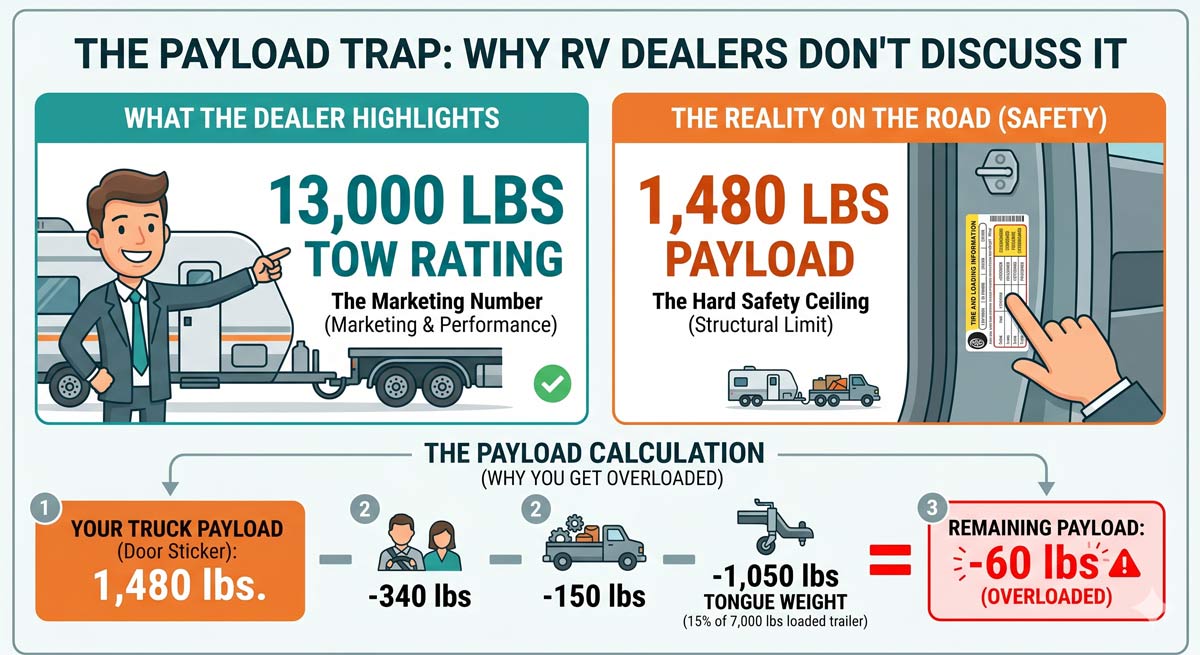
RV dealers sell against tow rating because it’s the bigger number. Payload — the number that actually determines whether your truck can safely pull a specific trailer with real people and real gear — almost never comes up on the sales floor. Payload is a hard ceiling certified by the manufacturer. Tow rating is a performance figure. Only one of them limits what you can safely hook up.
What the Salesperson Didn’t Mention
You walked into the dealership knowing your truck’s tow rating. The salesperson confirmed it, pointed at a trailer 500 pounds under that number, and called it a match. What nobody mentioned was the payload sticker on your driver’s door — and that’s not an accident.
RV dealers are not legally required to verify payload compatibility before completing a sale. They are, however, financially motivated to sell trailers. Those two facts explain almost everything about how the payload conversation goes: it doesn’t.
Tow rating is the number that appears in truck commercials and on window stickers. It sounds large. It sells products. Payload is the number on a yellow label inside your door jamb that tells you how much total weight your truck’s frame, axles, and springs can carry — passengers, cargo, and trailer tongue weight included. It is almost always smaller than buyers expect, and it almost never comes up until something goes wrong.
The Truck: F-150 XLT SuperCrew
For this walkthrough, we’re using a 2024 Ford F-150 XLT SuperCrew with the 3.5L EcoBoost — a common configuration for buyers stepping into RV towing and one frequently described as capable by dealers selling mid-size travel trailers.
Specs from the door sticker — not the brochure:
- GVWR: 7,050 lbs
- Curb weight: 5,570 lbs
- Payload capacity: 1,480 lbs
The payload figure comes from the Tire and Loading Information label on the driver’s door jamb. That number is specific to this truck’s exact build — cab style, bed length, engine, drivetrain, and installed options. The advertised payload range for the F-150 spans from roughly 1,300 to over 2,000 lbs depending on configuration. The number in a brochure reflects the full production spread. The only number that applies to your truck is the one on that door sticker. If your truck has a different build, run those specs instead.
The Trailer: A Half-Ton-Marketed Travel Trailer
The trailer in this scenario is a mid-size 26-foot travel trailer — the kind routinely marketed to half-ton buyers and sold with phrases like “half-ton compatible” or “light enough for most trucks.”
Specs from the manufacturer’s label:
- Dry weight: 5,840 lbs
- GVWR: 7,495 lbs
- Listed tongue weight: 825 lbs
Dry weight does not equal loaded weight. Dry weight is the trailer as it left the factory — no water in the tanks, no food in the kitchen, no gear in the storage bays, no clothing in the closets. Nobody tows a trailer in that condition. A trailer sold as a 5,840-lb unit will weigh considerably more by the time it reaches the highway.
From Lot Weight to Loaded Weight
A trailer’s dry weight is a floor, not an operational figure. Buyers routinely add 600 to 1,200 lbs of water, food, gear, tools, and personal items before departure. That is not unusual loading — that is standard use on any trip longer than an overnight.
Loaded trailers routinely exceed their dry weight by 15 to 30 percent. Applied to this trailer:
- Dry weight: 5,840 lbs
- 15% loading: +876 lbs → loaded estimate: 6,716 lbs
- 25% loading: +1,460 lbs → loaded estimate: 7,300 lbs
The GVWR of 7,495 lbs is the legal maximum. A loaded weight of 7,000 lbs — the center of that realistic range — is a reasonable working estimate for a trailer this size on a multi-day trip. That is the number that belongs in any honest payload calculation.
Tongue Weight: The 12–15% Rule
Tongue weight is the downward force the trailer’s coupler exerts on your hitch ball. Standard engineering guidance places tongue weight at 12 to 15 percent of the loaded trailer weight — not the dry weight, not the GVWR. Loaded weight.
At a loaded trailer weight of 7,000 lbs:
- 12% = 840 lbs
- 15% = 1,050 lbs
For this calculation, 15 percent is used — the upper end of the accepted range and the loading position that provides the best trailer stability under most conditions.
Tongue weight: 1,050 lbs.
The manufacturer’s listed tongue weight of 825 lbs is calculated from a dry, unloaded trailer. That figure is not relevant to how this trailer will actually behave on a trip. It is a spec sheet number, not a field number.
F-150 XLT Payload Math With a Loaded Trailer
| Item | Weight (lbs) |
| Truck Payload Capacity (door sticker — not brochure) | 1,480 |
| minus Driver + Passenger | minus 340 |
| minus Gear / cargo in truck bed | minus 150 |
| minus Tongue weight (15% of 7,000 lb loaded trailer) | minus 1,050 |
| = Remaining Payload Margin | **−60 lbs** |
Over Payload Before the First Trip
This truck is already 60 pounds over its certified payload limit — before a bag of ice, before a dog in the back seat, before the fresh water tank is filled. There is no margin left to work with. The math ran out before the trip started.
The dealer confirmed the truck could tow the trailer. The tow rating — 13,000 lbs — had nothing to do with what just happened. Payload was the binding constraint the entire time. It just never came up.
Even adjusting tongue weight down to 12 percent — a loading that requires careful weight distribution and a shorter, lighter trailer proportionally — the remaining margin is only 90 lbs. That assumes zero additional cab weight beyond two people and modest gear. One more passenger, a heavier cooler in the bed, or a slightly heavier load in the trailer shifts the number back into negative territory.
If you’re wondering where your truck would land in this calculation, don’t guess.
Not sure if your truck is within safe limits? Towing Limit Pro helps you verify your real setup using your actual payload sticker, passengers, cargo, and trailer numbers.
- Remaining payload (what you actually have left)
- Realistic tongue weight estimate (loaded, not brochure)
- GVWR margin + a clear safety buffer
- Risk-zone warning if your setup is pushing limits
Tip: Use your truck’s yellow door sticker payload for the most accurate result.
Verdict: The Dealer’s Match Doesn’t Pass
Risky. A 2024 F-150 XLT SuperCrew with 1,480 lbs of door sticker payload and a loaded 26-foot travel trailer produces a negative payload margin under standard real-world loading. This is not a close call on paper — the truck is structurally overloaded before the trip starts. A higher-payload F-150 configuration, a meaningfully lighter trailer, or a 3/4-ton platform are the only paths to a safe combination here. Running the numbers at 12 percent tongue weight produces a nominal positive margin, but that buffer disappears with any additional cab weight. This pairing should not be treated as borderline.
Know your real margin before you hook up.
Most half-ton trucks hit their payload limit long before they hit their tow rating limit — and most owners don’t realize it until they’re already committed. Verify your exact setup and know where you stand.
- Remaining payload (your real limit)
- Realistic tongue weight (loaded)
- GVWR margin + safety buffer
- Clear risk-zone indicator
Best results: use your yellow door-sticker payload number and your loaded trailer estimate (not dry weight).
FAQs
Why do RV dealers focus on tow rating instead of payload?
Tow rating is a larger number that creates the appearance of a broad match between a truck and a trailer. A half-ton rated to tow 13,000 lbs sounds capable of pulling almost anything on the lot. Payload capacity — typically 1,300 to 1,700 lbs on common half-ton builds — is a much tighter constraint that can eliminate trailers a buyer is actively considering. There is no legal requirement for dealers to confirm payload compatibility before completing a sale, and confirming it would frequently end the sale.
What is the actual difference between tow rating and payload capacity?
Tow rating is the maximum weight your hitch can pull under controlled conditions. Payload capacity is the total certified weight your truck's frame, springs, and axles can carry — passengers, cab cargo, and trailer tongue weight combined. You can be well under your tow rating and still be over payload, which is the more common failure mode for half-ton buyers towing mid-size travel trailers. Payload is the number that gets violated first and most often.
Does dry weight tell me what a trailer actually weighs when I tow it?
No. Dry weight reflects the trailer as shipped from the factory — empty tanks, no provisions, no gear. Real-world towing adds 600 to over 1,000 lbs depending on trip length and loading habits. That additional weight directly increases tongue weight, which directly competes with your truck's payload capacity. Tongue weight calculations that use dry weight instead of loaded weight will underestimate your actual payload consumption and produce a false sense of margin.
Where do I find my truck's real payload capacity — not the advertised range?
The only authoritative source is the Tire and Loading Information label on your driver's door jamb. It shows the payload specific to your truck's exact build. The payload figures in brochures, on manufacturer websites, or cited by dealers reflect the full production range for that model — they are not specific to your configuration. Two F-150s built the same year with different cab sizes, bed lengths, or option packages will have different payload numbers. Only the door sticker applies to your truck.
Can aftermarket suspension or a weight distribution hitch increase my payload capacity?
No. Aftermarket springs or leveling kits do not change your truck's certified GVWR or payload rating. A weight distribution hitch redistributes tongue weight more evenly across the tow vehicle's axles to improve ride and handling — it does not increase the total payload your truck is certified to carry. Your payload limit is a structural certification set at the factory and reflects the engineering limits of the entire platform, not just the rear springs. The number on the door sticker does not change based on what you bolt on afterward.