
Quick Answer
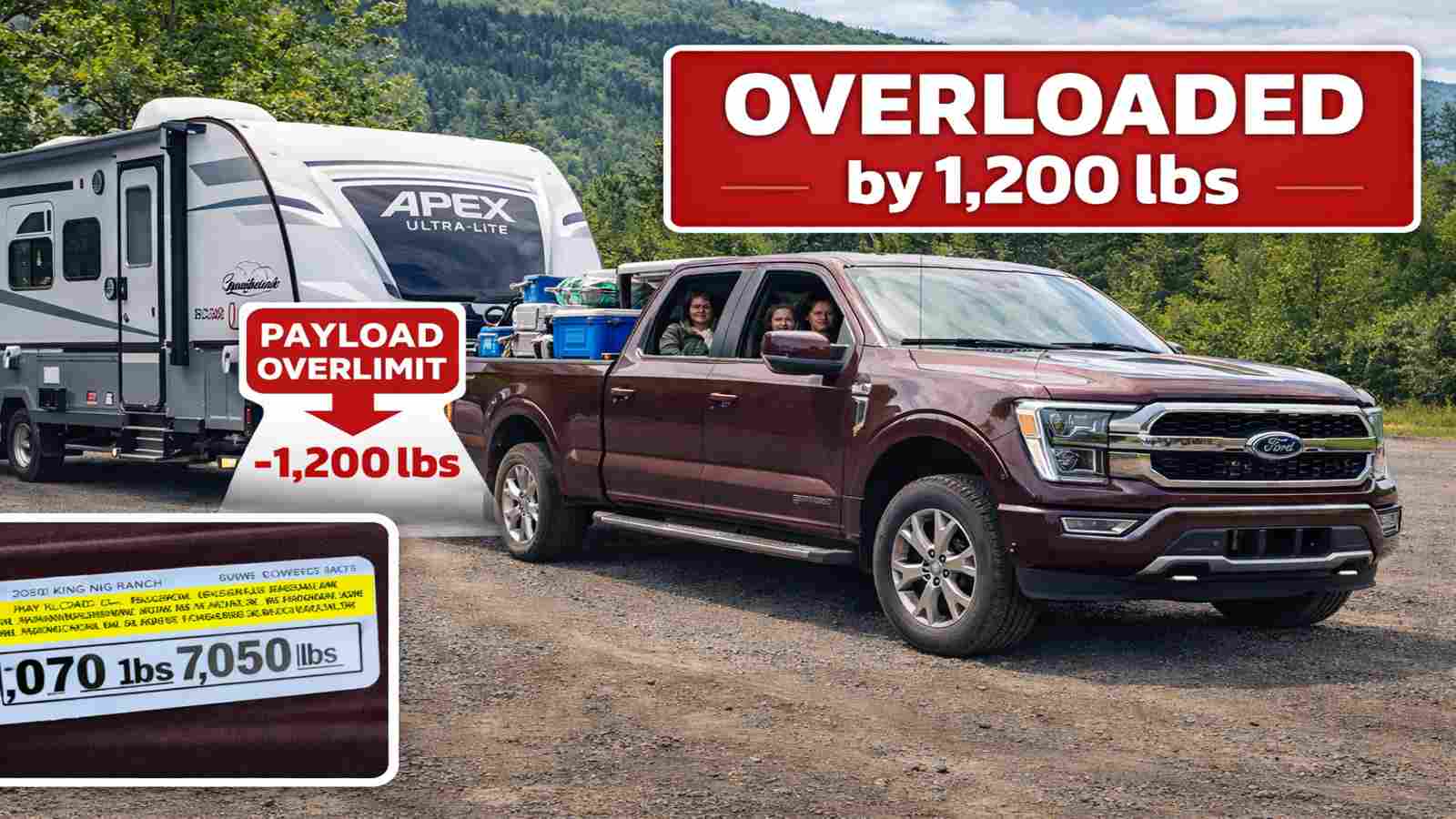
A 2022 Ford F-150 King Ranch SuperCrew 4×4 with the PowerBoost hybrid engine towed a Coachmen Apex 249RBS on a family camping trip — and exceeded its door sticker payload capacity by over 1,200 pounds. The truck’s tow rating was never the problem. Payload was.
The tow rating said yes. The payload sticker said absolutely not.
The Setup
Buying a loaded F-150 hybrid with a 12,700-pound tow rating feels like buying a margin of safety. A family of four, a mid-size travel trailer, and a summer vacation plan — this is one of the most common towing configurations on the road. It is also one of the most commonly overloaded.
Nobody checks the door sticker on a truck that can tow 12,000-plus pounds. That is the problem.
The Truck: F-150 King Ranch PowerBoost
The truck in this scenario is a 2022 Ford F-150 King Ranch SuperCrew 4×4 with the 3.5L PowerBoost V6 hybrid. This is a popular configuration — premium trim, full-time 4×4, and the hybrid powertrain for fuel economy on long hauls.
Here is what the door sticker says — not the brochure, not the spec sheet, the actual placard on the driver’s door jamb:
- GVWR: 7,050 lbs
- Curb weight: 5,980 lbs
- Payload capacity: 1,070 lbs
That last number is what matters. The PowerBoost hybrid system adds battery weight and motor weight. The King Ranch trim adds leather, sound deadening, and premium options throughout. The SuperCrew cab adds structural mass. The 4×4 drivetrain adds transfer case and front differential weight. By the time this truck is fully configured, there is 1,070 pounds of capacity between its curb weight and its maximum allowable loaded weight.
One thousand and seventy pounds. Not 2,000. Not 1,500. 1,070.
The Trailer: Coachmen Apex 249RBS
The trailer is a Coachmen Apex 249RBS — a popular family bunkhouse layout, regularly marketed as half-ton compatible.
From the manufacturer’s published specs:
- Dry weight: 5,212 lbs
- GVWR: 7,995 lbs
- Tongue weight (est. at 15% of loaded weight): up to 1,200 lbs
Important note: dry weight does not equal loaded weight. It never does.
Dry vs. Loaded Weight: The Gap Nobody Accounts For
The Apex 249RBS has a listed dry weight of 5,212 lbs and a GVWR of 7,995 lbs. That is a cargo capacity of nearly 2,800 pounds before the trailer exceeds its own limit.
A family of four packs for a week: full fresh water tank (approximately 360 lbs), food and coolers (150 lbs), clothing and personal gear (200 lbs), outdoor furniture, games, and kids’ equipment (400 lbs), kitchen supplies and tools (100 lbs). That is roughly 1,200 lbs of cargo without trying hard. Add the standard factory-installed options and dealer accessories that were never included in the published dry weight figure — house battery, propane, outdoor kitchen additions, bike rack — and loaded trailers routinely land 15–30% above their published dry weight, sometimes higher.
In this case, the Apex 249RBS arrived at the campground loaded at or near its GVWR: approximately 8,000 lbs.
Tongue Weight: Use Loaded Weight, Not Dry
Tongue weight should run between 12 and 15 percent of the total loaded trailer weight — not the dry weight figure, not a guess from the GVWR, but the actual weight the trailer is carrying when it rolls down the highway.
For this trailer loaded at 8,000 lbs:
> 15% × 8,000 = 1,200 lbs of tongue weight
That 1,200 pounds transfers directly onto the truck’s rear axle and counts entirely against payload capacity. Before a single person sits in the cab, before a single piece of gear goes in the bed, the tongue weight alone already exceeds the truck’s entire 1,070-lb payload budget by 130 pounds.
The family has not gotten in the truck yet.
Payload Math: King Ranch + Apex 249RBS
| Item | Weight (lbs) |
| Truck Payload Capacity (door sticker — not brochure) | 1,070 |
| minus Driver + 3 passengers | minus 620 |
| minus Gear / cargo in truck bed | minus 450 |
| minus Tongue weight (15% of 8,000 lb loaded trailer) | minus 1,200 |
| **= Remaining Payload Margin** | **-1,200 lbs** |
How Far Over Payload It Went
Negative 1,200 pounds.
Not 85 lbs over. Not a rounding error. Not a borderline call. The truck was carrying 1,200 pounds more than its door sticker permits. The rear suspension was compressed beyond design intent. Steering geometry was shifted. Braking distances lengthened. A weight distribution hitch can redistribute tongue weight across axles and reduce rear squat — but it cannot manufacture payload capacity that does not exist. The chassis, the tires, and the brakes were absorbing a load the truck was never rated to handle.
The driver looked at a 12,700-lb tow rating and a trailer under 8,000 lbs and concluded there was comfortable headroom. He was looking at the wrong number entirely.
If you’re wondering where your truck would land in this calculation, don’t guess.
Not sure if your truck is within safe limits? Towing Limit Pro helps you verify your real setup using your actual payload sticker, passengers, cargo, and trailer numbers.
- Remaining payload (what you actually have left)
- Realistic tongue weight estimate (loaded, not brochure)
- GVWR margin + a clear safety buffer
- Risk-zone warning if your setup is pushing limits
Tip: Use your truck’s yellow door sticker payload for the most accurate result.
Verdict: Risky, and No Hitch Fixes It
This is a risky configuration. The truck exceeded its door sticker payload by 1,200 lbs — a deficit so large that no field-adjustable modification resolves it. The weight distribution hitch does not fix it. Airing down the tires does not fix it. Removing the toolbox from the bed recovers maybe 80 lbs.
The viable paths forward are narrow: a different truck with a higher payload (a properly spec’d work-trim F-150 Regular Cab can exceed 2,200 lbs of payload from the same platform), a meaningfully lighter trailer, or a serious reduction in what gets loaded into both. Loading the Apex 249RBS to 70% of GVWR rather than 100% — approximately 5,600 lbs — drops tongue weight to around 840 lbs and changes the entire calculation. That still leaves a tight margin, but a workable one.
The binding constraint here was never the tow rating. It was the payload number on a door sticker that most buyers never open their door wide enough to read.
Know your real margin before you hook up.
Most half-ton trucks hit their payload limit long before they hit their tow rating limit — and most owners don’t realize it until they’re already committed. Verify your exact setup and know where you stand.
- Remaining payload (your real limit)
- Realistic tongue weight (loaded)
- GVWR margin + safety buffer
- Clear risk-zone indicator
Best results: use your yellow door-sticker payload number and your loaded trailer estimate (not dry weight).
FAQs
What is the difference between tow rating and payload capacity on an F-150?
Tow rating is the maximum weight the truck can pull, as determined by the powertrain, hitch receiver, and braking system. Payload capacity is the maximum additional weight the truck can carry — people in the cab, gear in the bed, and tongue weight transferred from the trailer hitch. These are completely separate limits, and on a loaded half-ton truck, payload is almost always the binding constraint. A high tow rating becomes irrelevant if the payload sticker says you are already over the line.
Does dry weight matter when calculating tongue weight?
Only as a starting point. Dry weight reflects the trailer as it left the factory — no water, no gear, no supplies, and often without all factory-installed options. By the time a trailer is loaded for a family trip with a full fresh water tank, food, clothing, and a week's worth of supplies, actual weight frequently runs 1,000–1,500 lbs above the published dry figure. Tongue weight calculations based on dry weight will consistently underestimate what the truck is actually carrying. Always calculate from the loaded weight.
Why does the King Ranch F-150 have a lower payload than a base model?
Every trim upgrade, feature addition, and option package adds to the truck's curb weight. Since GVWR is largely fixed within a cab and axle configuration, every pound added to the truck is a pound subtracted from payload. The King Ranch includes premium leather seating, additional sound insulation, a larger hybrid battery pack, upgraded audio, running boards, and a full list of luxury content — all of which reduce the number on the door sticker. An XL Regular Cab 4x2 with the same GVWR can have a payload above 2,200 lbs from the same factory floor.
Does a weight distribution hitch fix an overloaded payload situation?
No. A weight distribution hitch redistributes tongue weight across all axles, which levels the truck, improves steering feel, and reduces rear squat — but it does not change the truck's payload capacity. If the truck is 1,200 lbs over its payload limit, a weight distribution hitch improves the subjective feel of the tow without resolving the structural overload on the chassis, tires, and brakes. The only actual fix is to reduce the total weight placed on the truck.
How do I find my F-150's actual payload capacity?
Open the driver's door and look for the placard on the door jamb. It lists the GVWR and the combined allowable weight of occupants and cargo — that number is your payload. Do not use the brochure figure, the manufacturer website spec sheet, or the advertised "up to" payload number in press materials. Those reflect a best-case configuration, not your specific truck. Two F-150s with the same model year, cab size, and engine can have different payload capacities depending on how they were optioned at the factory. The door sticker is the only number that counts.