
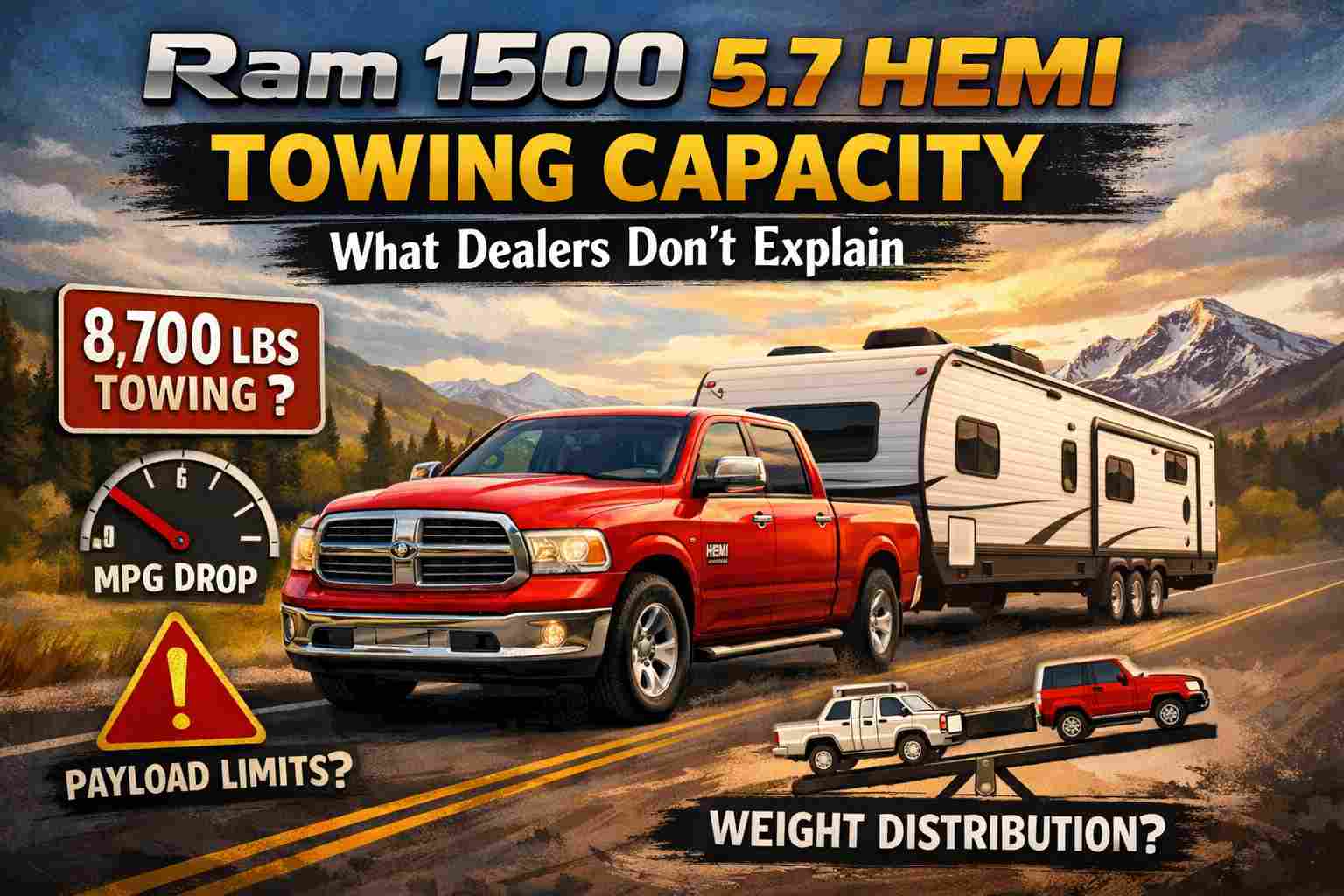
Quick Answer: A Ram 1500 5.7 HEMI (Crew Cab 4×4) can legally tow a 28ft trailer with a loaded weight of 6,700 lbs — but the real payload margin after accounting for tongue weight, occupants, and bed gear is only 75 lbs. That is razor-thin. One extra passenger or a fully topped-up fresh water tank wipes it out.
The Question Ram Dealers Don’t Answer at the Lot
Walk into any Ram dealership and the conversation about towing starts — and usually ends — with the tow rating. For a 2024 Ram 1500 5.7 HEMI, that number is 8,810 lbs with a conventional hitch and up to 12,750 lbs with the available Max Tow package. Those are real numbers. They are on the window sticker. And they are not the number that will limit your truck on the road.
The number that actually limits your Ram 1500 is on the inside of the driver’s door. It is called the payload capacity, it lives on the Tire and Loading Information sticker, and most Ram 1500 owners have never looked at it. This article runs the real math for a common Ram 1500 5.7 HEMI setup — and the result is going to surprise you.
What Payload Capacity Actually Means
Payload capacity is the maximum weight your truck can carry above its factory curb weight. This includes every single thing added to the vehicle after it leaves the factory floor: every passenger, every pound of gear in the truck bed, and — critically — the tongue weight of any trailer connected to the rear hitch ball.
Tongue weight is not a separate category. It is payload. When a 28-foot travel trailer is connected to the rear hitch ball of your Ram 1500, the downward force that tongue exerts on the truck’s rear axle is counted against payload — not against the tow rating. This is the distinction most dealers never walk buyers through.
The tow rating tells you how heavy a trailer your Ram 1500’s engine, transmission, cooling system, and frame can pull. The payload capacity tells you how much total weight the truck’s suspension, axles, and tires can safely carry. Both limits apply simultaneously. Most Ram 1500 owners only think about one.
2024 Ram 1500 5.7 HEMI — The Actual Numbers
For this analysis we are using a 2024 Ram 1500 Crew Cab 4×4 with the 5.7L HEMI V8. The GVWR for this configuration is 7,100 lbs. The curb weight is approximately 5,480 lbs.
The door sticker payload capacity for this specific truck is 1,620 lbs. That is the number Ram engineers calculated for this configuration — accounting for curb weight, axle ratings, suspension capacity, and GVWR. It is the legally binding maximum for everything this truck carries.
Important note: Ram 1500 payload varies dramatically across configurations. A tradesman work truck on the same platform can reach over 2,000 lbs of payload. A loaded Laramie Longhorn with the panoramic sunroof and full luxury package may come in under 1,400 lbs. The only number that counts is the one on your specific door sticker.
The Trailer: 28ft Coachmen Clipper
For this scenario, the trailer is a 28-foot Coachmen Clipper — a popular mid-size travel trailer well within the Ram 1500’s tow rating. Factory unloaded vehicle weight (UVW) is approximately 5,130 lbs. GVWR is 7,271 lbs. The gap between dry and GVWR — the cargo capacity — is roughly 2,141 lbs.
A typical family trip with water tank, food, clothing, outdoor gear, and the small extras adds approximately 1,500 to 1,700 lbs of real-world loaded weight. For this analysis we are using a loaded weight of 6,700 lbs — conservative, but realistic for a long weekend with a family of four.
Why the Dry Weight Number Is Almost Meaningless
The dry weight listed on a trailer sticker represents the trailer as it came off the assembly line. No water. No food. No gear. No one has ever actually towed a trailer at its dry weight in real-world use.
The 1,570-pound difference between the Coachmen Clipper’s dry weight and its loaded weight in this scenario is not a calculation error — it is a reflection of what a real trip looks like. Fresh water tank at 75% capacity adds roughly 300 lbs. Food and groceries for four people add another 200 lbs. Clothing, bedding, and personal items: 150 lbs. Bikes: 60 lbs. Outdoor furniture and a propane tank: 120 lbs. It adds up fast.
When you calculate payload math, always use the loaded weight of the trailer. If you do not know the loaded weight, use a realistic estimate based on your actual packing habits — not the dry weight.
The 15% Rule and Why It Matters for Payload
The standard tongue weight guideline for conventional trailers is 10–15% of the loaded trailer weight. At the lower end of 10%, the trailer is more prone to sway. At 15%, you have the best balance of stability and load distribution. We calculate at 15% — the conservative, safety-first end.
For a trailer loaded at 6,700 lbs, tongue weight at 15% is 1,005 lbs. That 1,005 lbs sits directly on the rear hitch ball of the Ram 1500 and counts against the truck’s payload capacity. More than 62% of the 1,620-lb payload budget is claimed by tongue weight alone — before anyone sits in the truck.
The Real Payload Math
This is the calculation that matters. Every line comes directly out of the truck’s 1,620-lb payload capacity:
| Item | Weight | Remaining Payload |
| Starting Payload (Door Sticker) | 1,620 lbs | |
| − Tongue Weight (15% of 6,700 lbs) | 1,005 lbs | 615 lbs |
| − Driver + Passenger | 340 lbs | 275 lbs |
| − Gear in Truck Bed | 200 lbs | 75 lbs |
| REMAINING PAYLOAD | 75 lbs |
Step up to a ~7,200 lb loaded coach and the margin disappears. See can a 2026 Ram 1500 5.7 HEMI tow a Grand Design Imagine.
Seventy-five pounds. That is the margin remaining on this Ram 1500 5.7 HEMI with a 28-foot trailer loaded at 6,700 lbs, two occupants, and 200 lbs of bed gear. That is the difference between within payload and over payload — and it disappears with one additional adult passenger, a fuller water tank, or a slightly heavier gear load.
Where Ram 1500 Owners Run Out of Payload
The tow rating says your Ram 1500 can pull 8,810 lbs. The 6,700-lb loaded trailer is well under that number. So most owners assume everything is fine. But the payload math tells a completely different story: 75 lbs of margin between legal and overloaded on a 5,500-lb truck combination.
This is not an edge case or an unusual scenario. This is a perfectly common Ram 1500 setup with a mid-size travel trailer and two adults — a trip that happens tens of thousands of times every weekend across North America. And most of those trucks are operating with a payload margin measured in double digits.
Not sure if your truck is within safe limits? Towing Limit Pro helps you verify your real setup using your actual payload sticker, passengers, cargo, and trailer numbers.
- Remaining payload (what you actually have left)
- Realistic tongue weight estimate (loaded, not brochure)
- GVWR margin + a clear safety buffer
- Risk-zone warning if your setup is pushing limits
Tip: Use your truck’s yellow door sticker payload for the most accurate result.
What Happens When Payload Is Exceeded
Exceeding payload capacity is not just a theoretical risk. When the rear axle of a Ram 1500 carries more weight than the door sticker allows, the suspension is operating outside its engineered range. Rear coil springs and air suspension components that are spec’d for a specific load range degrade faster under overload conditions. Tire sidewalls experience higher stress at lower inflation pressures, increasing the risk of blowout on long highway runs.
Beyond the mechanical consequences, there are legal ones. Operating a vehicle in excess of its GVWR — which is what happens when payload is exceeded — is a violation in most jurisdictions. In the event of an accident, your insurance carrier can deny coverage if the vehicle was overloaded at the time of the incident. The tow rating is not a legal limit. The GVWR and payload capacity are.
How to Create Real Payload Margin with a Ram 1500
The solutions are practical and specific. First, reduce loaded trailer weight. Dump the fresh water tank before departure and fill up once you arrive at the campground — this alone can remove 200 to 400 lbs from your loaded trailer weight, which directly reduces tongue weight and frees up payload. Second, carry less in the truck bed. Every pound of gear in the truck bed is a pound against payload.
Third, look at your specific Ram 1500 door sticker. If your truck has a payload number higher than 1,620 lbs — some Ram 1500 configurations reach 1,900 to 2,100 lbs — you have more room to work with. The window sticker tow rating is the same across configurations. The door sticker payload is not. Fourth, consider stepping to a Ram 2500 for this trailer pairing if you consistently run near or over the payload limit on long trips.
Verdict: Borderline — And That’s the Problem
A 2024 Ram 1500 5.7 HEMI with a 1,620-lb door sticker can technically carry the payload in this scenario — but 75 lbs is not a real margin. Real-world variables including a third passenger, a heavier gear load, a fuller water tank, or a slightly denser packing job push this combination into overloaded territory with ease.
The responsible answer is to reduce loaded trailer weight to the point where remaining payload is at least 150 to 200 lbs — a buffer that accounts for real-world variability. For this specific combination, that means targeting a loaded trailer weight no higher than approximately 6,400 lbs with two occupants and standard bed gear. See how the HEMI compares to the Silverado with a 7,000 lb travel trailer.
Know your real margin before you hook up.
Most half-ton trucks hit their payload limit long before they hit their tow rating limit — and most owners don’t realize it until they’re already committed. Verify your exact setup and know where you stand.
- Remaining payload (your real limit)
- Realistic tongue weight (loaded)
- GVWR margin + safety buffer
- Clear risk-zone indicator
Best results: use your yellow door-sticker payload number and your loaded trailer estimate (not dry weight).
Frequently Asked Questions
What is the towing capacity of a Ram 1500 5.7 HEMI?
The 2024 Ram 1500 5.7 HEMI has a conventional hitch tow rating of 8,810 lbs in standard configuration, and up to 12,750 lbs with the Max Tow package. However, the relevant limit for most real-world towing scenarios is the payload capacity from the door sticker — not the tow rating.
Is the Ram 1500 5.7 HEMI good for towing a travel trailer?
Yes — the Ram 1500 5.7 HEMI is a capable tow vehicle with strong engine torque and an available tow package. But matching the tow rating is only part of the equation. The payload capacity on your specific door sticker determines the maximum combined load of tongue weight, passengers, and bed gear. Always run the payload math for your specific combination.
How do I find my Ram 1500's payload capacity?
Open the driver's door and look at the sticker on the door jamb. The Tire and Loading Information sticker lists the Combined Weight of Occupants and Cargo — this is your payload capacity. It is specific to your truck's exact configuration and options. This number is the one that matters for towing math.
What is tongue weight and how does it affect payload?
Tongue weight is the downward force exerted by the front of the trailer on the truck's hitch ball. A typical rule is 10–15% of the loaded trailer weight. Every pound of tongue weight counts against the truck's payload capacity — it is not a separate budget. For a trailer loaded at 6,700 lbs, tongue weight at 15% is 1,005 lbs drawn directly from the truck's payload.
Can I increase my Ram 1500's payload capacity?
No. Payload capacity is determined at the factory based on axle ratings, suspension, tires, and GVWR. It cannot be increased through aftermarket modifications. The only way to carry more payload is to reduce the weight of what is already in or on the truck — lighter trailer load, fewer passengers, less bed gear.