Quick Answer
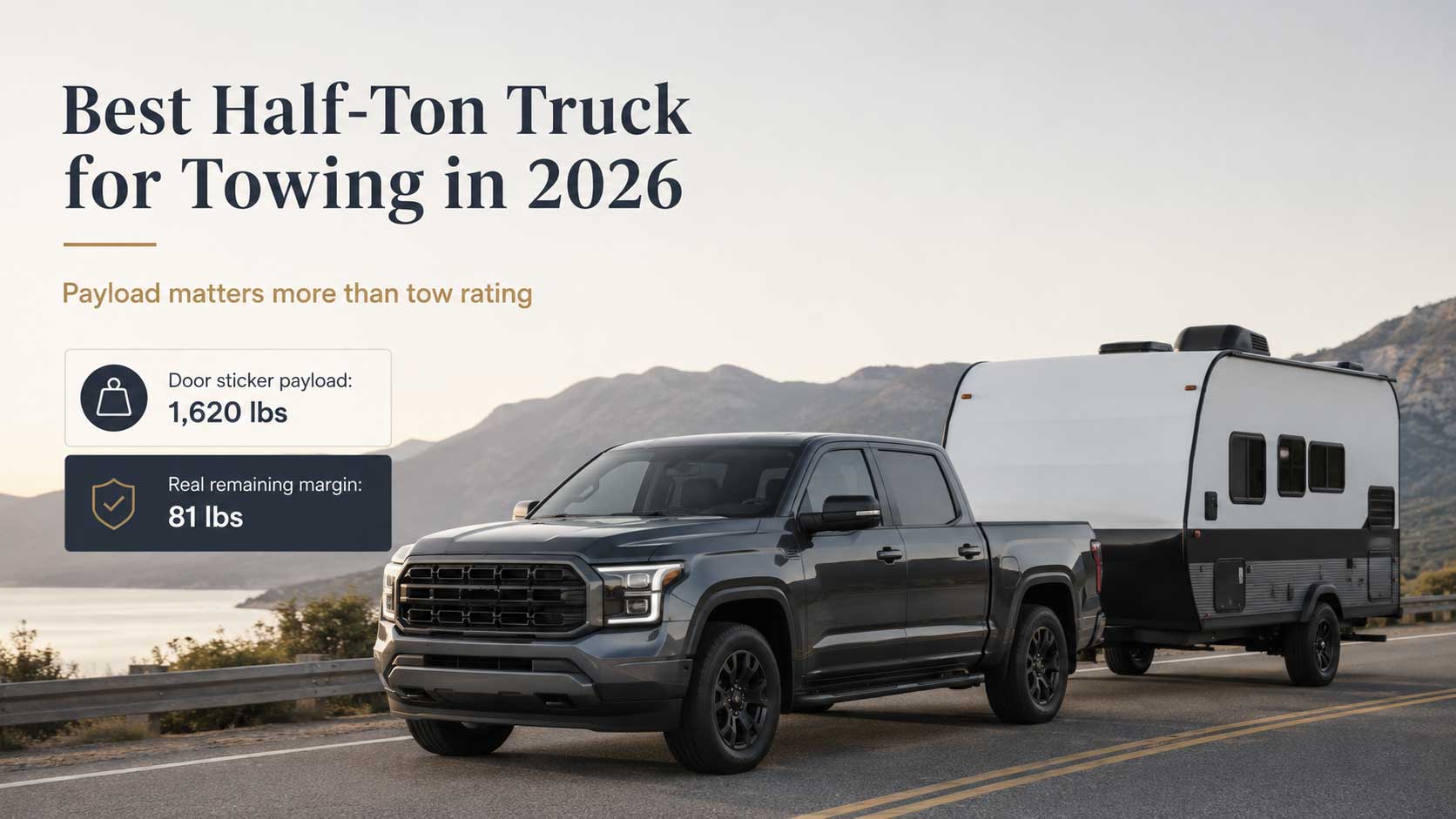
The best half-ton truck for towing in 2026 is the one with the highest payload capacity on its door sticker — not its highest advertised tow rating. For a 2026 Ford F-150 XLT SuperCrew 4×4 with the 3.5L EcoBoost, that door sticker number is approximately 1,620 lbs, and when you run the real math against a fully loaded “half-ton compatible” trailer, the margin is tighter than almost any buying guide will tell you.
Payload determines what “best” means. Tow rating tells you what the engineers tested on an idealized rig. Door sticker payload tells you what your specific truck — with your cab, your bed, your drivetrain, and your options — can actually carry.
Introduction
Every year, the same buying decision plays out at dealerships and forums across the country. Someone asks which half-ton is best for towing, gets a comparison of tow ratings and engine options, and drives home confident they made the right call. The comparison they read was thorough. The number it ignored was the only one that matters.
Half-ton tow ratings have climbed to 11,000 and 12,000 lbs over the last decade. But payload capacity — the number that governs whether you are actually within the truck’s engineering limits — has not kept pace. In some configurations, it has gotten tighter. The gap between what a truck can legally hitch and what it can safely carry has never been wider, and most comparison content never mentions it.
Truck Specs: 2026 Ford F-150 XLT SuperCrew 4×4 (3.5L EcoBoost)
This is one of the most frequently purchased F-150 configurations in the country. It is also one of the most frequently used as a tow vehicle without a full payload calculation.
All figures below come from the door sticker, not the brochure. Brochure tow ratings and payload figures reflect best-case, minimum-equipment configurations — typically a Regular Cab, long bed, 2WD with the lightest available powertrain. Most buyers do not purchase that truck.
- GVWR: 7,050 lbs
- Curb weight: 5,430 lbs
- Payload capacity (door sticker): 1,620 lbs
One important note: F-150 payload capacity ranges from under 1,500 lbs to over 2,300 lbs depending on cab style, bed length, drivetrain, and installed options. Two F-150s sitting next to each other on a dealer lot — looking identical — can differ by 400 lbs of payload capacity. That is exactly why the door sticker is the only authoritative number. Ford’s published “maximum payload” applies to a truck configuration the majority of buyers never purchase.
Trailer Specs: Coachmen Apex Ultra-Lite 213RBS
This trailer is actively marketed as “half-ton compatible.” Buyers choose it specifically because the label implies the math has already been done for them.
- Dry weight (UVW): 4,750 lbs
- GVWR: 6,995 lbs
- Tongue weight: calculated at 15% of loaded weight
Dry weight does not equal loaded weight. The 4,750 lb figure assumes an empty fresh water tank, no food, no gear, no clothing, and no passengers. A realistic weekend camping trip adds 800 to 1,400 lbs before you reach the end of your street. The GVWR of 6,995 lbs is the number the trailer was engineered around, and it is the number this analysis uses.
Dry vs. Loaded Weight
Trailers routinely exceed their dry weight by 15 to 30 percent once loaded for actual use. The Apex 213RBS has 2,245 lbs of capacity between its dry weight and its GVWR. Water weighs 8.3 lbs per gallon. A 40-gallon fresh tank fully loaded adds 332 lbs before you pack a single bag. Add food for four people for a week, bedding, tools, a generator, bikes, and camping gear — and the gap between dry weight and GVWR closes quickly.
Planning your tow around the dry weight number is how people end up over payload without realizing it. This analysis uses GVWR — 6,995 lbs — as the working loaded weight.
Tongue Weight Rule
Tongue weight should fall between 12 and 15 percent of the loaded trailer weight. At 15 percent:
15% × 6,995 lbs = 1,049 lbs of tongue weight
That 1,049 lbs transfers directly onto the truck’s rear axle — and directly into the payload budget. It does not go into the tow rating. It does not disappear because the trailer is “half-ton compatible.” It comes out of the 1,620 lbs the door sticker allows before the truck exceeds its Gross Vehicle Weight Rating.
Real Math Table
| Item | Weight (lbs) |
| Truck Payload Capacity (door sticker — not brochure) | 1,620 |
| minus Driver + Passenger | minus 340 |
| minus Gear / cargo in truck bed | minus 150 |
| minus Tongue weight (15% of loaded trailer weight: 6,995 lbs) | minus 1,049 |
| = Remaining Payload Margin | **81 lbs** |
Shock Moment
Eighty-one pounds.
That is the remaining payload margin in one of the most common truck-and-trailer combinations in the half-ton segment today. Eighty-one pounds is roughly the weight of a full 5-gallon water jug and a sleeping bag. It is less than one medium-sized piece of luggage. It is less than the fresh water you might add to the tank on the way to the campsite.
“Half-ton compatible” means the trailer’s GVWR falls below what the category’s tow rating can handle. It says nothing about your payload. These are different constraints measuring different things, and only one of them shows up on your door sticker.
If the trailer had been loaded heavier than GVWR — which happens when dry weight estimates replace actual weight — or if you added a third adult passenger, the margin in this table is already gone. The math does not adjust for marketing language.
If you’re wondering where your truck would land in this calculation, don’t guess.
Not sure if your truck is within safe limits? Towing Limit Pro helps you verify your real setup using your actual payload sticker, passengers, cargo, and trailer numbers.
- Remaining payload (what you actually have left)
- Realistic tongue weight estimate (loaded, not brochure)
- GVWR margin + a clear safety buffer
- Risk-zone warning if your setup is pushing limits
Tip: Use your truck’s yellow door sticker payload for the most accurate result.
Verdict: Borderline
This matchup is borderline. The truck is within its tow rating. The trailer is marketed as compatible. The payload math shows 81 lbs of margin — which technically passes until you add any variable the table did not include. A third passenger brings it negative. A full fresh water tank brings it negative. An F-150 that came with the Max Trailer Tow Package, the panoramic roof, or other factory options that add curb weight will have a lower payload number than the one used here, and this matchup tips negative before a single bag is packed.
This is not an argument against the F-150 or against this trailer. It is an argument against the buying process that skips the math. The F-150 is a capable, well-engineered tow vehicle. But “best half-ton for towing” is not a universal title — it is a configuration-specific answer that depends on your door sticker number, your loaded trailer weight, and the weight you actually put in the cab and bed. A lighter F-150 build, a shorter bed, a 2WD configuration — any of these could shift this verdict from Borderline to Safe. A heavier build, or a more loaded trailer, shifts it the other direction.
Run the subtraction before you decide which truck is best for your trailer. That is the only comparison that actually matters.
Know your real margin before you hook up.
Most half-ton trucks hit their payload limit long before they hit their tow rating limit — and most owners don’t realize it until they’re already committed. Verify your exact setup and know where you stand.
- Remaining payload (your real limit)
- Realistic tongue weight (loaded)
- GVWR margin + safety buffer
- Clear risk-zone indicator
Best results: use your yellow door-sticker payload number and your loaded trailer estimate (not dry weight).
FAQs
Why does my F-150 have an 11,000 lb tow rating but only 1,620 lbs of payload?
Tow rating and payload capacity are separate measurements governing different failure modes. Tow rating reflects the maximum trailer weight the hitch, receiver, frame, drivetrain, and trailer brake controller were engineered to handle. Payload capacity is the total weight your truck can carry above its curb weight — including occupants, bed cargo, and tongue weight from the trailer. A truck can have a high tow rating and a low payload capacity simultaneously, because they are designed around different components. When the two conflict, payload is the binding constraint. Exceeding payload means exceeding the truck's GVWR, which is the hard engineering limit.
The trailer says "half-ton compatible" — why doesn't that mean my half-ton can tow it?
"Half-ton compatible" is a marketing category based on tow rating, not payload. It means the trailer's GVWR falls within a range a class of trucks can tow by hitch capacity. It does not account for your specific truck's payload rating, which varies by hundreds of pounds based on how your truck was built and what options are installed. Two F-150s with identical exteriors can have different door sticker payload ratings. The compatibility label does not know which one you have. Your door sticker does.
Does a weight distribution hitch improve my payload margin?
A weight distribution hitch redistributes some tongue weight load across both axles, which can level the truck and improve handling. It does not increase your payload capacity. The tongue weight still counts against your payload budget. Some manufacturers specify adjusted tongue weight limits for WDH setups, so the owner's manual is the right reference — but do not assume the hitch resolves a tight payload margin. It is a handling aid, not a payload solution.
What is the difference between the F-150's advertised max payload and what my truck actually has?
Ford's published maximum payload for the F-150 — often cited above 2,000 lbs — applies to a Regular Cab, long-bed, 2WD configuration with specific engine and axle choices. That is the configuration that produces the maximum number. Most buyers purchase a SuperCrew or SuperCab, 4x4, with the 3.5L EcoBoost and a package of options. Each added feature increases curb weight, reducing the payload number. The result is frequently 400 to 800 lbs below the advertised ceiling. This is not unique to Ford — every half-ton manufacturer publishes maximum figures that apply to configurations most buyers do not select. The door sticker resolves the ambiguity. It reflects your truck, not the category's best-case build.
Can I be within my tow rating and still be over my payload capacity?
Yes. This happens regularly, and it is the most common misunderstanding in half-ton towing. Tow rating and payload capacity are independent limits. A trailer that weighs 9,500 lbs is within a 10,000 lb tow rating. If that trailer's tongue weight is 1,425 lbs and the truck's payload capacity — after accounting for occupants and bed cargo — only has 1,200 lbs remaining, the truck is within the tow rating and over the payload limit at the same time. Both limits apply. Staying under the tow rating does not guarantee you are within the payload rating.