
Quick Answer
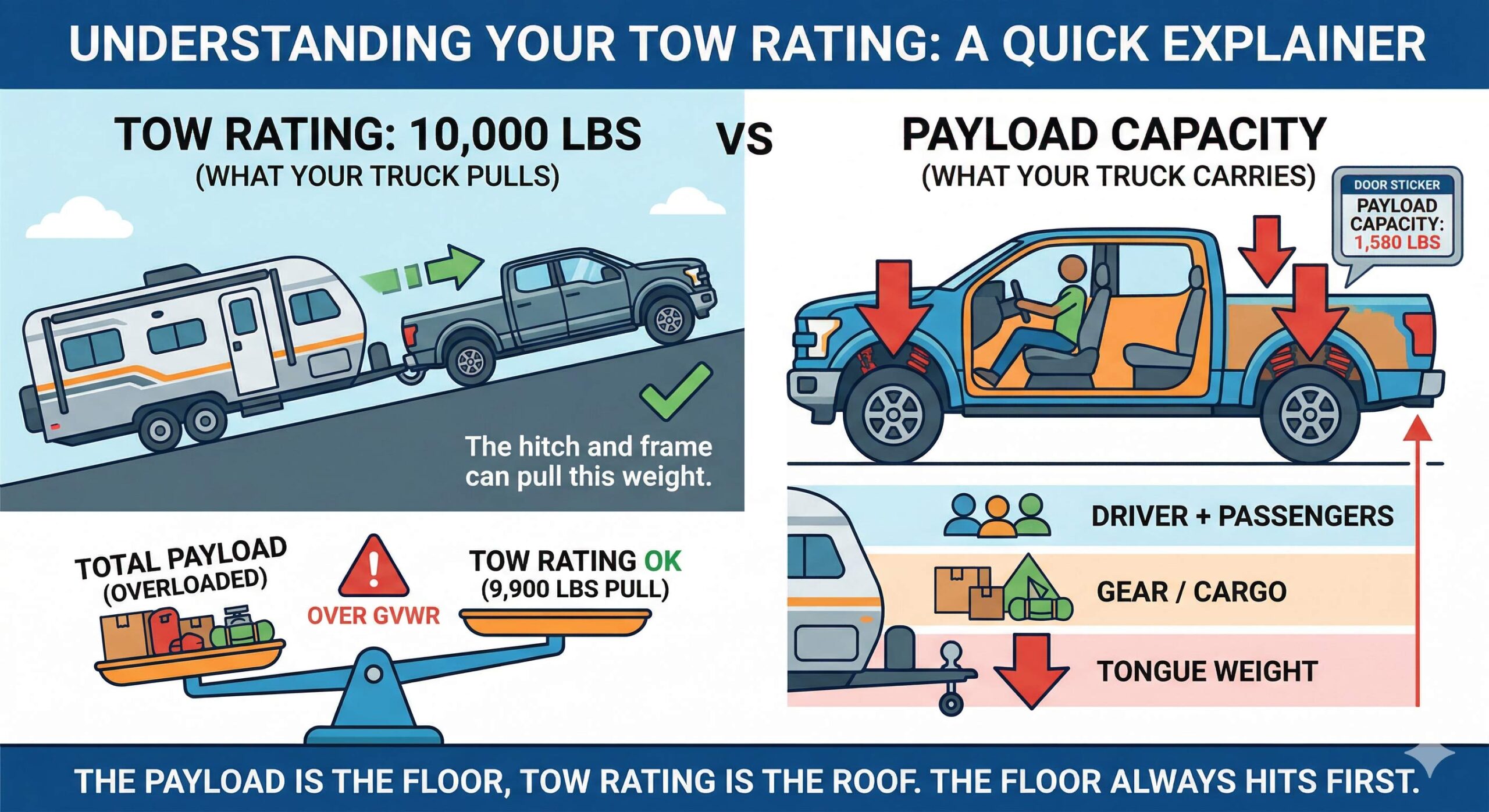
A tow rating tells you how much weight the hitch can pull. It says nothing about how much weight the truck can carry — and those are two completely different limits. The number that actually controls whether you’re legal and safe is the payload capacity on your door sticker, not the tow rating on the window sticker.
The Misunderstanding That’s Everywhere
Walk into any dealership and point at a half-ton with a 10,000 lb tow rating. Ask if you can tow a 9,500 lb trailer. The answer you’ll almost always get is yes.
That answer is incomplete — and it costs people real money in tires, suspension, and axle repairs every season.
The tow rating is not your limit. It’s one of your limits. The one most people never check is payload capacity, and it’s almost always the one that fails first. Even the Tesla Cybertruck, rated to tow up to 11,000 lbs (7,500 lbs on the base Dual Motor AWD), has limits beyond its tow rating. On that truck, the tongue weight cap usually arrives first.
Truck Specs That Actually Matter
For this example, we’re using a 2023 GMC Sierra 1500 SLE, Crew Cab, 4WD, 5.3L V8 — a popular truck with strong tow ratings and a dedicated following among travel trailer owners.
All figures below come from the door sticker — not the brochure, not GMC’s website. The door sticker is the only number that reflects your actual truck as it was built, with its exact options, equipment, and trim weight.
- GVWR: 7,100 lbs
- Curb weight: 5,520 lbs
- Payload capacity: 1,580 lbs
- Published max tow rating: 9,900 lbs
That 1,580 lb payload is the ceiling. Driver, passengers, cargo in the bed, fuel added at the pump, and tongue weight from the trailer all count against it. When the sum exceeds 1,580 lbs, you are over GVWR — full stop.
Trailer Specs: What the Numbers Mean
We’re pairing the Sierra with a Keystone Hideout 38FQTS, a large family travel trailer well-regarded for its floorplan. It’s the kind of trailer people buy specifically because their truck has a 9,900 lb tow rating and it felt like a safe match.
- Dry weight: 7,200 lbs
- GVWR: 9,500 lbs
- Manufacturer tongue weight rating: 950–1,140 lbs
Here is where the problem starts. Dry weight does not equal loaded weight. The 7,200 lb figure is the trailer with nothing in it — empty water tank, no food, no gear, no clothing, no tools, no propane. The moment you start packing for a real trip, that number climbs.
Dry vs. Loaded Weight: The Gap Nobody Talks About
A packed travel trailer routinely weighs 15–30% more than its dry weight. This is not speculation — it’s the result of adding fresh water (8.34 lbs per gallon), food for a week, camping gear, kids’ toys, clothing, tools, and anything else the family decided to bring.
For the Keystone Hideout 38FQTS, a realistic loaded weight for a typical family trip lands around 8,500 lbs — 1,300 lbs above dry weight and well within the range of normal packing habits. That loaded number is still comfortably below the 9,900 lb tow rating. On paper, nothing looks wrong. The math is about to say something different.
Tongue Weight: The Weight You’re Actually Carrying
Tongue weight is the downward force the front of the trailer exerts on the truck’s hitch ball. It transfers directly from the trailer into the truck’s payload budget.
The standard rule: tongue weight should be 12–15% of the loaded trailer weight. Too low and the trailer sways. Too high and the rear axle is overloaded.
At 15% of 8,500 lbs:
8,500 × 0.15 = 1,275 lbs of tongue weight
That 1,275 lbs is coming out of your payload capacity. It doesn’t stay on the trailer — it presses down through the hitch ball onto the truck’s rear axle and counts against the door sticker number.
Sierra 1500 + Hideout 38FQTS: Payload Math
Here is what the Sierra’s payload budget actually looks like on a real trip with this trailer loaded to 8,500 lbs:
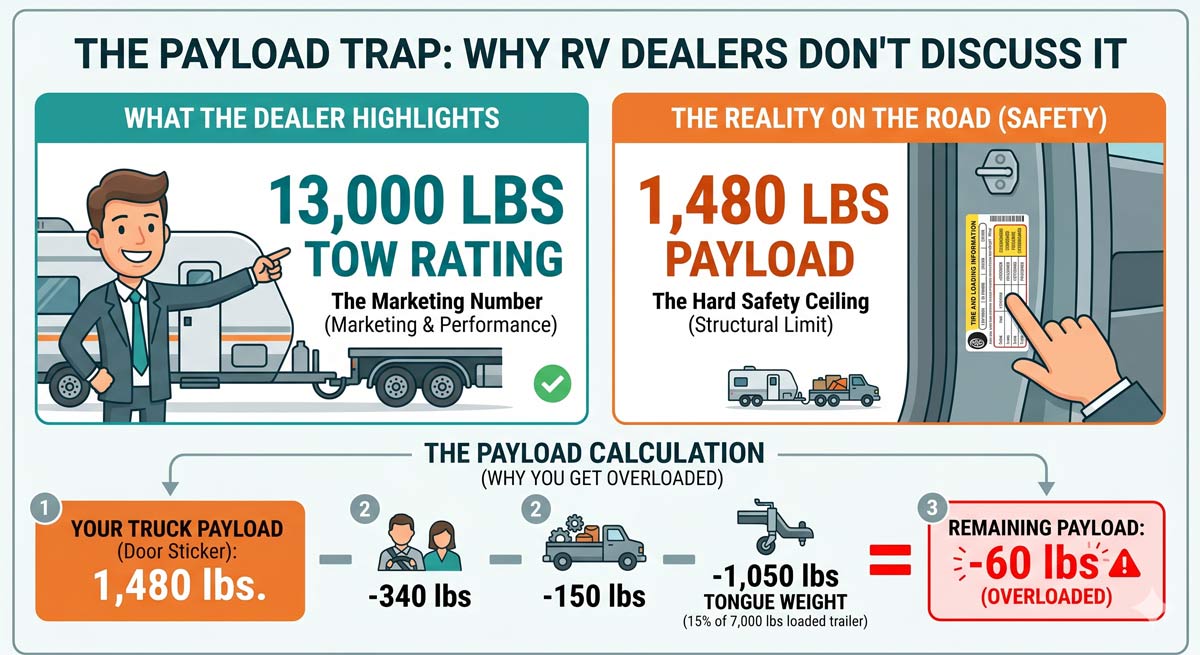
| Item | Weight (lbs) |
| Truck Payload Capacity (door sticker — not brochure) | 1,580 |
| minus Driver + Passenger | minus 340 |
| minus Gear / cargo in truck bed | minus 200 |
| minus Tongue weight (15% of loaded trailer weight at 8,500 lbs) | minus 1,275 |
| = Remaining Payload Margin | **-235 lbs** |
Over Payload, Under the Tow Rating
The margin is negative 235 pounds.
The tow rating said 9,900 lbs. The trailer weighs 8,500 lbs loaded — nearly 1,400 lbs under the limit. Both numbers look completely manageable. And yet the truck is overloaded before you consider a second passenger, a stop for fuel, or anything extra tossed in the bed at the last minute.
This is not a fringe case. This is what happens on a significant percentage of half-ton tows every weekend. The tow rating creates a false ceiling. Drivers look up, see plenty of room, and never check the floor.
If you’re wondering where your truck would land in this calculation, don’t guess.
Not sure if your truck is within safe limits? Towing Limit Pro helps you verify your real setup using your actual payload sticker, passengers, cargo, and trailer numbers.
- Remaining payload (what you actually have left)
- Realistic tongue weight estimate (loaded, not brochure)
- GVWR margin + a clear safety buffer
- Risk-zone warning if your setup is pushing limits
Tip: Use your truck’s yellow door sticker payload for the most accurate result.
Verdict: Risky Despite the Tow Rating
A 2023 GMC Sierra 1500 SLE towing a loaded Keystone Hideout 38FQTS is risky. The trailer fits well within the tow rating. The tongue weight alone — at a perfectly standard 15% of loaded weight — is enough to put a typical Sierra past its GVWR before a single extra pound is added anywhere else.
There are ways to bring this combination into compliance: lighter packing, fewer passengers, no cargo in the bed, or choosing a smaller trailer. But the point is not this specific truck-trailer combination. The point is that the tow rating said yes when the payload math said no — and most drivers never looked past the first number.
A 10,000 lb tow rating is the roof. Payload capacity is the floor. The floor is almost always lower than people expect, and it hits first.
Know your real margin before you hook up.
Most half-ton trucks hit their payload limit long before they hit their tow rating limit — and most owners don’t realize it until they’re already committed. Verify your exact setup and know where you stand.
- Remaining payload (your real limit)
- Realistic tongue weight (loaded)
- GVWR margin + safety buffer
- Clear risk-zone indicator
Best results: use your yellow door-sticker payload number and your loaded trailer estimate (not dry weight).
Frequently Asked Questions
Why doesn't my tow rating tell me if I can actually tow a trailer?
The tow rating is the maximum weight the truck's hitch, frame, and drivetrain are rated to pull. It was never designed to account for how much weight the truck can carry — that's the payload capacity, and it's a separate number on a separate sticker. A truck can have a 10,000 lb tow rating and only 1,400 lbs of payload, which means a standard tongue weight alone can push it over its GVWR. Both limits are real. Both need to be checked before you hook up.
What is the difference between dry weight and loaded trailer weight?
Dry weight is the trailer as it leaves the factory — nothing added, tanks empty. Loaded weight is what it actually weighs when you're on the road: filled fresh water tank, food for the trip, clothing, tools, kids' gear, propane, and anything else that made it inside. For a large travel trailer, the gap between dry and loaded weight is routinely 1,000–2,000 lbs. Using dry weight in your planning makes the numbers look safer than they are, every time.
What is tongue weight and why does it matter for payload?
Tongue weight is the downward force the front of your trailer places on the hitch ball. Because it physically presses down on the truck's rear axle, it counts as weight the truck is carrying — not pulling. That means it comes directly out of your payload capacity. A 1,200 lb tongue weight uses 1,200 lbs of your payload budget on top of everything else in the cab and bed. Most half-ton tow setups fail here, not at the hitch.
Can I use the tow rating from the manufacturer's website to plan my setup?
Manufacturer websites list best-case tow ratings — typically based on the lightest trim, a specific axle ratio, and minimal options. Your truck, as actually built with your specific options and added equipment, will have its own GVWR and its own payload figure. The only number that applies to your truck is the payload capacity stamped on the driver's door sticker. Use that number. Everything else is a starting point, not your answer.
How much payload buffer should I have before I consider a tow safe?
There is no regulatory minimum margin — you are either under GVWR or over it. In practice, a margin under 100 lbs means one extra passenger or a slightly heavier pack job puts you into overloaded territory. Most experienced towers aim to leave at least 200–300 lbs of buffer to account for variables: an extra person, last-minute cargo, a water tank that is fuller than expected, or tongue weight that shifts when the load moves. Run your real numbers, then build in room for the real world.