
Quick Answer
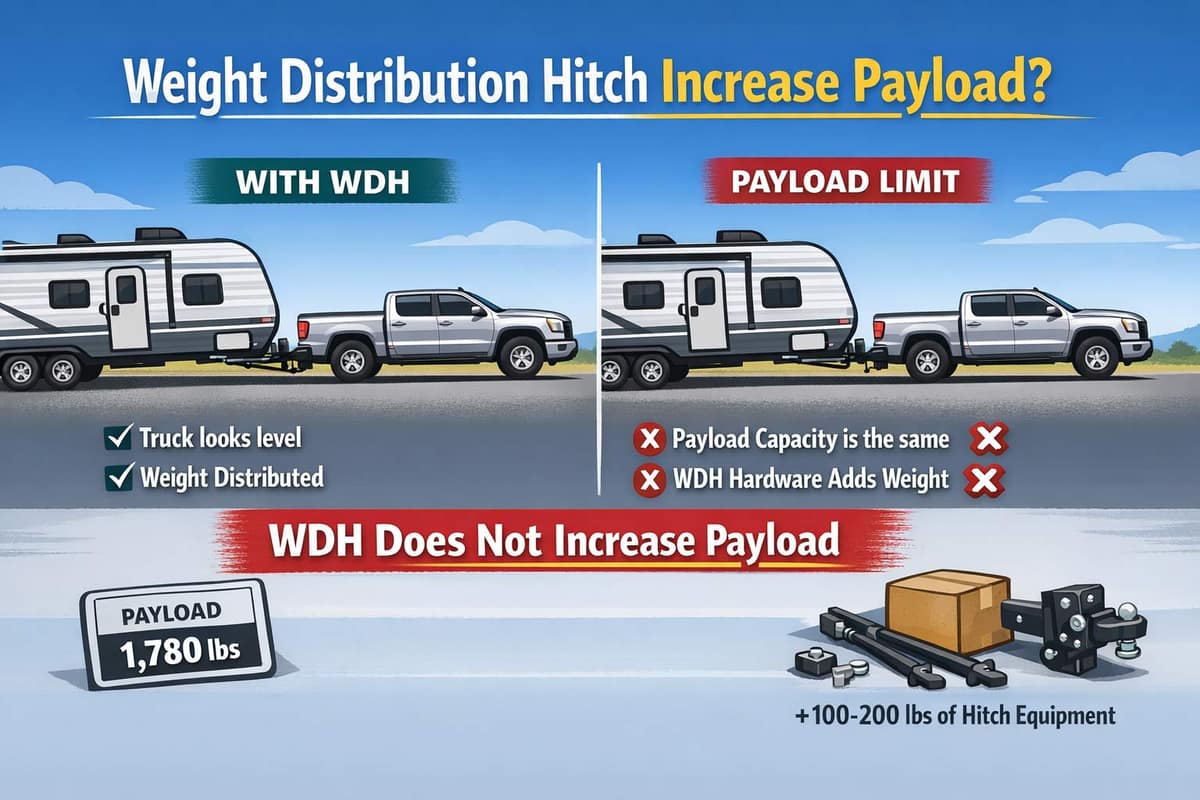
No. A weight distribution hitch does not increase your truck’s payload capacity — not by a single pound. It redistributes tongue weight across all axles to improve ride level and steering response, but it has no effect on your Gross Vehicle Weight Rating or your door-sticker payload number. Installing a WDH does not change what your truck is structurally or legally rated to carry — and the hardware itself reduces your remaining margin.
The Conversation That Keeps Happening
There’s a version of this exchange that plays out every weekend at dealerships and RV lots. A buyer hooks up a new trailer, the back of the truck squats hard, and someone recommends a weight distribution hitch. The buyer installs the WDH, the truck levels out, and the assumption takes hold: problem solved.
The truck looks better. It doesn’t handle better on paper. The total weight pressing down on that vehicle hasn’t changed — and in fact, here’s the thing dealers rarely mention: the WDH hardware itself, typically 100 to 200 pounds of head, bars, and brackets, comes directly out of your payload margin.
A weight distribution hitch is a legitimate safety device. It is not a payload workaround.
Truck Specs: 2024 GMC Sierra 1500 SLT 4×4 (5.3L V8, Short Box)
Numbers sourced from the door sticker, not the brochure. These are the only figures that matter.
- GVWR: 7,100 lbs
- Curb weight: 5,320 lbs
- Payload capacity (door sticker): 1,780 lbs
GMC’s marketing materials advertise up to 2,200 lbs of payload for the Sierra 1500 family. Your specific truck — with your specific cab, bed, axle ratio, drivetrain, and option packages — is stamped at 1,780 lbs. That is the number. The brochure maximum is irrelevant to this calculation.
Trailer Specs: Grand Design Transcend Xplor 261BH
- Dry weight: 5,643 lbs
- GVWR: 7,695 lbs
- Tongue weight range (12–15% of GVWR): 923 to 1,154 lbs
One critical note: dry weight does not equal loaded weight. Dry weight is the trailer as it left the factory — no fresh water, no gear, no clothing, no food, no propane, no bikes strapped to the back. A family of four heading out for a long weekend can add 800 to 1,200 lbs in personal load alone. Never plan a towing scenario around dry weight.
Transcend Xplor 261BH: Dry vs Loaded Weight
Loaded trailers routinely exceed their dry weight by 15 to 30 percent. The Transcend Xplor 261BH carries a dry weight of 5,643 lbs and a GVWR of 7,695 lbs. That 2,052-lb gap represents everything you haven’t put in it yet.
For this calculation, we use GVWR — the maximum the trailer is rated to weigh when loaded. This is the structurally and legally correct figure to use when verifying payload margin against your truck’s door sticker.
Tongue Weight on the Transcend Xplor 261BH
Tongue weight should fall between 12 and 15 percent of the loaded trailer weight. Using 15 percent — the conservative ceiling — against the full GVWR:
7,695 lbs × 0.15 = 1,154 lbs of tongue weight
This is the force applied to the hitch ball and transferred into the truck’s rear axle. It counts in full against your payload capacity.
Real Math: Sierra 1500 + Transcend Xplor 261BH
| Item | Weight (lbs) |
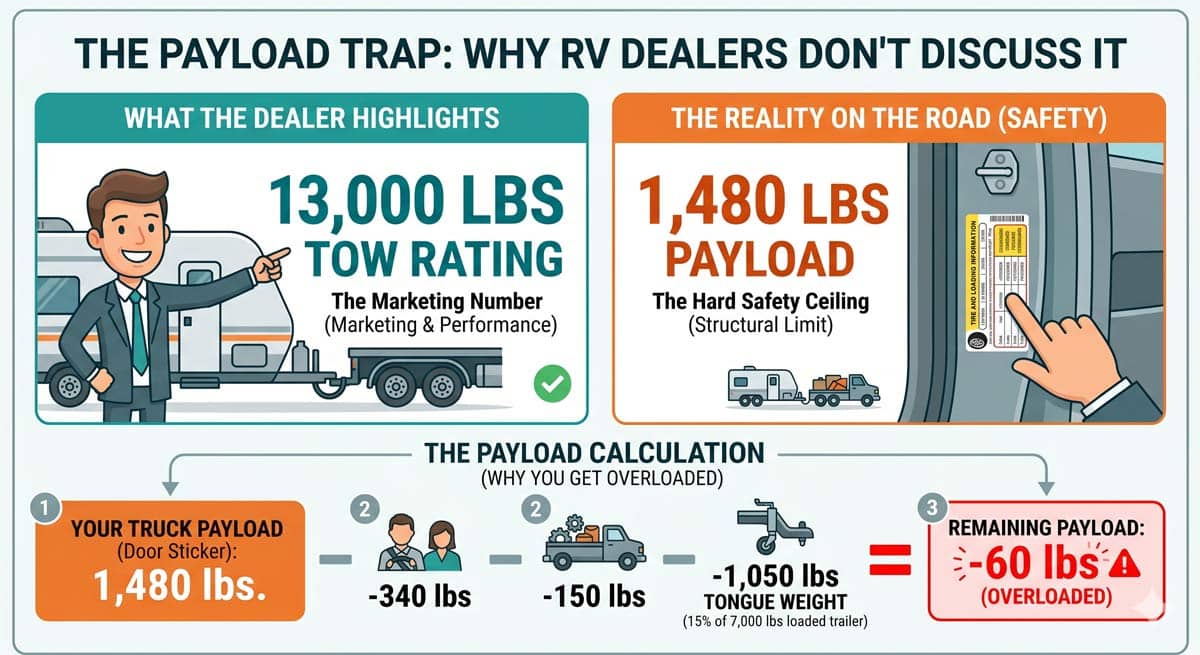
| Truck Payload Capacity (door sticker — not brochure) | 1,780 |
| minus Driver + Passenger | minus 360 |
| minus Gear / cargo in truck bed | minus 150 |
| minus Tongue weight (15% of loaded trailer weight) | minus 1,154 |
| = Remaining Payload Margin | **116 lbs** |
One hundred and sixteen pounds. That’s the margin before you touch the hitch.
Now Add the WDH
A mid-grade weight distribution setup — a Husky Center Line TS, an Andersen No-Sway, a Reese Dual Cam — typically runs between 100 and 200 lbs once you account for the head, spring bars, ball mount, and hardware. Call it 140 lbs for a realistic mid-range unit.
That 140 lbs is not exempt from payload math. It mounts to the truck’s receiver and rides with the truck. It counts.
116 lbs − 140 lbs = −24 lbs
This Sierra, towing this trailer, with a weight distribution hitch installed, is 24 lbs over payload capacity before a single bag is added to the cab. The truck looks level. The sway is reduced. The WDH is doing exactly what it was designed to do.
The numbers say overloaded.
A Level Truck Isn’t a Legal Truck
A level truck is not the same as a legal truck. A level truck is not a safe truck if the door-sticker number has been exceeded. The WDH transfers the appearance of correctness without changing the underlying math.
In this scenario, the margin without the hitch is 116 lbs — a number that offers almost no buffer for a real-world family load. Add the hitch hardware and that margin disappears entirely. Neither outcome changes by selecting a different hitch brand or a lighter spring bar kit. The payload number is fixed. The GVWR of the trailer is fixed. Only your choices about what goes in the truck and how you load the trailer are variable.
If you’re wondering where your truck would land in this calculation, don’t guess.
Not sure if your truck is within safe limits? Towing Limit Pro helps you verify your real setup using your actual payload sticker, passengers, cargo, and trailer numbers.
- Remaining payload (what you actually have left)
- Realistic tongue weight estimate (loaded, not brochure)
- GVWR margin + a clear safety buffer
- Risk-zone warning if your setup is pushing limits
Tip: Use your truck’s yellow door sticker payload for the most accurate result.
Verdict: A WDH Doesn’t Fix a Payload Problem
This combination rates Borderline at best — 116 lbs of margin before accounting for the WDH — and tips to Risky once the hitch hardware is factored in. If you run two passengers instead of two adults, swap an empty water tank for a full one, or add a toolbox to the bed, this scenario is over payload before you leave the neighborhood.
The weight distribution hitch does not solve this problem. It addresses a real secondary issue — rear squat, reduced steering control, trailer sway — without touching the primary constraint. Buyers who install a WDH and conclude their setup is now acceptable have confused the symptom fix for the root cause fix.
If this is your truck and your trailer, the math demands either a lighter load, a lower trailer GVWR, or a truck with more payload capacity on its door sticker.
Know your real margin before you hook up.
Most half-ton trucks hit their payload limit long before they hit their tow rating limit — and most owners don’t realize it until they’re already committed. Verify your exact setup and know where you stand.
- Remaining payload (your real limit)
- Realistic tongue weight (loaded)
- GVWR margin + safety buffer
- Clear risk-zone indicator
Best results: use your yellow door-sticker payload number and your loaded trailer estimate (not dry weight).
Frequently Asked Questions
Does a weight distribution hitch add to my truck's payload capacity?
No. Payload capacity is determined by GVWR minus curb weight, and that number is printed on your door sticker the day the truck is built. No aftermarket hitch, suspension upgrade, or airbag system changes that figure. A WDH redistributes tongue weight between axles — it does not alter the truck's structural load rating or its legal payload limit.
Does the WDH hardware itself count against my payload?
Yes. Any component that mounts to or rides on the truck — including the hitch head, spring bars, receiver shank, and weight distribution brackets — contributes to the truck's loaded weight. A typical mid-range WDH setup runs 100 to 200 lbs. That weight reduces your available payload margin pound for pound, often erasing a margin that was already tight.
What's the difference between tow rating and payload?
Tow rating describes how much weight your truck can pull on a hitch. Payload describes how much weight the truck itself can carry — including passengers, cab cargo, bed cargo, and tongue weight. Both limits apply simultaneously, and violating either one creates a problem. Most overloaded towing setups exceed payload long before they approach tow rating. Tow rating is the number dealers advertise. Payload is the number that actually limits you.
Why does dry weight matter if I should be calculating against GVWR?
Dry weight matters because it's consistently misused to make a trailer appear compatible with a given truck. If you run payload math against dry weight instead of loaded weight or GVWR, you produce a false margin that evaporates the moment you pack for a real trip. Loaded trailers routinely come in 15 to 30 percent above dry weight. Always calculate against GVWR or, ideally, actual scale weights from a CAT scale run with the trailer fully loaded for travel.
Will a weight distribution hitch make my truck safer to tow with?
Often, yes — reduced rear squat, improved steering feel, and lower sway risk are real benefits. But feeling more controlled on the road and being within your payload capacity are two separate things. A WDH improves towing dynamics. It does not verify your numbers or validate your setup against the door sticker. Run the payload math independently, regardless of how level the truck sits.