
Quick Answer
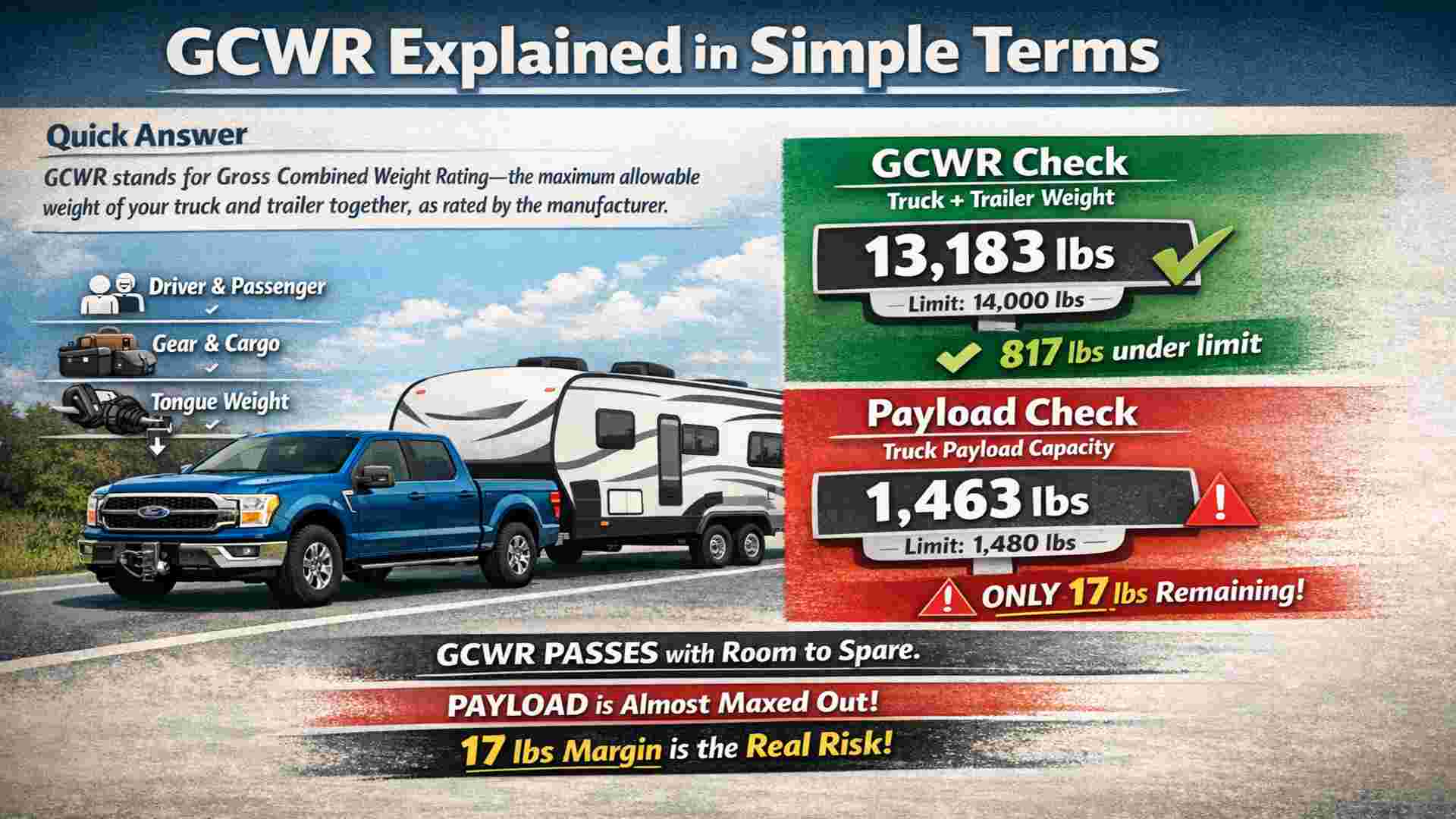
GCWR stands for Gross Combined Weight Rating—the maximum allowable weight of your truck and trailer together, as rated by the manufacturer. It accounts for the whole rig: loaded truck, loaded trailer, passengers, gear, and tongue weight transferred to the hitch. GCWR caps the system, but payload capacity is almost always the constraint that gets violated first.
Why GCWR Gets Overlooked
Tow ratings get all the attention. Dealers quote them. Brochures headline them. Drivers memorize them. But GCWR is the number that defines the outer boundary of your entire towing system—and most half-ton drivers have never looked it up on their door sticker.
That’s a problem. Because GCWR works in combination with payload capacity, and when the two converge on a real-world setup, the math is usually far tighter than the spec sheet suggests.
Truck Specs: Start at the Door Sticker
For this walkthrough, we’ll use a 2023 F-150 XLT with a 3.5L EcoBoost—a common pairing for mid-size travel trailers.
Pull these numbers from the door jamb sticker, not the brochure. Brochures show best-case configurations for the trim line. Your sticker shows the legal limits for your specific truck as built.
- GVWR: 7,050 lbs — the maximum allowable weight of the fully loaded truck
- Curb weight: 5,570 lbs — truck empty, full fluids, no passengers
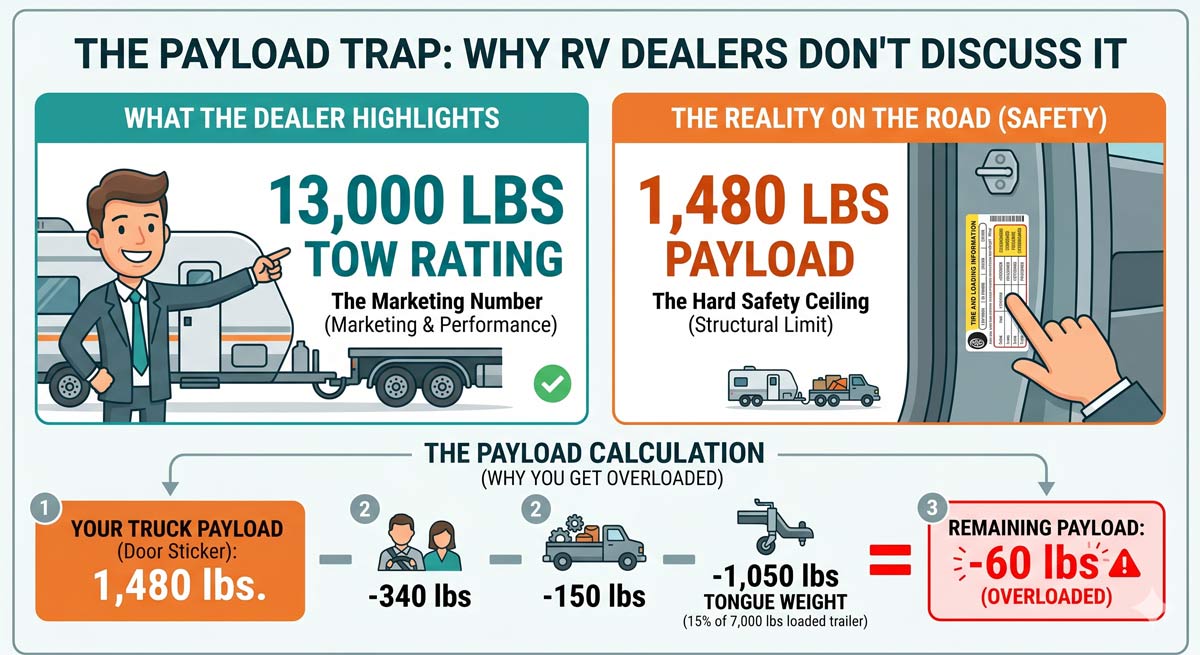
- Payload capacity: 1,480 lbs — this is the number that governs everything else
The GCWR for this truck is listed at 14,000 lbs. That tells you the maximum combined weight of truck plus trailer. But GCWR assumes you’re operating within payload capacity—a condition many setups quietly violate without anyone noticing.
Trailer Specs: Dry Weight Is Not Your Number
Our trailer is a mid-size travel trailer with these manufacturer specs:
- Dry weight: 5,200 lbs
- Trailer GVWR: 7,200 lbs
- Listed tongue weight: 620 lbs (dry configuration)
Dry weight is the trailer with nothing in it. That is not how you tow it.
Dry weight does not equal loaded weight. The trailer GVWR of 7,200 lbs represents the maximum allowable loaded weight, not the expected loaded weight. Once you add water, food, clothing, bedding, tools, and gear, the trailer’s actual weight is substantially heavier than the dry figure.
Dry vs. Loaded Weight: The Gap That Breaks Setups
Loaded trailers routinely exceed dry weight by 15–30%. That range is the observed norm when you put real gear into real trailers and weigh them.
For our 5,200 lb dry trailer:
- At 15% load increase: 5,980 lbs loaded
- At 20% load increase: 6,240 lbs loaded
- At 25% load increase: 6,500 lbs loaded
We’ll use 6,150 lbs as the working loaded weight—an 18% increase over dry, well within normal range for a trailer in active use.
This distinction matters because tongue weight, payload consumption, and GCWR compliance all depend on actual loaded weight, not dry weight. Calculating with dry weight produces a setup that looks safe on paper and fails under real conditions.
Tongue Weight Rule: 12–15% of Loaded Trailer Weight
Tongue weight is the downward force the trailer hitch applies to the truck’s rear axle. Manufacturers recommend keeping it between 12–15% of loaded trailer weight.
With our 6,150 lb loaded trailer:
- At 12%: 738 lbs tongue weight
- At 15%: 923 lbs tongue weight
The conservative calculation uses 15%. That gives you the correct number for evaluating worst-case payload impact.
Tongue weight counts against your truck’s payload capacity. It is not a separate category. Every pound on the hitch subtracts directly from your 1,480 lb payload budget before you account for a single person or bag.
Real Math: Where GCWR and Payload Converge
Here’s the full payload accounting against the truck’s 1,480 lb door sticker rating:
| Item | Weight (lbs) |
| Truck Payload Capacity (door sticker — not brochure) | 1,480 |
| minus Driver + Passenger | minus 340 |
| minus Gear / cargo in truck bed | minus 200 |
| minus Tongue weight (15% of 6,150 lb loaded trailer) | minus 923 |
| = Remaining Payload Margin | 17 lbs |
Now the GCWR check, using actual payload consumed rather than theoretical maximum:
| Item | Weight (lbs) |
| Truck curb weight | 5,570 |
| plus Actual payload used (340 + 200 + 923) | plus 1,463 |
| plus Loaded trailer weight | plus 6,150 |
| = Actual Gross Combined Weight | 13,183 |
| GCWR limit | 14,000 |
| = GCWR margin | 817 lbs |
The GCWR check passes with 817 lbs to spare. The payload check nearly fails with 17 lbs remaining.
This is the core lesson of GCWR: a setup can clear the combined weight ceiling while simultaneously maxing out the payload rating. They are different constraints operating on different systems. Both have to pass independently.
When GCWR Clears but Payload Doesn’t
Seventeen pounds.
That’s the margin between this common, real-world setup and an overloaded truck. A few extra water jugs. A heavier toolbox. A second passenger above the assumed average weight.
GCWR gives you one view of the system—and this setup passes it comfortably. Payload capacity gives you another view—and this setup is one poor packing decision from being over.
The margin that matters here is 17 lbs, not 817 lbs. If you’re leading with the GCWR number, you’re looking at the wrong constraint.
If you’re wondering where your truck would land in this calculation, don’t guess.
Not sure if your truck is within safe limits? Towing Limit Pro helps you verify your real setup using your actual payload sticker, passengers, cargo, and trailer numbers.
- Remaining payload (what you actually have left)
- Realistic tongue weight estimate (loaded, not brochure)
- GVWR margin + a clear safety buffer
- Risk-zone warning if your setup is pushing limits
Tip: Use your truck’s yellow door sticker payload for the most accurate result.
Verdict: Fine on GCWR, Borderline on Payload
This setup is borderline. The GCWR clears with room, but the payload margin is effectively zero at real-world load levels. Any variation in passenger weight, truck bed cargo, or trailer load pushes this into overloaded territory.
A borderline verdict does not mean the setup is wrong. It means precision is required. Weigh the tongue—don’t estimate it. Account for every person in the cab and every item in the bed. Confirm that your actual loaded trailer weight matches your calculation before you leave the driveway.
A 17 lb margin does not absorb guessing. If you are not measuring, you are assuming the math works—and in this setup, the math barely does.
Know your real margin before you hook up.
Most half-ton trucks hit their payload limit long before they hit their tow rating limit — and most owners don’t realize it until they’re already committed. Verify your exact setup and know where you stand.
- Remaining payload (your real limit)
- Realistic tongue weight (loaded)
- GVWR margin + safety buffer
- Clear risk-zone indicator
Best results: use your yellow door-sticker payload number and your loaded trailer estimate (not dry weight).
FAQs
What is GCWR and how is it different from tow rating?
GCWR (Gross Combined Weight Rating) is the maximum allowable weight of your truck and trailer together as a complete system. Tow rating is the maximum weight of the trailer alone. A truck might show a 13,000 lb tow rating alongside a 14,000 lb GCWR, but those numbers do not operate independently—once you subtract for the loaded truck, actual available trailer capacity is often several hundred pounds less than the tow rating implies. Both limits apply simultaneously; whichever is more restrictive governs.
Does payload or GCWR limit my setup more in practice?
In most real-world half-ton configurations, payload capacity is the binding constraint—not GCWR. Payload includes driver, passengers, bed cargo, and tongue weight, all deducted from a budget that often sits below 1,500 lbs. GCWR is a system ceiling that rarely gets approached before payload is exhausted. If your GCWR check passes but your payload check fails, the setup is still over capacity. Passing one does not excuse the other.
Why can't I just use dry weight when planning a tow?
Dry weight represents the trailer with nothing loaded—no water, no food, no gear, no personal items. It's the manufacturer's floor, not your operating weight. Loaded trailers routinely weigh 15–30% more than dry weight in real use. Using dry weight systematically underestimates tongue weight, overstates payload margin, and produces numbers that look safe in a spreadsheet but fail on a scale. Always calculate with estimated loaded weight, not dry weight.
What happens if my setup exceeds payload capacity but stays within GCWR?
The truck is overloaded regardless of the GCWR result. Payload capacity governs the structural and mechanical limits of the vehicle—suspension travel, axle ratings, brake performance. Exceeding payload degrades handling, extends stopping distance, and accelerates wear on components, even if the total combined weight stays under the GCWR ceiling. The two ratings are independent. Both must be satisfied.
Where do I find my truck's actual payload rating?
The door jamb sticker on the driver's side—not the owner's manual, not the manufacturer's website, and not the brochure. The sticker is specific to your vehicle as configured: cab size, drivetrain, options package. Brochure figures represent the maximum payload for the trim, which may not apply to how your truck was built. The sticker is the legal document. Use it.