
Quick Answer
Tongue weight counts directly against your truck’s payload capacity — not your tow rating. On a loaded mid-size travel trailer, that single number can consume 60 percent or more of a half-ton’s available payload, leaving almost nothing for passengers, gear, and the driver.
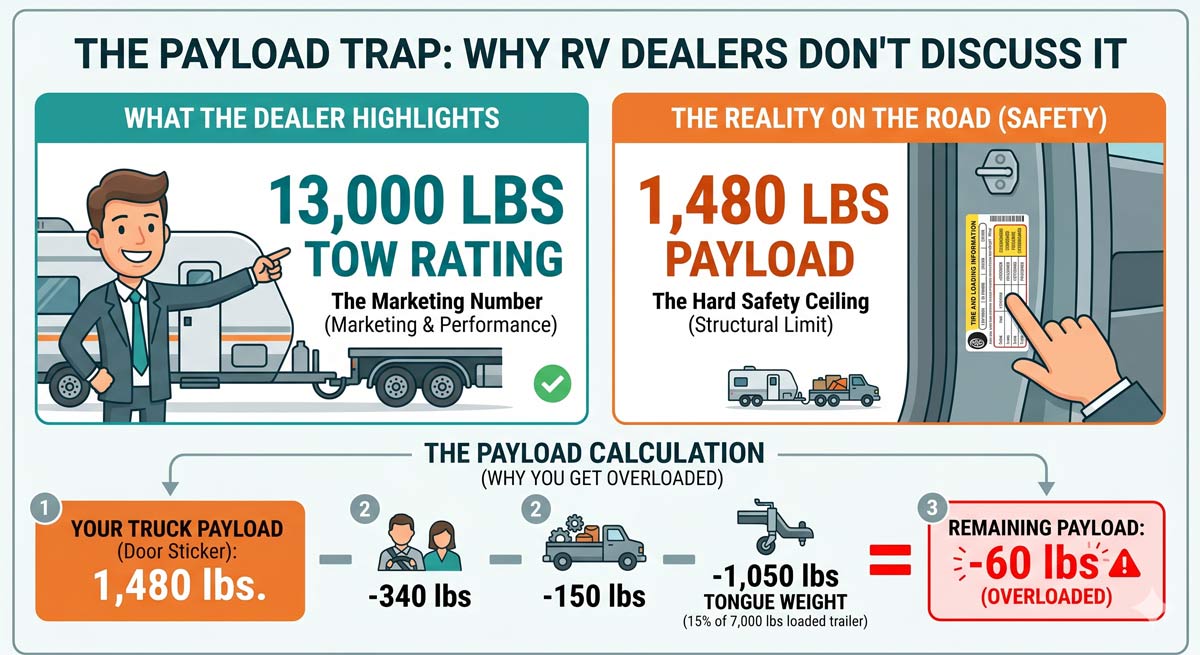
Your truck’s payload capacity is found on the door sticker — not the brochure — and that number is what actually limits your tow.
The Number Nobody Talks About
Most half-ton owners spend hours comparing tow ratings. Almost none of them know their payload number. That gap is where the real problems start.
Here’s the part that stings: manufacturer tow ratings assume a near-empty truck. The moment you add people, fuel, cargo, and a trailer’s tongue weight, that generous number from the window sticker becomes irrelevant. The door sticker payload is the only math that matters — and it runs out faster than you think.
Truck Specs That Actually Matter
For this walkthrough, we’ll use a representative configuration: a half-ton crew cab short-bed with the common 3.5L turbocharged V6.
Numbers below come from the door sticker — not the brochure.
- GVWR: 7,050 lbs
- Curb weight: 5,570 lbs
- Payload capacity: 1,480 lbs
That 1,480 lbs is the entire budget — for every pound that goes onto or into this truck. Driver, passengers, luggage, tongue weight. All of it subtracts from that single number.
Trailer Specs: What the Sticker Says vs. What You’re Actually Towing
Consider a popular mid-size travel trailer in the 24–26 foot range:
- Dry weight: 4,800 lbs
- GVWR: 6,500 lbs
- Manufacturer-stated tongue weight: 650 lbs
Dry weight does not equal loaded weight. Dry weight is what the trailer weighs empty — no water, no gear, no food, no clothing, no bikes. The GVWR is the maximum loaded weight. What you’ll actually tow lands somewhere between those two numbers, and it’s closer to GVWR than most people expect.
Dry vs. Loaded: The Gap Most People Ignore
Loaded trailers routinely exceed dry weight by 15 to 30 percent. Water alone — a 40-gallon fresh tank — adds 334 lbs. Add bikes on a rack, a full wardrobe, pantry staples, bedding, tools, and gear for the kids, and you’ve added 700 to 1,400 lbs without trying.
On our 4,800 lb dry-weight trailer, a conservative real-world load of roughly 19 percent over dry puts you at 5,700 lbs — before fuel is topped off or passengers are in the truck.
That is your actual towing number. Build your math from here.
The Tongue Weight Rule: Show the Math
Tongue weight is the downward force the trailer’s hitch coupler exerts on the truck’s receiver. Industry standard: tongue weight should fall between 12 and 15 percent of loaded trailer weight.
At 5,700 lbs loaded:
| Loaded Trailer Weight | Tongue Weight at 12% | Tongue Weight at 15% |
| 5,000 lbs | 600 lbs | 750 lbs |
| **5,700 lbs** | **684 lbs** | **855 lbs** |
| 6,500 lbs | 780 lbs | 975 lbs |
| 7,000 lbs | 840 lbs | 1,050 lbs |
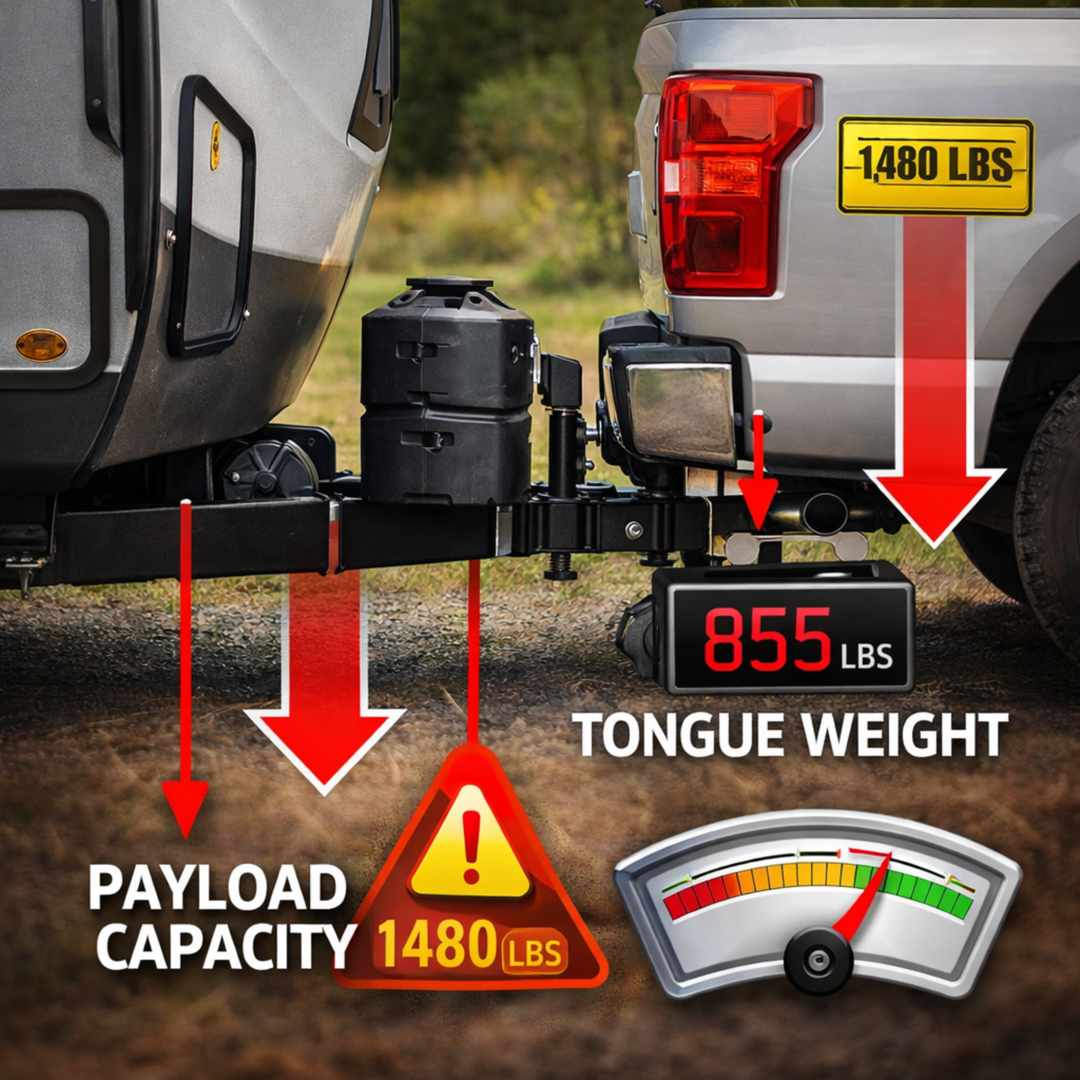
Using 15 percent — the conservative end of the safe loading range — tongue weight on this trailer at real-world loaded weight is 855 lbs. That’s 205 lbs more than the manufacturer’s stated 650 lb tongue weight. And it lands directly on your truck’s payload budget.
The Real Math: What’s Left After You Add It Up
| Item | Weight (lbs) |
| Truck Payload Capacity (door sticker — not brochure) | 1,480 |
| minus Driver + Passenger | minus 340 |
| minus Gear / cargo in truck bed | minus 200 |
| minus Tongue weight (15% of 5,700 lbs loaded trailer weight) | minus 855 |
| **= Remaining Payload Margin** | **85 lbs** |
How Little Payload Is Left
Eighty-five pounds.
That is your entire remaining payload margin — the buffer between a legal, stable tow and a truck operating over its rated capacity. One extra water jerry can in the truck bed eliminates it. A third passenger eliminates it twice over. A different packing day, with tanks a little fuller and a few more items along for the trip, and that number goes negative. This isn’t a close call. It’s a truck sitting at its structural limit before the trailer leaves the driveway.
If you’re wondering where your truck would land in this calculation, don’t guess.
Not sure if your truck is within safe limits? Towing Limit Pro helps you verify your real setup using your actual payload sticker, passengers, cargo, and trailer numbers.
- Remaining payload (what you actually have left)
- Realistic tongue weight estimate (loaded, not brochure)
- GVWR margin + a clear safety buffer
- Risk-zone warning if your setup is pushing limits
Tip: Use your truck’s yellow door sticker payload for the most accurate result.
Verdict: Borderline to Risky for This Half-Ton
This scenario lands in borderline-to-risky territory, and which side of that line you fall on depends on passenger count and how the trailer is actually packed. An 85 lb remaining margin is not a safety cushion — it’s a technicality. Any deviation from these exact inputs, whether that’s a third passenger, a heavier load day, or additional gear in the truck bed, pushes this tow past the truck’s rated payload capacity. A truck operating over payload isn’t just a compliance issue in many jurisdictions — it affects braking distance, suspension geometry, and steering response in ways that don’t announce themselves until you need emergency handling. The tow rating on the window sticker changes none of this. You can be well inside the tow rating and still be overloaded at the axle.
Know your real margin before you hook up.
Most half-ton trucks hit their payload limit long before they hit their tow rating limit — and most owners don’t realize it until they’re already committed. Verify your exact setup and know where you stand.
- Remaining payload (your real limit)
- Realistic tongue weight (loaded)
- GVWR margin + safety buffer
- Clear risk-zone indicator
Best results: use your yellow door-sticker payload number and your loaded trailer estimate (not dry weight).
FAQs
What's the difference between tow rating and payload capacity — and which one actually limits me?
Tow rating describes the maximum trailer weight the truck's drivetrain and hitch system can handle under near-empty-truck conditions. Payload capacity is a structural limit on how much total weight can be added to the vehicle itself — passengers, cargo, and tongue weight combined. Both can limit you, but payload runs out first on virtually every real-world half-ton tow. You can be 2,000 lbs inside your tow rating and still be over payload. Most people only check tow rating. That's the wrong number.
Does tongue weight count against my tow rating or my payload?
Tongue weight counts against your payload — not your tow rating. This surprises most people. The hitch's tongue weight rating tells you the hitch won't fail. The truck's payload capacity tells you the truck won't be overloaded. Those are two separate numbers with two separate consequences. If your payload is 1,480 lbs and your tongue weight is 855 lbs, you have 625 lbs remaining for every person and every item in or on the truck. Passengers are not free.
I've seen trailers listed at 4,800 lbs dry weight. Does that mean I'm towing 4,800 lbs?
No — it means the trailer left the factory weighing 4,800 lbs with tanks empty, no personal gear, and no dealer-added options. Every gallon of fresh water adds 8.3 lbs; a 40-gallon tank contributes 334 lbs before a single bag is packed. Bikes, tools, outdoor furniture, food, and clothing commonly add another 400 to 700 lbs on a typical trip. Dry weight is a starting point for manufacturer comparisons, not a planning number. Use loaded weight in every calculation that touches your truck's payload.
Can I tow safely if I'm within my tow rating but over payload?
No. Tow rating and payload are independent limits, and exceeding either one creates a problem regardless of where you land on the other. An overloaded truck — one where total added weight exceeds the door sticker payload — has compressed suspension, extended braking distance, and altered steering response. The truck will tow in this condition. It will not tow the way the engineers designed it to, and the consequences compound the faster you go and the harder you have to brake.
Why doesn't the dealer tow capacity figure include passengers or cargo?
It doesn't have to. SAE towing standards allow manufacturers to calculate tow capacity with a single 150 lb occupant. Everything above that one person is left for the buyer to account for. This means a truck marketed as capable of towing 13,000 lbs may carry only 1,200 to 1,600 lbs of total payload — and the published capacity assumes you'll barely load it. The math is technically accurate under controlled conditions. It does not survive contact with a real family, a packed trailer, and a tank of fuel.