
Quick Answer
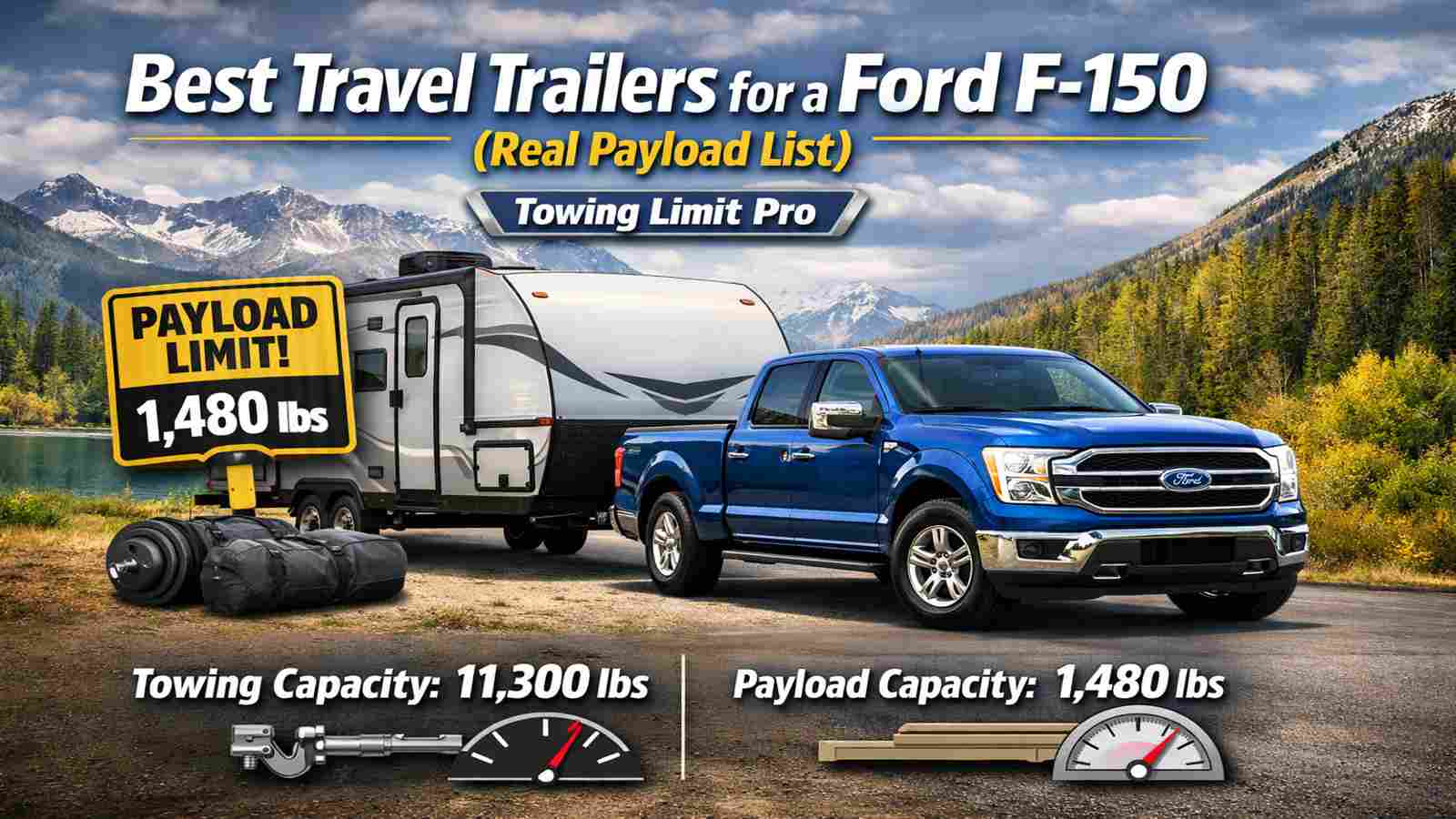
Yes, the F-150 can tow travel trailers — but far fewer than the tow rating suggests. Payload capacity, not tow rating, determines which trailers actually fit.
Most popular ‘half-ton towable’ trailers push the F-150 XLT to its payload limit or beyond.
Why the F-150 Tow Rating Is a Trap
The 2024 Ford F-150 XLT SuperCrew 4×4 is one of the most popular pickup trucks on the road, and for good reason. It feels capable, looks the part, and the spec sheet screams 11,300 lbs of towing power. But that number is a trap.
Here’s the uncomfortable truth: tow rating almost never determines which trailers fit. Payload capacity does. And the F-150 XLT has only 1,480 lbs of payload — according to the door sticker, not the brochure. Once you subtract driver and passenger weight, plus gear and supplies, the margin for tongue weight evaporates. This guide walks you through the math with the most popular travel trailers so you can see exactly where your pickup truck stands.
2024 Ford F-150 XLT SuperCrew 4×4 Specifications
The 2024 Ford F-150 XLT SuperCrew 4×4 with the stock 5.0L V8 engine and 4-wheel drive delivers an GVWR of 7,050 lbs and a curb weight of 4,950 lbs. That leaves a GAWR of 2,100 lbs for cargo and passengers. The actual payload capacity is 1,480 lbs according to the door sticker, not the brochure — this is critical. The tow rating is 11,300 lbs, which sounds impressive until you realize that number assumes nearly ideal conditions and does not account for payload deductions. The door sticker is your source of truth.
Popular Travel Trailers for the F-150
Travel trailers vary dramatically in weight. A dry weight is the trailer’s weight empty, with no water, propane, or personal gear. A loaded weight estimate adds 15-30% for full tanks, furniture, and supplies. The tongue weight is the downward force on the pickup truck’s hitch and counts against payload. For a Keystone Passport SL 229RK, the dry weight is approximately 4,876 lbs, but loaded it reaches around 6,100 lbs. The tongue weight is 915 lbs.
Why Dry Weight and Loaded Weight Matter
Confusing dry weight with loaded weight is one of the biggest mistakes in the towing world. A trailer’s dry weight is what it weighs when it leaves the factory — empty, with no propane in the tank, no water in the holding tanks, and no personal belongings inside. Loaded weight estimates add a realistic 15-30% to account for fuel, water systems, bedding, kitchen supplies, and everything else you actually travel with.
For the Keystone Passport SL 229RK example, the difference is 1,224 lbs. That’s not trivial. Many buyers see the dry weight and think they’re fine, then get the trailer home, fill the fresh water tank, close up the propane, and suddenly they’re over the pickup truck’s payload limit before they leave the driveway. Always plan for loaded weight, not dry weight.
The 15% Tongue Weight Rule
Tongue weight is typically 10-15% of the trailer’s total weight. For the math that matters, assume 15% to be conservative. With the Keystone Passport SL 229RK loaded at 6,100 lbs, 15% is 915 lbs. This 915 lbs counts against the pickup truck’s payload budget — it’s not separate. Your F-150 has 1,480 lbs of payload total. Subtract driver and passenger weight (approximately 340 lbs), subtract cargo and gear (approximately 200 lbs), and you have 940 lbs left. The tongue weight alone is 915 lbs. That leaves 25 lbs of margin. That’s not safe.
The Math: F-150 XLT with Keystone Passport SL 229RK
Below is the real math for the 2024 Ford F-150 XLT SuperCrew 4×4 with a Keystone Passport SL 229RK 24ft travel trailer loaded and ready to travel.
| Item | Weight (lbs) |
| Payload Capacity (door sticker) | 1,480 lbs |
| − Driver + Passenger | −340 lbs |
| − Gear & Supplies | −200 lbs |
| − Tongue Weight (6,100 × 15%) | −915 lbs |
| = Remaining Payload Margin | 25 lbs |
Remaining payload: 25 lbs. That’s a bag of ice. The F-150 XLT is at the edge of its payload limit.
If you’re wondering where your pickup truck would land in this calculation, don’t guess.
Not sure if your truck is within safe limits? Towing Limit Pro helps you verify your real setup using your actual payload sticker, passengers, cargo, and trailer numbers.
- Remaining payload (what you actually have left)
- Realistic tongue weight estimate (loaded, not brochure)
- GVWR margin + a clear safety buffer
- Risk-zone warning if your setup is pushing limits
Tip: Use your truck’s yellow door sticker payload for the most accurate result.
The Verdict: Which Trailers Work for the F-150?
The F-150 XLT can tow some travel trailers safely, but not the most popular mid-size models. Lightweight trailers under 4,500 lbs loaded work well — the Airstream Bambi 16RB (loaded 4,400 lbs, tongue 660 lbs) leaves 480 lbs of margin, which is comfortable. The Forest River R-Pod 193 (loaded 4,000 lbs, tongue 600 lbs) is even safer at 540 lbs of margin.
The moment you move toward 24-28 ft trailers loaded above 5,500 lbs, the F-150 XLT’s payload constraint becomes real. The Grand Design Imagine XLS 17MKE (loaded 4,700 lbs, tongue 705 lbs) leaves only 235 lbs of margin — tight but possible. The Salem Cruise Lite 261BHXL (loaded 6,600 lbs, tongue 990 lbs) actually overloads the F-150 by 50 lbs before you add a single personal item.
In short: the F-150 XLT is safe for trailers under roughly 5,000 lbs loaded. Anything larger requires careful calculation and honest assessment of your own weight, plus supplies.
Know your real margin before you hook up.
Most half-ton trucks hit their payload limit long before they hit their tow rating limit — and most owners don’t realize it until they’re already committed. Verify your exact setup and know where you stand.
- Remaining payload (your real limit)
- Realistic tongue weight (loaded)
- GVWR margin + safety buffer
- Clear risk-zone indicator
Best results: use your yellow door-sticker payload number and your loaded trailer estimate (not dry weight).
FAQs
What is the best travel trailer for a Ford F-150?
The best travel trailer for an F-150 XLT is one that stays under approximately 4,500 lbs loaded weight. Lightweight, compact models like the Airstream Bambi 16RB or Forest River R-Pod 193 deliver safety margins and better fuel economy. Avoid the popular mid-size models (24-28 ft) unless you are willing to run at or near the F-150's payload limit.
Can an F-150 tow a 30-foot travel trailer?
Not safely for an F-150 XLT. A 30-foot travel trailer typically weighs 6,500-8,000 lbs loaded, with tongue weight around 975-1,200 lbs. That tongue weight alone exceeds the F-150 XLT's available payload margin after accounting for driver and gear. A 30-footer needs a 3/4-ton pickup truck like a Ram 2500 or Silverado 2500.
What is the real payload capacity of an F-150 XLT?
The 2024 Ford F-150 XLT SuperCrew 4x4 has a payload capacity of 1,480 lbs according to the door sticker. This is not the same as tow rating. Payload is the weight the pickup truck can safely carry downward (passengers, cargo, tongue weight). The door sticker shows the manufacturer's tested rating for your exact pickup truck configuration.
Why does payload matter more than tow rating for the F-150?
Tow rating is based on ideal conditions and engine power alone. Payload is the actual limiting factor because tongue weight is downward force that counts against your payload budget directly. An F-150 might have an 11,300 lbs tow rating, but if the trailer's tongue weight is 1,000 lbs and your payload is only 1,480 lbs, the trailer overloads your pickup truck before it even moves. The door sticker payload determines compatibility, not the tow rating.
How do I check my F-150's real payload capacity?
Look at the driver's door jamb sticker on your F-150. It will list GVWR (Gross Vehicle Weight Rating), curb weight, and payload capacity in lbs. Never use the brochure or online spec sheet — those are averages. Your door sticker shows the exact rating for your specific pickup truck configuration (engine, drivetrain, cab style, bed length). This is the only number that matters.