
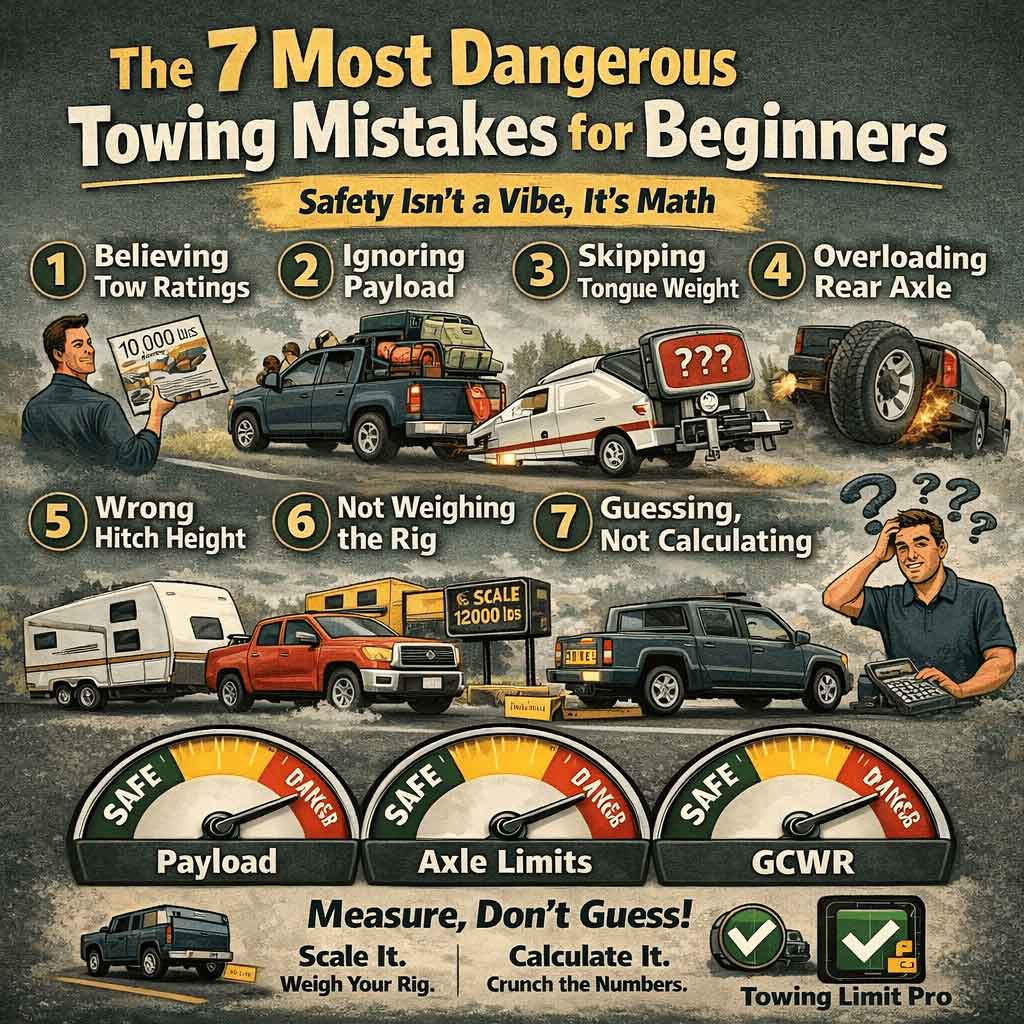
TL;DR — Safety Isn’t a Vibe, It’s Math
Most towing problems come from bad numbers: believing brochure tow ratings, ignoring payload and axle limits, guessing tongue weight, and skipping the scale. Fix those and you’ll tow straighter, stop shorter, and keep tires cool.
Table of Contents
- Mistake #1: Believing the dealer’s tow rating
- Mistake #2: Ignoring payload
- Mistake #3: Not checking tongue weight
- Mistake #4: Overloading the rear axle
- Mistake #5: Wrong hitch height / nose-up trailers
- Mistake #6: Not weighing the rig
- Mistake #7: Guessing instead of calculating
- Quick formulas & a worked example
- Pre-trip checklist (print this)
- Make it automatic with Towing Limit Pro
Mistake #1: Believing the dealer’s tow rating
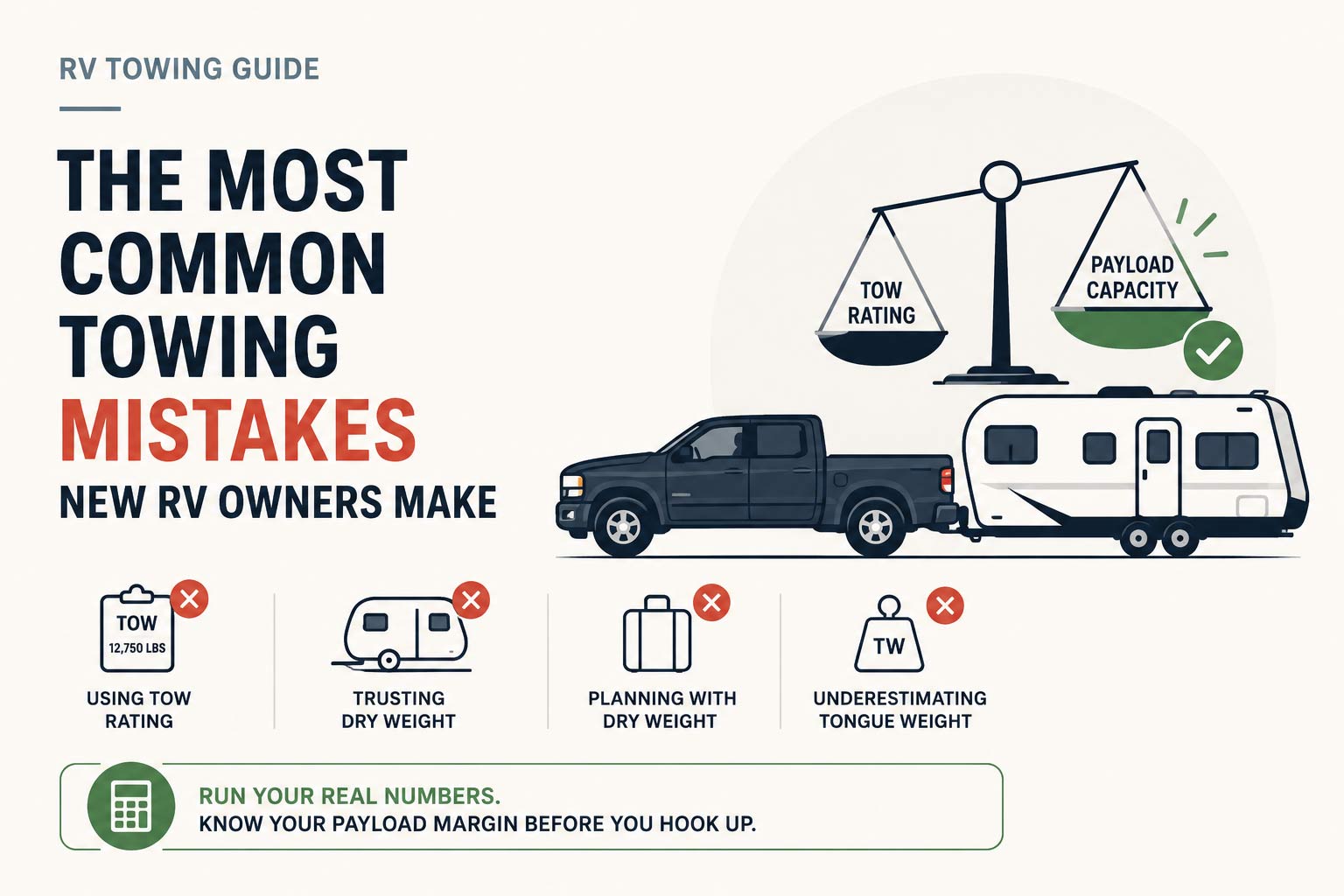
The problem: Brochure “max tow” numbers assume an ideal truck—base trim, light options, maybe one small driver and nothing else.
Why it’s dangerous: You can be under the tow rating and still be over payload, over rear GAWR, or over receiver/tire limits—the things that actually cause poor handling, hot brakes, and blowouts.
How to fix it:
- Find your yellow payload sticker on the driver door jamb (“The combined weight of occupants and cargo should never exceed…”).
- Read your GAWR (front/rear) on the certification label.
- Look up GCWR (truck + trailer max) in your owner’s manual/specs.
- Compare these to your actual scaled weights (see Mistake #6).
Pro move: Shop for payload, not tow rating. Sunroof, big wheels, 4×4, luxury seats—all reduce payload.
Mistake #2: Ignoring payload
The problem: Payload is the #1 limit most beginners break first.
What counts against payload?
- People (driver + passengers)
- Cargo (bed + cab)
- Tongue weight (100% of it)
- Hitch hardware (often 70–120 lb for a WDH)
Why it’s dangerous: Over payload → saggy rear, light steering, long stopping, hot tires, insurance headaches.
How to fix it:
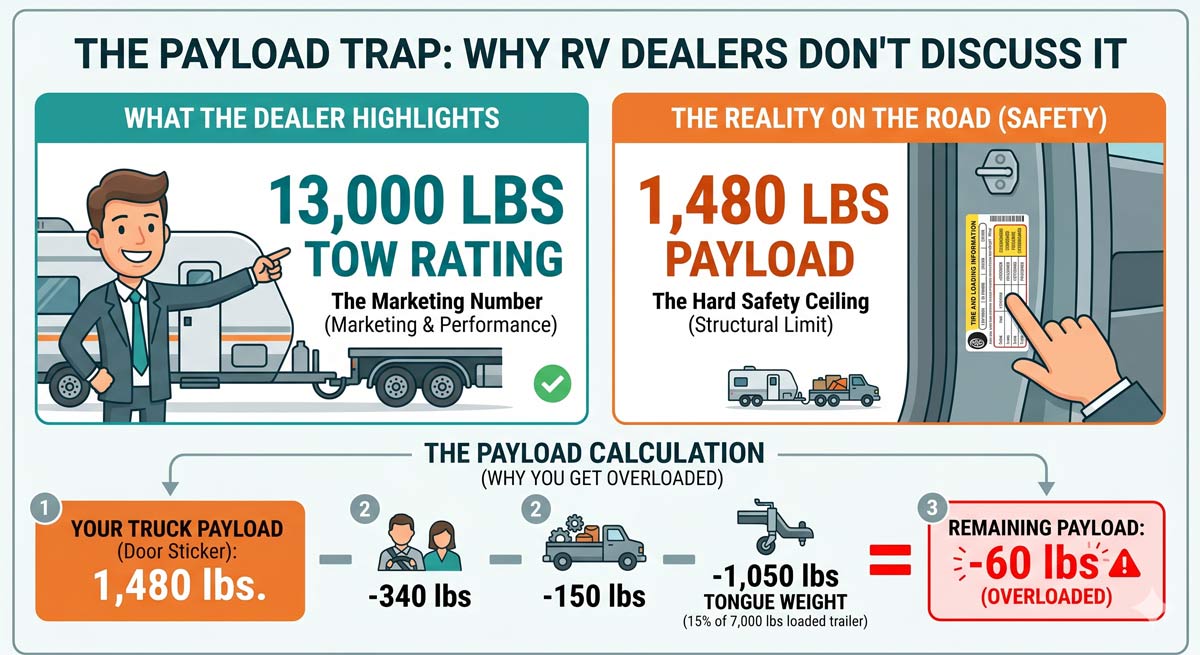
- Payload left = Payload sticker − (people + cargo + hitch + tongue weight).
- If negative, you’re overloaded. Reconfigure: lighten cargo, move to a higher-payload trim, or step up a class (¾-ton).
Mistake #3: Not checking tongue weight
The problem: Guessing TW (tongue weight) leads directly to sway or axle overload.
Targets:
- Travel trailers: 10–15% of actual trailer weight (Airstreams often 12–14%)
- Too light (<10%) → sway risk
- Too heavy (>15%) → payload/rear-axle overload
How to fix it:
- Measure with a tongue scale or compute via CAT Scale (see Mistake #6).
- Pack heavy items low and near trailer axles; avoid stuffing everything in the front pass-through.
- Use a weight-distribution hitch (WDH) sized for loaded TW.
Mistake #4: Overloading the rear axle
The problem: Even if payload looks OK, rear GAWR often blows past its limit from tongue weight + cargo.
Why it’s dangerous: Overloaded rears cook tires, squash suspension, and stress wheel bearings/axle tubes.
How to fix it:
- Weigh on a platform scale that gives front axle and rear axle separately (CAT Scale does).
- Adjust WDH tension to restore some weight to the front axle without exceeding its GAWR.
- Move cargo forward in the cab, not stacked at the tailgate.
- Increase tow vehicle capacity (more payload/stronger rear axle) if you can’t make numbers work.
Not sure if your truck is within safe limits? Towing Limit Pro helps you verify your real setup using your actual payload sticker, passengers, cargo, and trailer numbers.
- Remaining payload (what you actually have left)
- Realistic tongue weight estimate (loaded, not brochure)
- GVWR margin + a clear safety buffer
- Risk-zone warning if your setup is pushing limits
Tip: Use your truck’s yellow door sticker payload for the most accurate result.
Mistake #5: Wrong hitch height / nose-up trailers
The problem: A nose-up trailer shifts weight rearward and reduces tongue percentage—an invitation to sway.
Why it’s dangerous: Less tongue weight + higher rear tire load = twitchy handling and hot rubber.
How to fix it:
- Set ball height so the trailer tows level or slightly nose-down (≈ ½–1″ down at the coupler when loaded).
- Verify with a level on the frame rails on flat ground.
- Re-check after loading water/gear; adjust shank holes or WDH head tilt as needed.
Mistake #6: Not weighing the rig
The problem: “Feels fine” isn’t a measurement.
Why it’s dangerous: You can’t see overloaded axles or low front-axle weight from the driver’s seat.
How to fix it (CAT Scale basics):
- Weigh #1 (truck only) — steer + drive + gross (baseline).
- Weigh #2 (hitched, WDH engaged) — steer + drive + trailer axles.
- Optional Weigh #3 (hitched, WDH loosened) — reveals true tongue weight and how much the WDH is moving.
What you want to confirm:
- Truck gross ≤ GVWR
- Each axle ≤ GAWR
- Combined total ≤ GCWR
- Receiver limits not exceeded (TW & trailer weight with WDH)
- Tire load within ratings (adjust PSI accordingly)
Mistake #7: Guessing instead of calculating
The problem: Mental math caves under real-world variables: passengers change, water tanks fill, bikes appear, weather shifts.
Why it’s dangerous: Small miscalculations compound—suddenly your rear axle is 400 lb over and the steering feels like a canoe.
How to fix it:
- Use formulas (below) and verify on a scale.
- Or let Towing Limit Pro crunch everything: payload, axles, GCWR, receiver, tires, and WDH front-axle restoration—green/yellow/red at a glance.
Quick formulas & a worked example
Key terms:
- GVWR: Max weight of the truck, loaded
- GAWR F/R: Max weight on front/rear axles
- GCWR: Max combined truck + trailer
- Payload: GVWR − curb weight (on yellow sticker)
- Tongue weight (TW): Down force on the hitch ball
Compute true tongue weight (with CAT Scale):
- TW = (Truck gross hitched, WDH loose) − (Truck gross unhitched)
Front-Axle Load Restoration (FALR) with WDH:
- Steer lost without WDH: S₁ − S₃
- Steer regained with WDH: S₂ − S₃
- FALR % = (S₂ − S₃) / (S₁ − S₃) × 100
(S₁ = steer unhitched; S₂ = steer hitched WDH on; S₃ = steer hitched WDH loose)
Example
- Payload sticker: 1,450 lb
- People + dog + cooler + tools: 520 lb
- WDH hardware: 90 lb
- Trailer loaded: 6,800 lb
- Target TW 12–13% → ~820–885 lb
Payload math: 1,450 − (520 + 90 + 850) = −10 lb (over payload)
Fix options: move gear to trailer axles (keep TW ≥10%), remove heavy bed box, or upgrade to higher-payload trim/¾-ton.
Axle check (scale):
- If rear GAWR is exceeded, increase WDH tension to shift some load forward (but keep front ≤ GAWR), or reduce tongue weight within the safe window.
Pre-trip checklist (print this)
Truck & hitch
- Yellow sticker math done (payload vs people + cargo + hitch + TW)
- Receiver rating ≥ trailer & TW (with WDH as required)
- WDH bars matched to loaded TW; head tilt/links set; bolts torqued
- Brake controller gain set (start 5–6; test at 20–25 mph)
- Mirrors, lights, 7-pin, safety chains crossed, breakaway cable attached
Trailer
- Tires < 6 years; correct PSI; lugs torqued
- Load heavy items low and near axles; front pass-through not overstuffed
- Tongue weight measured/verified (scale or CAT math)
- Doors/compartments latched; awning locked; stabilizers up
On the road
- Cruise 60–65 mph; increase following distance
- Smooth inputs (steer/throttle/brake)
- If sway begins: ease off throttle, hold wheel straight, manually apply trailer brakes (don’t over-steer)
Make it automatic with Towing Limit Pro
You can scribble math on a napkin—or you can let the app do it in seconds.
What you get:
- Green/Yellow/Red checks for payload, front/rear GAWR, GCWR, receiver & tire limits
- Cat Scale Mode: enter steer/drive/trailer readings; get true tongue weight, WDH FALR%, and instant compliance
- WDH guidance: see how head tilt/link changes move axle loads
- Profiles & history: save multiple trucks/trailers and weigh tickets (weekend vs long-haul loadouts)
- Pre-trip checklist: torque, tire PSI, brake gain, chain/cable reminders
Bottom line: The most dangerous towing mistakes are math mistakes. Measure, don’t guess—then let Towing Limit Pro keep you in the green so every trip feels calm, straight, and safe.
Most half-ton trucks hit their payload limit long before they hit their tow rating limit — and most owners don’t realize it until they’re already committed. Verify your exact setup and know where you stand.
- Remaining payload (your real limit)
- Realistic tongue weight (loaded)
- GVWR margin + safety buffer
- Clear risk-zone indicator
Best results: use your yellow door-sticker payload number and your loaded trailer estimate (not dry weight).