
Why Weighing Matters (No, You Can’t “Eyeball” It)
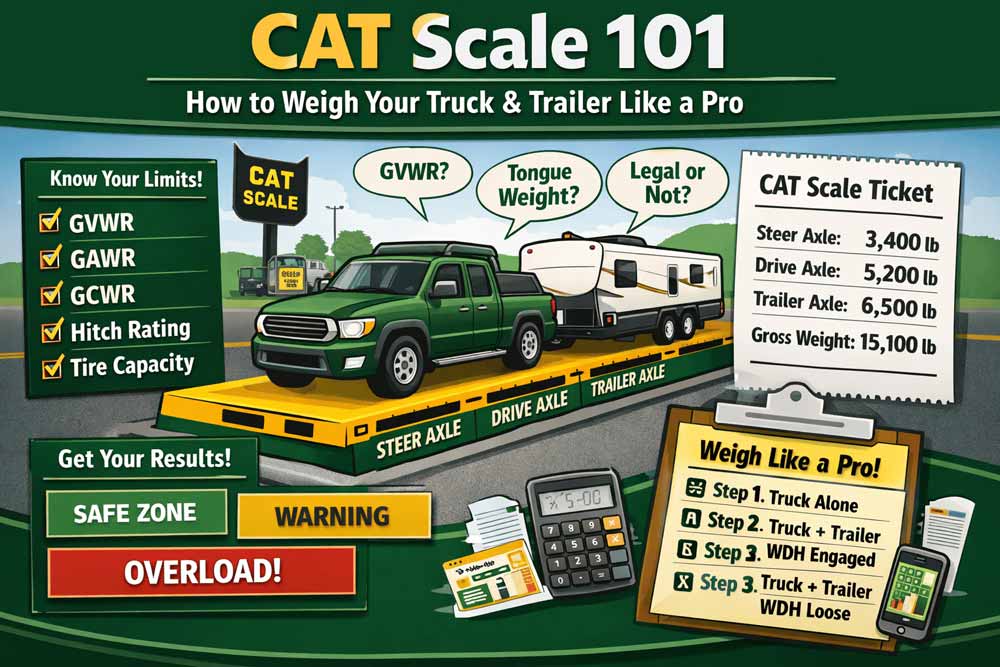
Towing safety isn’t a vibe—it’s math. You need real axle weights and real tongue/pin weight to confirm you’re within:
- GVWR (max loaded weight of your truck)
- GAWR (max per axle—front/rear)
- GCWR (max truck + trailer together)
- Receiver rating (hitch & tongue limits)
- Tire load capacity (truck & trailer)
If you skip the scale, you’re guessing on brakes, steering feel, tire temps, and legal compliance. One quick stop at a CAT Scale (available at many truck stops) replaces guesswork with facts.
What You’ll Get From a CAT Scale Ticket
Your ticket (or digital receipt) shows:
- Steer axle (truck’s front axle)
- Drive axle (truck’s rear axle)
- Trailer axle(s)
- Gross weight (all platforms combined)
With two or three quick weighs, you can compute:
- Actual tongue (travel trailer) / pin (5th-wheel) weight
- Front-axle load restoration from your weight-distribution hitch (WDH)
- Compliance vs. GVWR, GAWRs, GCWR, receiver rating, and tire limits
The Fastest Step-by-Step: How to Use a CAT Scale
Pro tip: Show up fully loaded as you’d tow—people, fuel, cargo, typical water/propane. If you change your packing later, re-weigh.
- Approach & position.
Drive onto the scale so steer axle is on platform 1, drive axle on platform 2, trailer axle(s) on platform 3. Stay straight; stop when the platform lights or lines match your axles. - Press the intercom / start at kiosk.
Say: “First weigh.” Provide your plate or basic info if asked. - Roll forward and park safely.
Pick up the printed ticket inside or receive it in the app if supported. - Reweighs (optional but recommended).
You can do one or two quick reweighs without leaving the property (lower cost). See “Weigh Sequences” below.
The Three Weigh Sequences (Travel Trailers & 5th-Wheels)
You can do one weigh and learn a lot. But with 2–3 quick weighs you’ll get the full picture.
Weigh #1 — Truck Alone (Baseline)
- Why: Establish unhitched front/rear axle loads.
- How: Drive onto the scale without the trailer. Record steer, drive, gross.
Weigh #2 — Truck + Trailer, WDH Engaged (Normal Towing)
- Why: See real on-road axle loads with your hitch set as you tow.
- How: Pull on with steer on platform 1, drive on 2, trailer axles on 3. Record values.
Weigh #3 — Truck + Trailer, WDH Bars Loosened (Optional)
- Why: Measure true tongue weight (travel trailer) and see exactly how much the WDH is shifting.
- How: In a safe pull-through spot away from traffic, loosen/uncouple the spring bars (do not unhook the coupler). Re-position on the scale and record. Re-tension after.
Safety note: Only adjust WDH tension where it’s safe and level. Follow your hitch manufacturer’s instructions.
Not sure if your truck is within safe limits? Towing Limit Pro helps you verify your real setup using your actual payload sticker, passengers, cargo, and trailer numbers.
- Remaining payload (what you actually have left)
- Realistic tongue weight estimate (loaded, not brochure)
- GVWR margin + a clear safety buffer
- Risk-zone warning if your setup is pushing limits
Tip: Use your truck’s yellow door sticker payload for the most accurate result.
How to Read (and Use) the Numbers
Let’s name the readings:
- S₁, D₁ = Steer/Drive from Weigh #1 (truck alone)
- S₂, D₂, T₂ = Steer/Drive/Trailer from Weigh #2 (WDH engaged)
- S₃, D₃, T₃ = Steer/Drive/Trailer from Weigh #3 (WDH loose)
1) Actual Tongue (or Pin) Weight
- Travel trailer (true tongue weight):
Use Weigh #3 (bars loose).
TW = (S₃ + D₃) − (S₁ + D₁)
(That’s how much extra weight the trailer adds to your truck when no distribution is helping.) - If you only did Weigh #2 (bars engaged):
Added load on truck = (S₂ + D₂) − (S₁ + D₁)
This understates true TW because WDH shifts some weight back to the trailer. It’s still useful for payload math. - 5th-wheel (pin weight): Same formula; there’s no WDH, so one hitched weigh is fine.
PW = (S₂ + D₂) − (S₁ + D₁)
2) Front-Axle Load Restoration (WDH Tuning)
- Steer-axle loss without WDH: ΔF = S₁ − S₃ (often a positive number; front got lighter)
- Steer-axle gain with WDH: S₂ − S₃
- FALR (% restored):
\text{FALR} = \frac{S_2 – S_3}{S_1 – S_3} \times 100\% - Target: Restore most of the lost steer weight (often 50–100%), without pushing the front axle over its GAWR.
3) Compliance Checks (All Must Pass)
- Truck gross: (S₂ + D₂) ≤ GVWR
- Front axle: S₂ ≤ Front GAWR
- Rear axle: D₂ ≤ Rear GAWR
- Combined gross: (S₂ + D₂ + T₂) ≤ GCWR (from manual)
- Receiver rating: Trailer weight & tongue weight within WDH limits
- Tires: Per-axle loads within tire capacities (adjust pressures accordingly)
Example (Travel Trailer With WDH)
Weigh #1 (truck alone): S₁ = 3,400 | D₁ = 2,600 | Gross = 6,000
Weigh #2 (hitched, WDH engaged): S₂ = 3,360 | D₂ = 3,780 | T₂ = 5,600 | Gross = 12,740
Weigh #3 (hitched, WDH loose): S₃ = 3,220 | D₃ = 4,020 | T₃ = 5,420 | Gross = 12,660
Tongue weight (true):
TW = (S₃ + D₃) − (S₁ + D₁) = (3,220 + 4,020) − (3,400 + 2,600) = 1,240 lb
Added load with WDH engaged (for payload math):
(S₂ + D₂) − (S₁ + D₁) = (3,360 + 3,780) − 6,000 = 1,140 lb
FALR:
Steer lost with no WDH: 3,400 − 3,220 = 180 lb
Steer regained with WDH: 3,360 − 3,220 = 140 lb
FALR = 140 / 180 = 78% restored (good)
Now check limits:
- Truck gross (S₂ + D₂) = 7,140 → must be ≤ GVWR
- Front GAWR: S₂ = 3,360 → must be ≤ rating
- Rear GAWR: D₂ = 3,780 → must be ≤ rating
- Combined gross (S₂ + D₂ + T₂) = 12,740 → must be ≤ GCWR
- Receiver/hitch: ensure trailer weight and 1,240 lb TW within WDH/receiver specs
- Tires: confirm loads against tire load tables / placard
If anything is high: increase WDH tension (to move some load forward), redistribute cargo, reduce water/propane up front, or choose a higher-capacity tow vehicle.
Common Mistakes (and Easy Fixes)
- Measuring with empty people/gear. Always weigh as you tow—kids, dogs, coolers, bikes, tools, water.
- Relying on “tow rating” alone. Payload/axles/receiver/tire limits often fail before tow rating.
- WDH bars too soft or too tight. Use FALR math and axle limits to set tension correctly.
- Under-inflated tires. Heat and sidewall roll = sway and blowouts. Match PSI to load; trailer tires usually at sidewall max cold.
- Too little tongue weight (<10%). Invites sway. For many travel trailers, aim 10–15% (Airstreams often 12–14%).
- One-and-done. Re-weigh when you change loadouts (water, kayaks, generator, bikes, etc.).
Special Cases
- 5th-wheels: Use two weighs (truck alone; truck+trailer). Pin weight is the truck’s weight gain between those two. Confirm rear GAWR and GVWR; WDH not used.
- Motorhome + toad: Use similar platform logic; confirm front/rear GAWR of the motorhome and that your tow bar/baseplate ratings aren’t exceeded.
- Dually trucks: Same math—just more tire capacity headroom. Don’t skip the scale.
- Night/24-7 weighing: Many CAT locations are open late. Use intercom/kiosk; follow staff directions.
Brake Controllers, Speed & Road Feel (Quick Hits)
- Integrated or proportional brake controller preferred. Start gain ~5–6, test at 20–25 mph, adjust so the trailer neither shoves nor jerks.
- Speed kills stability. Most sway events begin with too much speed for conditions. Cruise 60–65 mph unless conditions dictate lower.
- If sway begins: Ease off throttle, hold the wheel steady, and manually apply trailer brakes. Do not over-steer.
Pre-Scale Checklist (Print This)
- Fully loaded as you’d tow (people, cargo, water/fuel)
- Tire pressures set (truck & trailer)
- Hitch/receiver ratings verified (WDH required if specified)
- Safety chains crossed, breakaway cable connected, lights checked
- WDH torqued to spec; bars matched to loaded tongue weight
- Know your GVWR/GAWR/GCWR and tire load ratings
Got your CAT scale ticket? Turn those axle and gross weights into a clear answer: enter them in Towing Limit Pro and see exactly how much payload and GVWR margin you have left.
- Remaining payload (your real limit)
- Realistic tongue weight (loaded)
- GVWR margin + safety buffer
- Clear risk-zone indicator
Best results: use your yellow door-sticker payload number and your loaded trailer estimate (not dry weight).
FAQs
Do I need to unhook at the scale?
No. Stay hitched. Only loosen/tighten WDH bars if you’re doing the optional third weigh.
What if I only have time for one weigh?
Do Weigh #2 (normal towing). You’ll confirm axle compliance and total combined weight. If close to limits, come back for a baseline and WDH-off weigh.
Are CAT Scales accurate?
Yes—commercial-grade. Keep your axles cleanly on each platform and follow staff directions.
How often should I weigh?
At least once per new setup, and after significant packing changes (water tanks, bikes/generator, extra passengers).
Make It Automatic with Towing Limit Pro
You gathered the numbers—now let the app do the thinking:
- Cat Scale Mode: Enter your steer/drive/trailer readings; the app calculates true tongue/pin weight, FALR, and compliance against GVWR/GAWR/GCWR, receiver, and tires.
- Green/Yellow/Red dashboard: instant clarity on which limit is tight and why.
- WDH guidance: See how much front-axle load you’ve restored and how a link/tilt change affects balance.
- Profiles & history: Save multiple tow vehicles/trailers and weigh tickets to compare “weekend” vs. “long-haul” loadouts.
- Pre-trip checklist: Built-in reminders for torque, tire PSI, brake gain, chains, and lights.
Bottom line: Scales give you facts. Towing Limit Pro turns those facts into fast, confident decisions—so you hitch once, drive straight, and arrive relaxed.