
What You Must Know Before You Hitch Up an Airstream
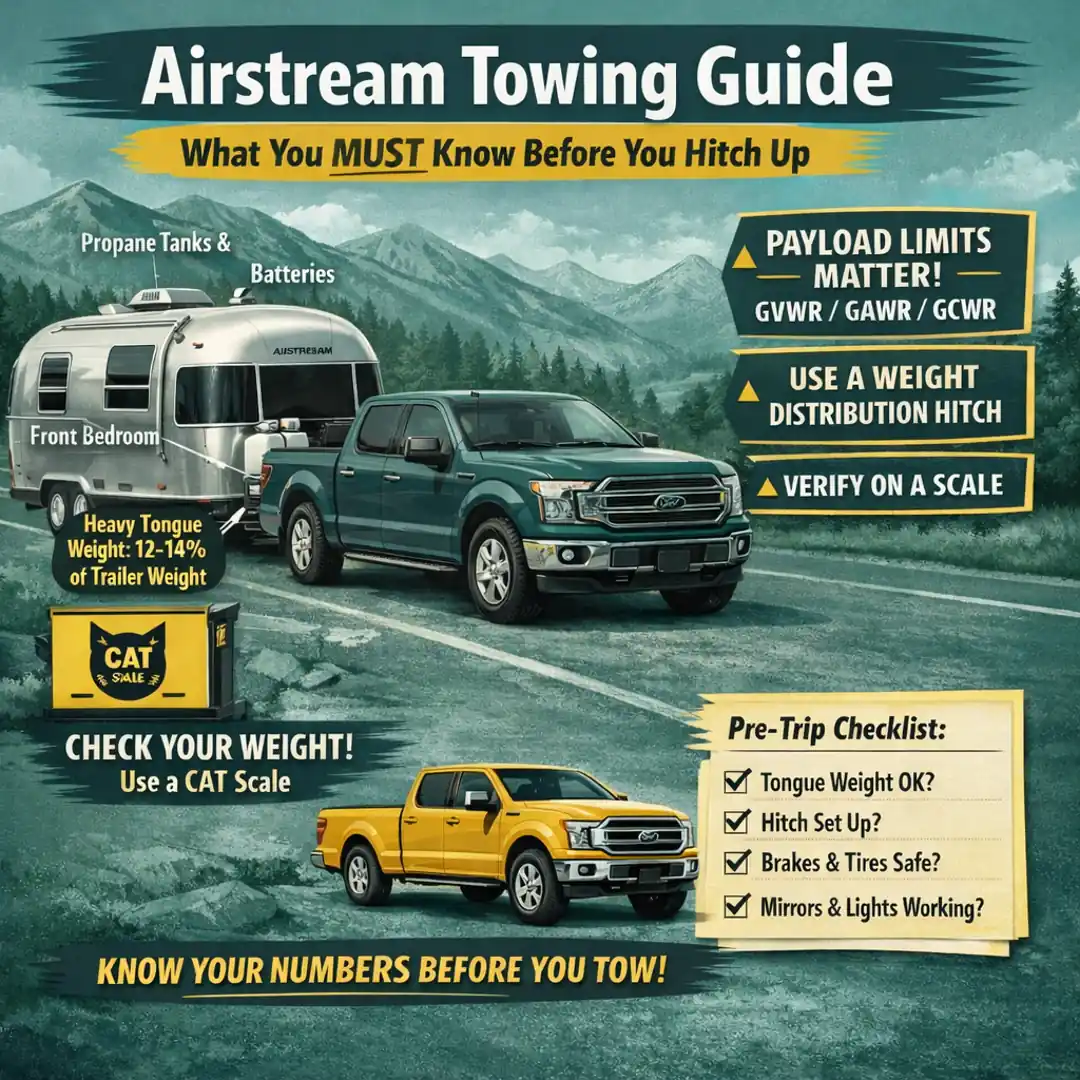
- Airstream travel trailers are front-heavy (propane + batteries + shell) and often carry 12–14% of total trailer weight on the tongue.
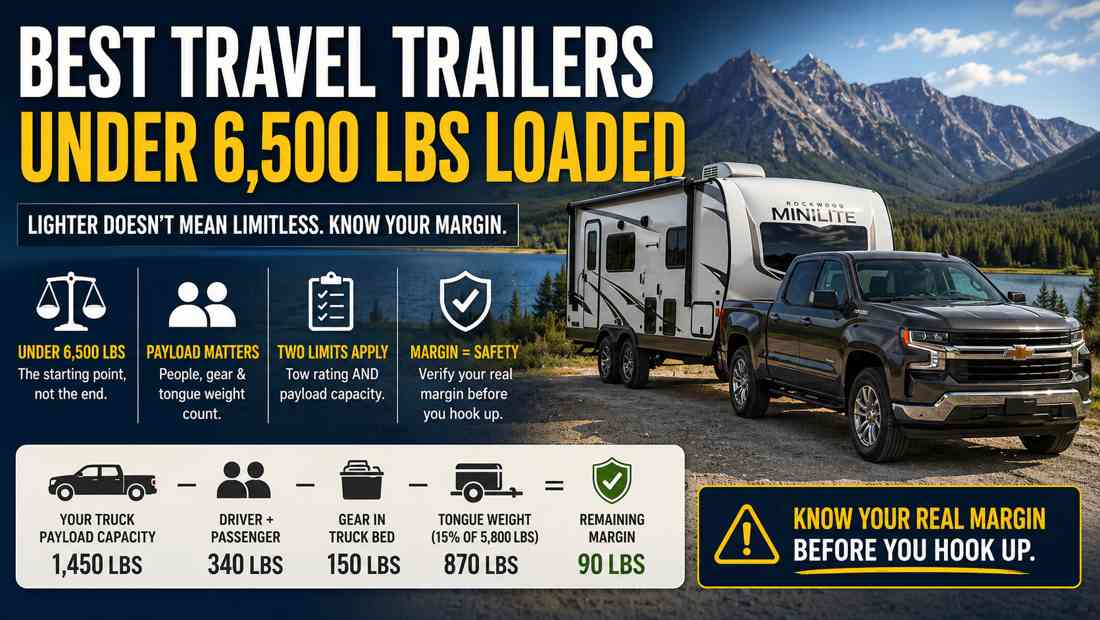
- That high tongue weight eats payload in your truck/SUV—fast. If your F-150 has a 1,400 lb payload, an Airstream 25FB with ~900–1,000 lb tongue weight leaves ~400–500 lb for people, gear, and hitch hardware.
- Safe towing = don’t exceed any of the limits: GVWR, GAWR (front/rear), GCWR, receiver rating, tire capacity—and verify on a scale.
- Use a weight-distribution hitch (WDH), check your actual tongue weight each trip, and weigh with a CAT Scale(or use Cat Scale Mode in your app) to confirm axle loads.
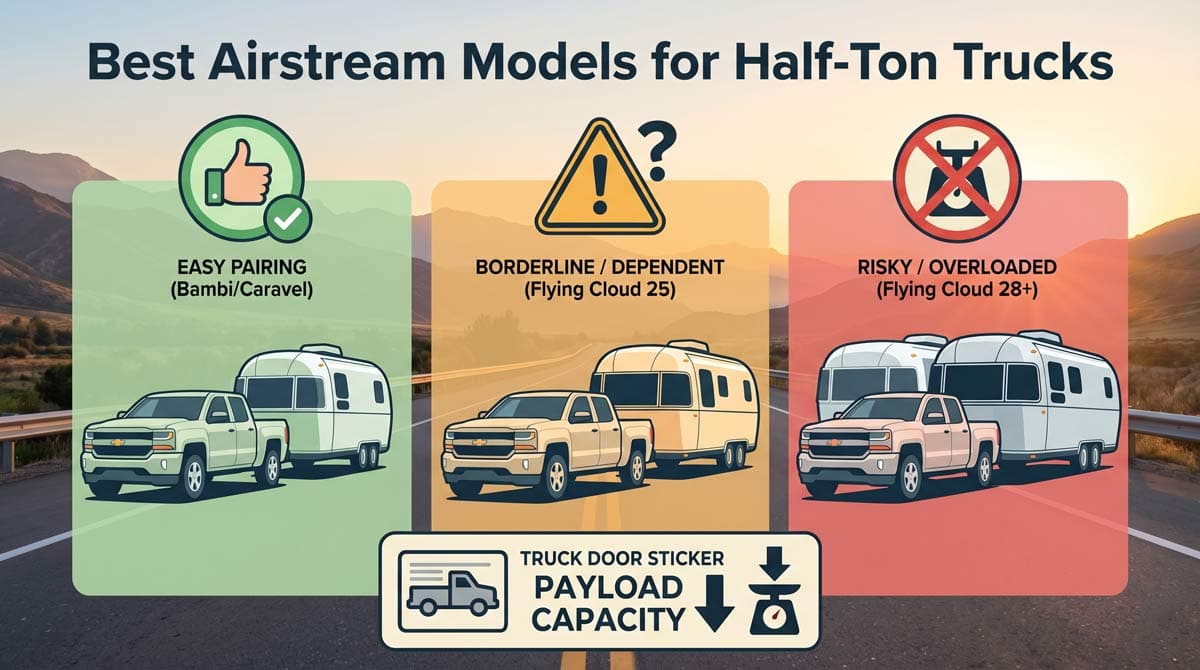
- If you’re shopping: ¾-ton pickups (F-250, Ram 2500, Silverado/Sierra 2500) make Airstream life easy. Some half-tons can work, but you must spec for payload, not just tow rating.
Table of Contents
- Why Airstreams Are Tongue-Heavy
- The Payload Trap (and How to Avoid It)
- Real-World Example: Airstream 25FB + Half-Ton
- Know Your Numbers (Glossary + Formulas)
- Set Up a Weight-Distribution Hitch Correctly
- How to Weigh on a CAT Scale (Step-by-Step)
- Brakes, Tires, Sway & Speed (Road Behavior)
- Best Tow Vehicles for Airstreams (and Smart Half-Ton Picks)
- Pre-Trip Checklist (Print-worthy)
- FAQ: Can My Half-Ton Tow an Airstream?
Why Airstreams Are Tongue-Heavy
Airstream’s polished, riveted shell doesn’t just look aerodynamic—it concentrates weight forward:
- Aluminum monocoque and sub-structure shift weight toward the A-frame.
- Batteries & propane live on/near the tongue.
- Many popular floorplans (e.g., FB = Front Bedroom) stack furnishings and storage ahead of the axles, especially with front pass-throughs.
Result: Compared with many box-style RVs that hover around 10–12% tongue weight, Airstreams frequently land 12–14% loaded—and sometimes higher if you pack heavy forward.
Target rule: 10–15% tongue weight is the safe window; 12–14% is common for Airstream. Too light (<10%) risks sway; too heavy (>15%) overloads the tow vehicle’s payload and rear axle.
The Payload Trap (and How to Avoid It)
Most owners shop tow vehicles by “max tow rating.” That’s a mistake. Your real choke-point is payload—the number on your yellow door-jamb sticker that reads: “The combined weight of occupants and cargo should never exceed …”
Payload is consumed by:
- People (driver + passengers)
- Cargo in cab/bed (coolers, tools, bikes)
- Tongue weight (full amount counts against payload)
- The hitch hardware itself (WDH head, shank, bars are often 70–120 lb total)
If payload runs out, you’re overloaded even if your tow rating looks fine. That’s why some half-tons tow a boat fine (low tongue) but struggle with Airstreams.
Real-World Example: Airstream 25FB + Half-Ton
Trailer: Airstream 25FB
- GVWR: 7,300 lb
- Likely loaded weight: ~6,800–7,300 lb (trip-dependent)
- Tongue weight (12–14%): ~820–1,020 lb
- WDH hardware: ~80–100 lb (counts against payload too)
Truck: Half-ton with 1,400 lb payload
- Subtract TW ~950 lb → 450 lb left
- Subtract WDH 90 lb → 360 lb left
- Subtract Passengers & gear (driver 180, partner 140, cooler + tools 100) → −60 lb (over payload)
Even with a “good” tow rating, you’re out of payload fast. Solutions:
- Move to a higher-payload configuration (regular cab, 2WD, lighter trims)
- Consider ¾-ton (F-250/Ram 2500/2500HD) to gain payload headroom
- Pack weight aft of the trailer axles carefully to reduce TW (but do not go below ~10%)
Know Your Numbers (Glossary + Formulas)
GVWR (Gross Vehicle Weight Rating): Max the truck can weigh loaded. On the door sticker.
GAWR (Gross Axle Weight Rating): Max weight on each axle (front & rear). On the door sticker.
GCWR (Gross Combined Weight Rating): Max truck + trailer together. Owner’s manual/spec.
Curb weight: Truck empty, with fuel & standard equipment.
Payload: GVWR − curb weight. (On the yellow sticker.)
Receiver rating: Max tongue weight & trailer weight your hitch/receiver allows (WD vs. dead-weight).
Tongue Weight (TW): Downward force at the ball—counts 100% against payload.
Essential checks (you must pass all five):
- Truck actual weight ≤ GVWR
- Each axle actual ≤ GAWR (front & rear)
- Combined truck+trailer ≤ GCWR
- Receiver rating not exceeded (TW & trailer weight, with/without WDH)
- Tire load ratings not exceeded (check sidewalls & pressures)
Set Up a Weight-Distribution Hitch Correctly
A WDH is mandatory for most Airstream + half-ton pairings and still smart on ¾-tons for balance.
Your goals:
- Restore front-axle weight close to unhitched value (commonly 50–100% of the loss)
- Keep rear axle within GAWR
- Maintain level or slight nose-down trailer stance
Setup walkthrough:
- Measure unhitched: On level ground, record front/rear fender heights (or better, weights on a scale).
- Mount WDH head: Set ball height ~1″ above coupler height; add 2–6° rear tilt (per brand).
- Choose spring bars: Rate them for loaded tongue weight (TW + 100–200 lb margin).
- Attach bars & tension: Start with manufacturer’s link count or jack-point; aim to recover most of the front-axle drop without over-lifting.
- Re-measure: Fender heights or axle weights should show front restored and rear within GAWR; adjust head tilt/links as needed.
- Re-torque everything after the first 50–100 miles; recheck chain/link counts.
Sway control: Many WDHs integrate sway friction (Equal-i-zer, Reese Dual Cam). Premium hitches (Hensley/ProPride) change geometry to resist sway altogether. Still, the best sway control is correct tongue weight & balance.
How to Weigh on a CAT Scale (Step-by-Step)
Bring your rig ready to camp (full people, gear, typical water). Use your app’s Cat Scale Mode to log readings.
Weigh #1 – Truck alone (baseline)
- Pull onto the scale without the trailer.
- Record steer axle (front), drive axle (rear), and gross.
Weigh #2 – Truck + trailer, WDH engaged
- Pull on with steer axle on platform 1, drive axle on platform 2, trailer axles on platform 3.
- Record all three axle weights.
Weigh #3 – (Optional) WDH loose
- Loosen bars (carefully, out of traffic), reweigh to see how much weight the WDH is moving forward.
Calculate:
- Actual TW ≈ (Truck gross with trailer attached) − (Truck gross unhitched)
- Check each axle against GAWR, truck gross against GVWR, total against GCWR
- If any are high, adjust load, WDH settings, or vehicle choice.
Not sure if your truck is within safe limits? Towing Limit Pro helps you verify your real setup using your actual payload sticker, passengers, cargo, and trailer numbers.
- Remaining payload (what you actually have left)
- Realistic tongue weight estimate (loaded, not brochure)
- GVWR margin + a clear safety buffer
- Risk-zone warning if your setup is pushing limits
Tip: Use your truck’s yellow door sticker payload for the most accurate result.
Brakes, Tires, Sway & Speed (Road Behavior)
Brake controller:
- Use a quality proportional controller or integrated OEM system.
- Start brake gain around 5.0–6.0, test at 20–25 mph, adjust so the trailer neither shoves nor grabs.
Tires & pressures:
- Inflate tow-vehicle tires to the load-inflation recommended for your rear axle weight (often near the door-placard max when towing).
- Trailer tires: run at the sidewall max cold unless the manufacturer specifies otherwise; inspect dates—replace around 5–6 years from DOT code.
Speed:
- Most trailer sway incidents start with speed. Keep it 60–65 mph unless conditions demand less.
- Headwinds, passing semis, and downhill curves amplify sway forces—slow down early.
Packing & balance:
- Keep heavy items low and near the trailer axles.
- Avoid overloading the front pass-through; aim to keep TW in the 12–14% pocket, not 16–18%.
Best Tow Vehicles for Airstreams (and Smart Half-Ton Picks)
Easiest mode (recommended): ¾-ton pickups
- Ford F-250, Ram 2500, Chevy/GMC 2500HD
- Typical payload: ~2,500–3,500 lb (varies by trim)
- Strong rear axles, firm springs, larger brakes—headroom for tongue, people, gear, and hitch.
Half-tons that can work—if spec’d for payload
- Ford F-150 with HD Payload Package (where available) or lighter trims (2WD, smaller cab, no panoramic roof)
- Toyota Tundra: choose trims with higher payload, not the heaviest luxury packages
- Silverado/Sierra 1500, Ram 1500: look for higher payload configurations; verify the yellow sticker—not the brochure
Bonus tip:
- Sunroofs, 4×4, big wheels, and luxury seats reduce payload. If the family and a 25–27′ Airstream are your priority, shop for the sticker, not the chrome.
Pre-Trip Checklist (Print-worthy)
Truck & hitch
- Payload math confirmed (yellow sticker vs. people + cargo + TW + WDH)
- Receiver rating (weight-distribution) ≥ loaded trailer weight & TW
- WDH bars matched to loaded TW; head tilt/links set; bolts torqued
- Brake controller tested; trailer brakes functional
- Mirrors adjusted; lights checked; safety chains crossed; breakaway cable attached
Trailer
- Tires < 6 years old; no cracks; torqued lugs; correct PSI
- Propane off for fueling; detectors tested
- Load low and near axles; front pass-through not overloaded
- Tongue weight measured (scale, Sherline, or app + CAT math)
- Stabilizers up; doors/compartments latched; awning locked
On the road
- Target speed 60–65 mph; leave space
- Smooth inputs: steer, throttle, brake
- If sway starts: let off throttle, hold wheel straight, manually apply trailer brakes; do not over-steer
FAQ: Can My Half-Ton Tow an Airstream?
Q: My truck says it can tow 9,500 lb. Is that enough for a 25FB (7,300 GVWR)?
A: Maybe—but tow rating isn’t the hurdle. Payload is. Airstream tongue weight (~12–14%) plus people, gear, and the WDH often overruns a typical half-ton’s payload before you hit tow rating. Check the yellow sticker and do the math.
Q: Do I really need a WDH?
A: With an Airstream and a half-ton, yes. A WDH restores front-axle weight for steering/braking and helps keep the rear axle within GAWR. Many receivers require WDH for anything above a certain trailer weight or TW.
Q: Can I lighten tongue weight by moving stuff to the back?
A: Carefully. Keep tongue weight ≥10% (ideally 12–14% for Airstreams). Too light invites sway. Use scales to confirm.
Q: What about SUVs?
A: Full-frame SUVs with adequate payload and receiver ratings can tow shorter Airstreams. Watch rear-axle GAWRand payload—the third row, glass roof, and luxury options eat capacity.
Q: Do electric trucks work for Airstreams?
A: They can tow within ratings, but range drops significantly at highway speeds with a high-drag trailer. Plan charging carefully and expect shorter legs.
Your Next Step
- Grab your truck’s numbers (yellow sticker, GAWRs, GCWR, receiver rating).
- Estimate your Airstream’s loaded tongue weight (12–14% of trip weight).
- Run the math, then verify at a CAT Scale.
- Dial in your WDH, set your brake controller, and use your app’s Cat Scale Mode each time you change cargo or water.
Bottom line: Airstreams tow beautifully when you respect payload and balance. Do the numbers, weigh the rig, and you’ll love the way that silver bullet tracks down the interstate.
Most half-ton trucks hit their payload limit long before they hit their tow rating limit — and most owners don’t realize it until they’re already committed. Verify your exact setup and know where you stand.
- Remaining payload (your real limit)
- Realistic tongue weight (loaded)
- GVWR margin + safety buffer
- Clear risk-zone indicator
Best results: use your yellow door-sticker payload number and your loaded trailer estimate (not dry weight).
Wrap-Up: Make the Math Automatic with Towing Limit Pro
If there’s one takeaway from this guide, it’s that Airstreams tow beautifully when your numbers are right—payload, tongue weight, axle loads, and receiver limits. You can do the math by hand every trip…or you can let Towing Limit Pro do it for you in seconds.
What the app helps you do
- Turn your yellow-sticker into clarity: Enter your payload, GAWRs, GCWR and GVWR. The app maps them to your Airstream’s specs so you can see instant green/yellow/red status for payload, front/rear axle, GCWR and GVWR.
- Dial in tongue weight the smart way: Set a target (e.g., 12–14% for most Airstreams). The calculator shows how packing changes move you toward a stable, sway-resistant setup.
- Verify on a scale, without guesswork: Use Cat Scale Mode to log steer/drive/trailer axles and automatically compute actual tongue weight and compliance against GVWR/GAWR/GCWR. Save each weigh ticket to the app to build your baseline.
- Weight-distribution made simpler: Enter your “unhitched” and “hitched” numbers; the app shows how much front-axle weight you’ve recovered and whether your WDH tension is in the zone.
- Save multiple rigs & trips: Store profiles for your tow vehicle(s) and Airstream(s), plus common packing lists—great if you swap between “weekend” and “long-haul” loadouts.
- Pre-trip confidence: Print or pull up the checklist (tires, torque, brake gain, chains, breakaway, lights) and go.
Quick start (takes 5 minutes):
- Open Towing Limit Pro → Add Tow Vehicle (copy the numbers from your yellow door sticker + owner’s manual).
- Add Trailer (GVWR and your best estimate of loaded weight).
- Set tongue-weight target (start with 12–14% for Airstreams).
- If available, Weigh once with Cat Scale Mode and save the profile.
- Pack, re-check the app’s green/yellow/red indicators, and roll out with confidence.
Airstreams reward careful setup with quiet, stable miles. Let Towing Limit Pro handle the math, keep you honest at the scale, and turn every hitch-up into a quick, repeatable routine—so you can focus on the part you actually bought the rig for: the trip.