
Introduction: The Big Towing Misconception
Walk into any truck dealership and you’ll hear:
Scroll Instagram and you’ll see 1/2-ton trucks pulling 35-foot RVs down the highway like it’s nothing.
The problem?
Those numbers are marketing fantasy — not real-world towing limits.
And relying on a dealer’s tow rating can put your family, truck, and trailer at serious risk.
The truth is simple but rarely explained:
This guide breaks down the entire towing math in a way any truck owner can understand — no engineering degree required.
By the end, you’ll know the exact numbers that actually matter and how to calculate them in less than 30 seconds using the app Towing Limit Pro.
Chapter 1 — What Is a Tow Rating (and Why It Misleads People)?
A tow rating is the maximum trailer weight a truck can pull under ideal laboratory conditions.
- Professional drivers
- Perfect weather
- Empty truck (no passengers, no gear)
- No cargo
- No accessories
- Perfectly balanced trailer
- No hills
- No wind
- No real life
These ideal conditions never exist when families are towing.
Here’s the truth:
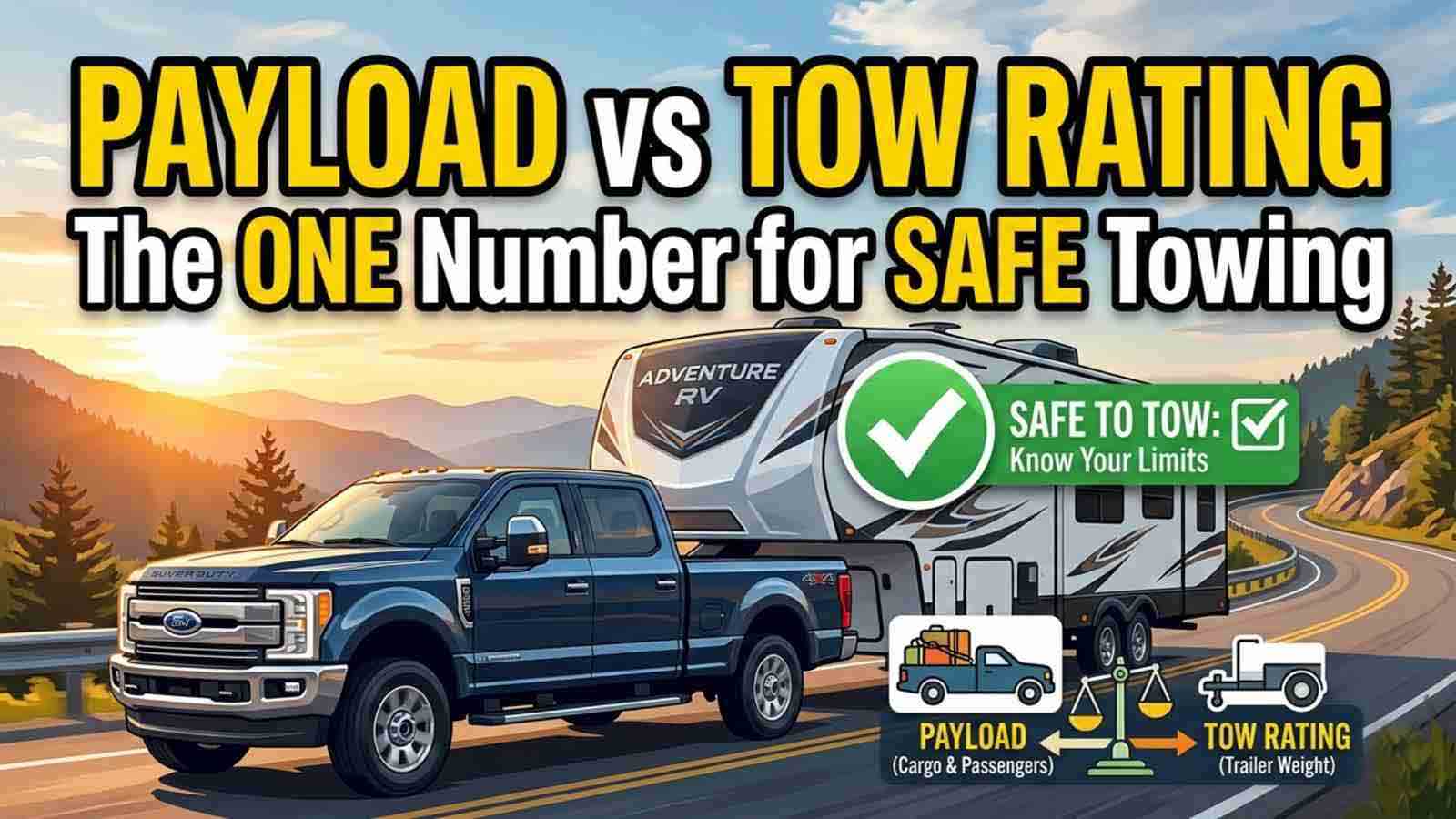
Tow rating is a marketing number — payload is the real safety limit.
Chapter 2 — Payload: The Most Critical Towing Number
Definition:
Payload = how much weight your truck can carry inside/over the suspension.
This includes:
- Passengers
- Dogs
- Cargo
- Coolers
- Tools
- Fuel
- Hitch
- Tongue weight
- Accessories
- Anything loaded into or onto the truck
Everything has weight.
Everything counts against payload.
Where to find your payload
Every truck has a yellow sticker on the door jamb that reads:
This number is unique to your specific truck VIN, not your model.
Example:
Two F-150s sitting side-by-side on the lot may have:
Truck A payload: 1,820 lbs
Truck B payload: 1,330 lbs
Why?
- Sunroof
- Leather seats
- 4×4
- Larger wheels
- Power seats
- FX4 package
- Hybrid battery
All add weight → lower payload.
This is why two “identical” trucks can tow very different sized trailers.
Chapter 3 — Tongue Weight: The Hidden Factor That Limits 90% of Trucks
What is tongue weight?
The amount of downward force the trailer puts on your hitch.
Most travel trailers have a tongue weight equal to:
Why tongue weight matters most
Because tongue weight comes out of your payload.
If your payload is 1,400 lbs and your tongue weight is 1,000 lbs…
You only have 400 lbs left for:
- kids
- spouse
- dog
- luggage
- fuel
- snacks
- bikes
- generator
It’s VERY easy to overload a truck without realizing.
Chapter 4 — Real Example: F-150 With a “13,000 lb Tow Rating”
Let’s break down the real towing capacity of a popular half-ton.
Sticker tow rating:
13,000 lbs
Sounds amazing, right?
Payload:
1,430 lbs
(Found on the yellow sticker)
Now let’s load the truck:
| Item | Weight |
| Driver + spouse | 350 lbs |
| 2 kids | 200 lbs |
| Dog | 80 lbs |
| Cooler + gear | 150 lbs |
| Gas (full tank) | 120 lbs |
| Hitch (WDH) | 80 lbs |
| TOTAL | 980 lbs |
Payload used: 980 lbs
Payload remaining: 450 lbs
Now add tongue weight:
Safe tongue weight = 10–15% of trailer.
Remaining payload = 450 lbs
This means:
Max safe tongue weight: 450 lbs → Trailer max ~4,000–4,500 lbs.
Not 13,000.
Not 10,000.
Not even 7,000.
Real-world towing limit (safe): 4,000–5,000 lbs.
This is why so many RV owners struggle with sway, rear sag, and unsafe setups.
Chapter 5 — Why Tow Ratings Do Not Apply in the Real World
Here are the real factors that destroy tow rating fantasy:
1. Passengers
Every human adds weight.
Kids + spouse can easily add 300–500 lbs.
2. Fuel
A full tank can weigh 120–180 lbs depending on truck size.
3. Cargo
Ice chests, tools, water, groceries — it adds up FAST.
4. Hitch weight
A weight-distribution hitch weighs 60–100 lbs.
5. Tongue weight
The biggest factor — often 600–1,500 lbs.
6. Aftermarket accessories
Tonneau cover = 60 lbs
Step rails = 40 lbs
Winch = 100 lbs
Steel bumper = 200+ lbs
All reduce payload.
7. Real trailer weight
Trailers rarely weigh “dry weight”…
They often weigh 500–1,300 lbs more once loaded.
8. Aerodynamics
A 7,000 lb box trailer pulls harder than a 10,000 lb boat.
9. Hills and wind
Your engine must work MUCH harder going uphill or in crosswind.
And this is why tow rating becomes irrelevant.
Chapter 6 — What Happens When You Exceed Real Towing Limits
Overloading isn’t just bad — it’s dangerous.
1. Steering becomes light
Too much tongue weight lifts the front axle → poor control.
2. Rear axle overload
Can cause:
- blowouts
- axle failure
- bent leaf springs
- sagging rear end
3. Sway becomes uncontrollable
Most sway accidents happen because tongue weight is too low.
4. Overheated transmission
Especially in half-tons and SUVs.
5. Braking distance increases drastically
Your truck cannot stop safely if overloaded.
6. Insurance can deny claims
If you crash while overloaded, you may not be covered.
Chapter 7 — The Only Three Numbers That Actually Matter
Forget the tow rating.
Ignore dry weight.
Ignore brochure numbers.
You need only three numbers for real safety:
1. Payload (yellow sticker)
The absolute maximum weight your truck can carry.
2. Tongue Weight
Should be 10–15% of total trailer weight.
Counts against payload.
3. GVWR / GCWR
These help determine if your truck + trailer combined are within safe limits.
Chapter 8 — How to Calculate Real Towing Capacity (Fully Explained)
Let’s walk through the real calculation method:
STEP 1 — Find your payload
Look at your yellow sticker.
Example:
Payload: 1,430 lbs
STEP 2 — Subtract passengers
Family of four:
≈ 500–600 lbs
STEP 3 — Subtract cargo
Gear: 150–250 lbs
STEP 4 — Subtract hitch weight
Typical WDH: 70–100 lbs
STEP 5 — Subtract fuel weight
Full tank: 120+ lbs
What’s left is your maximum tongue weight.
Remaining payload = Safe tongue weight
STEP 6 — Multiply tongue weight by 10
Example:
Tongue weight allowance: 500 lbs
→ Max trailer weight: 5,000 lbs
This is the real number.
Chapter 9 — The 30-Second Method (Using Towing Limit Pro)
Let’s make this even easier.
Open Towing Limit Pro:
- Select Basic or Expert mode.
- Enter your payload capacity.
- Enter passenger weight.
- Add cargo weight.
- Add hitch weight.
- Add trailer tongue weight.
The app instantly calculates:
- Remaining payload
- Safe tongue weight
- Max safe trailer weight
- GCWR
- Axle weights
- Safety margins
- Whether your setup is safe
- Where you’re overloaded
- How to fix it
You get a Trip Ready report before every trip.
This is the simplest, safest method for families and beginners.
Chapter 10 — Real-World Scenarios You Should Check Monthly
Different trip? Different weight.
Going camping with friends? More gear.
Hauling bikes? More weight.
Going empty? Less weight.
Weather changes everything.
High winds reduce safe tow speeds.
Your trailer weight changes.
Food, water, propane, gear — it fluctuates.
Your truck load changes.
Kids grow. Gear gets added.
A towing check is not “set it and forget it.”
It should be done before every big trip.
Chapter 11 — Why Half-Ton Trucks Struggle With RV Trailers
Half-tons (F-150, RAM 1500, Silverado 1500, Tundra) often have:
- Payload around 1,300–1,600 lbs
- Tongue weights of common trailers 700–1,200 lbs
- Passengers + gear 400–800 lbs
- Hitches 60–100 lbs
This combination pushes half-tons over limits fast.
This is why most RV experts recommend:
Half-tons → 4,000–7,000 lb trailers
Three-quarter tons (F-250, Ram 2500) → 8,000–12,000 lb trailers
One-ton trucks (F-350, 3500) → 12,000+ lb trailers
Chapter 12 — Should You Upgrade Trucks? How to Decide
You may need a bigger truck if:
- Your trailer’s tongue weight is > 12% of loaded trailer
- Your payload margin is under 200 lbs
- You experience sway
- You need to tow long distances or mountains
- Your GCWR is close to max
- You tow frequently with a full family onboard
- Your truck struggles on hills or with shifting
A 3/4 ton provides:
- higher payload
- stronger frame
- bigger brakes
- stronger transmission
- less sway
- better control
Chapter 13 — Why This Matters: Towing With Your Family
Truck + trailer accidents almost always involve:
- wrong tongue weight
- overloaded axles
- insufficient payload
- misunderstood tow ratings
If you tow with kids in the truck, these numbers matter even more.
Safety is not optional — it’s essential.
Conclusion: The Tow Rating Myth Ends Here
Tow rating is a marketing number.
Real towing safety is determined by:
- Payload
- Tongue Weight
- Axle Limits
- Real Weights
- Your Truck’s Actual Configuration
Once you understand these, towing becomes:
SAFE.
CONFIDENT.
STRESS-FREE.
And you never have to guess again.
Tow Smarter With Towing Limit Pro
If you want the fastest, simplest, most accurate way to calculate your real towing capacity:
Download Towing Limit Pro:

Get instant calculations for:
- Payload
- Tongue Weight
- Axle Weights
- Safe Trailer Limits
- GVWR/GCWR
- Trip Ready Status
- CAT Scale Mode
- Trailer Profiles
One app.
Every trip.
Safe towing forever.