Most truck owners check their tow rating before buying a trailer. Almost none of them check their payload. That gap — between what the sticker says and what the truck can actually carry — is where most towing mistakes happen.
This is the article dealers don’t give you. It’s the math behind the number that actually matters.
Quick Answer
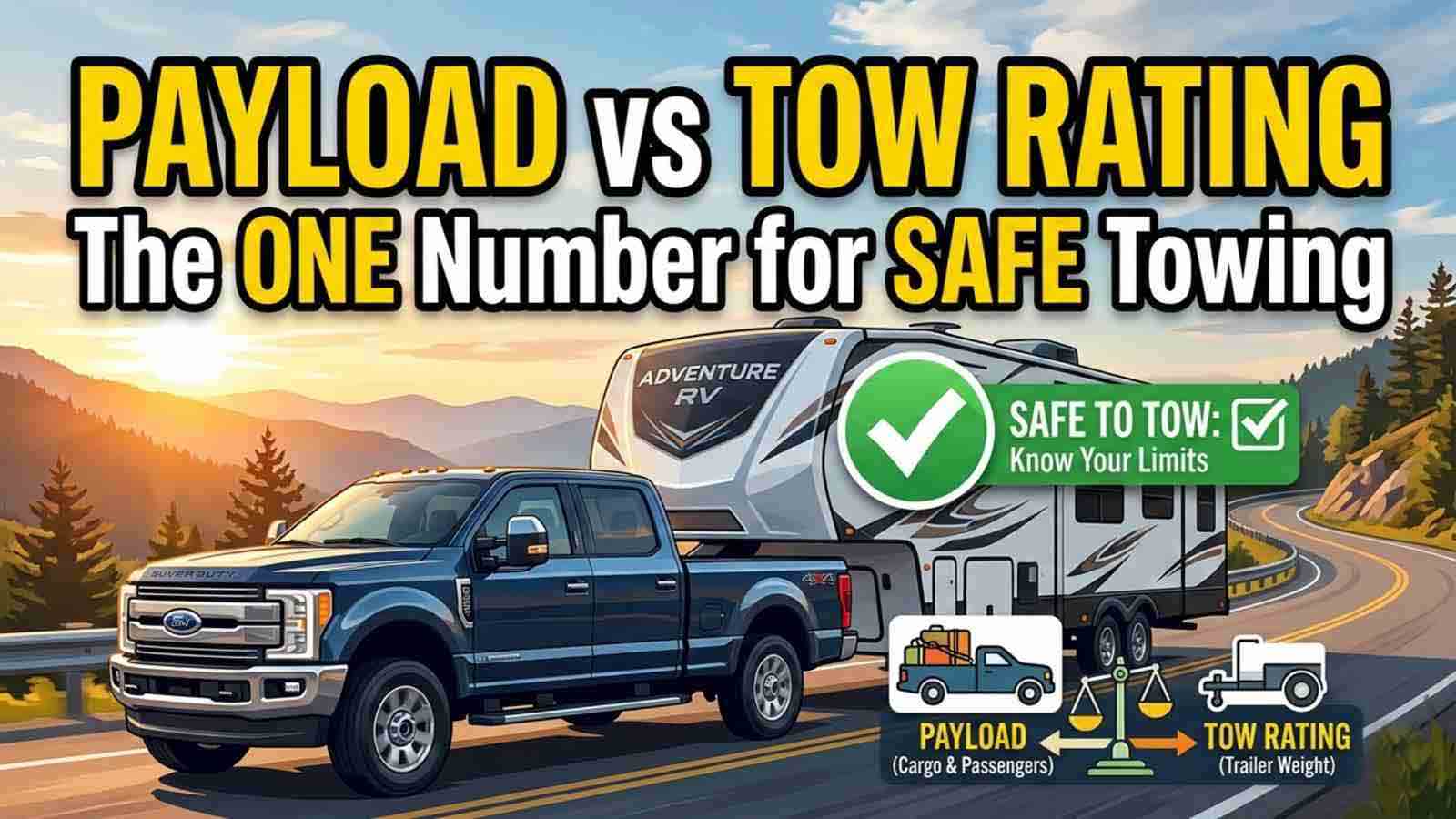
Tow rating tells you the maximum weight you can pull. Payload tells you the maximum weight your truck can carry — including the tongue weight of your trailer, passengers, fuel, and gear.
Your payload limit is almost always the binding constraint. Not your tow rating.
For most half-ton trucks, payload runs between 1,200 and 2,200 lbs depending on configuration. A trailer with a loaded tongue weight of 1,100 lbs, two passengers, and a bed full of gear can exceed that limit — even if the truck’s tow rating says it can pull 10,000 lbs with ease.
The Controversial Truth About Tow Ratings
Tow ratings are calculated under ideal conditions — typically a single driver, no cargo, and a trailer with optimized weight distribution. They are a marketing number as much as an engineering one.
Payload capacity is stamped on a sticker inside your driver’s door jamb. It is a federal safety rating. It does not flex based on conditions. Exceed it, and you’re operating outside the designed limits of your suspension, brakes, tires, and frame.
The tow rating gets the headline. The payload sticker gets ignored. That’s the problem.
What Is Payload Capacity?
Payload capacity is the maximum weight your truck can carry above its curb weight. It includes:
- Passengers and their luggage
- Cargo in the bed or cab
- Tongue weight of the trailer (the downward force the hitch exerts on the truck)
- Any aftermarket accessories added to the truck (roof racks, toolboxes, running boards)
The number on your door sticker is the maximum. Not a suggestion. Not a starting point. The ceiling.
If your truck’s payload is 1,680 lbs, everything loaded into and onto that truck — including tongue weight — must stay under 1,680 lbs combined.
What Is Tow Rating?
Tow rating is the maximum weight of the trailer your truck is rated to pull. It accounts for the truck’s engine, transmission, cooling system, and hitch rating.
It does not account for how much you’ve already loaded into the truck. It does not shrink when you add passengers. It does not adjust for a fully loaded bed.
This is why tow rating alone is an incomplete number. It tells you about the trailer. It tells you nothing about whether your truck can handle the trailer plus everything else.
Dry Weight vs. Loaded Weight: The Gap Nobody Talks About
Trailer manufacturers advertise dry weight — the weight of the trailer as it leaves the factory, empty, with no water, food, gear, or personal belongings.
A trailer listed at 6,200 lbs dry can easily weigh 7,400–7,800 lbs loaded with fresh water, clothing, food, tools, and bikes.
That difference matters for two reasons:
1. Your tow rating comparison becomes inaccurate. If your truck is rated to tow 9,500 lbs and you’re comparing it to a 7,000 lb dry trailer, the math looks comfortable. Load that trailer to 8,200 lbs and the margin shrinks fast.
2. Tongue weight increases proportionally. More total trailer weight means more downward force on the hitch ball — which means more weight being transferred to your truck’s payload budget.
Always run your numbers against estimated loaded weight. Dry weight comparisons are how people get into trouble.
The 12–15% Tongue Weight Rule
Tongue weight is the downward force the front of the trailer exerts on your hitch. Industry standard is that tongue weight should fall between 12% and 15% of total loaded trailer weight.
- Too low (under 10%): trailer sway risk
- Too high (over 15%): rear axle overload and handling issues
- Sweet spot: 12–15%
This number comes directly out of your payload budget. It is not separate from it.
Example: A trailer loaded to 8,200 lbs generates a tongue weight of approximately 1,066 lbs at 13%. That 1,066 lbs is now sitting on your truck’s rear axle and counting against your payload capacity — before you’ve added a single passenger, tool, or bag.
Real-World Payload Math: What It Actually Looks Like
Truck: 2023 Ford F-150 XLT 3.5L EcoBoost 4×4 SuperCrew
Payload capacity (door sticker): 1,945 lbs
Trailer: Grand Design Imagine 2600RB
Trailer dry weight: 6,479 lbs | Estimated loaded weight: 7,800 lbs
| Item | Weight |
| Tongue weight (13% of 7,800 lbs) | 1,014 lbs |
| Driver + passenger | 400 lbs |
| Gear in truck cab/bed | 200 lbs |
| Total payload used | 1,614 lbs |
| Remaining payload | 331 lbs |
331 lbs of remaining payload. That sounds like margin until you realize you haven’t accounted for a third passenger, a heavier water load in the trailer, or anything extra in the bed.
Now run that same math with a different F-150 configuration — the Max Trailer Tow Package on a SuperCab — and the payload sticker may read 1,410 lbs instead of 1,945 lbs. Same truck nameplate. 535 lbs difference. That is not a small margin.
The Shock Moment
Here’s that lower-payload F-150 at 1,410 lbs:
| Item | Weight |
| Tongue weight (13% of 7,800 lbs) | 1,014 lbs |
| Driver + passenger | 400 lbs |
| Gear in cab | 150 lbs |
| Total payload used | 1,564 lbs |
| Remaining payload | −154 lbs |
Remaining payload: −154 lbs. Overloaded. Before the trailer is fully loaded. With just two people in the truck.
The tow rating on that truck? 11,600 lbs. More than enough — on paper.
If you’re wondering where your truck would land in this calculation, don’t guess.
Not sure if your truck is within safe limits? Towing Limit Pro helps you verify your real setup using your actual payload sticker, passengers, cargo, and trailer numbers.
- Remaining payload (what you actually have left)
- Realistic tongue weight estimate (loaded, not brochure)
- GVWR margin + a clear safety buffer
- Risk-zone warning if your setup is pushing limits
Tip: Use your truck’s yellow door sticker payload for the most accurate result.
Why This Matters Beyond the Numbers
An overloaded truck doesn’t always feel overloaded. The rear may sag, or it may not. Brakes may feel sluggish, or the driver adapts without realizing it. Tire wear accelerates. Suspension components fatigue faster than designed.
In an emergency braking situation, an overloaded truck behaves differently than a properly loaded one. Stopping distances increase. Stability control works against a different baseline than it was calibrated for.
The risk is not always visible. That’s what makes it dangerous.
How Truck Configuration Changes Everything
Two trucks with identical model names can have dramatically different payload ratings based on:
- Cab style (Regular, SuperCab, SuperCrew — heavier cab = less payload)
- Bed length (longer bed adds weight)
- Drivetrain (4×4 is heavier than 4×2)
- Engine choice (heavier engines reduce payload)
- Packages and options (sunroof, tow mirrors, running boards all add weight)
A 2023 F-150 can have a payload anywhere from approximately 1,410 lbs to over 2,200 lbs depending on configuration. The only number that matters is the one on your specific truck’s door sticker.
Never use online specs. Never use what someone else’s truck had. Pull your door sticker. That is your number.
Verdict
Both numbers matter, but they answer different questions.
Tow rating answers: Can my truck physically pull this trailer?
Payload capacity answers: Can my truck carry the tongue weight of this trailer, plus everything else I’m loading into it, without exceeding its structural limits?
In most real-world half-ton setups, payload is the binding constraint — not tow rating. Trucks routinely have the power to pull a trailer they are not rated to carry.
The math that matters is your specific truck, with your specific configuration, loaded the way you actually load it. That calculation is almost never done at the dealership.
Know your real margin before you hook up.
Most half-ton trucks hit their payload limit long before they hit their tow rating limit — and most owners don’t realize it until they’re already committed. Verify your exact setup and know where you stand.
- Remaining payload (your real limit)
- Realistic tongue weight (loaded)
- GVWR margin + safety buffer
- Clear risk-zone indicator
Best results: use your yellow door-sticker payload number and your loaded trailer estimate (not dry weight).
Frequently Asked Questions
What is the difference between payload capacity and tow rating?
Payload capacity is how much weight your truck can carry — including tongue weight, passengers, and cargo. Tow rating is how much weight your truck can pull. They measure different things. Payload is usually the limiting factor on half-ton trucks.
How do I find my truck’s payload capacity?
Check the sticker on the inside of your driver’s door jamb. It will list the maximum payload for your specific truck. Do not use online specs — payload varies significantly based on configuration.
What percentage of trailer weight should tongue weight be?
Tongue weight should be between 12% and 15% of the total loaded trailer weight. At 13%, an 8,000 lb trailer generates approximately 1,040 lbs of tongue weight — which counts against your truck’s payload budget.
Can a truck be overloaded even if it’s under its tow rating?
Yes. This is one of the most common towing mistakes. A truck can be within its tow rating and still exceed its payload capacity once you account for tongue weight, passengers, and gear. Both limits must be respected independently.
Does dry weight vs loaded weight really make that big of a difference?
Typically 1,000–1,500 lbs on a mid-size travel trailer once you add water, food, clothing, and gear. That difference directly affects your tongue weight calculation and can push a setup from safe to overloaded. Always calculate against estimated loaded weight, not the dry weight in the brochure.