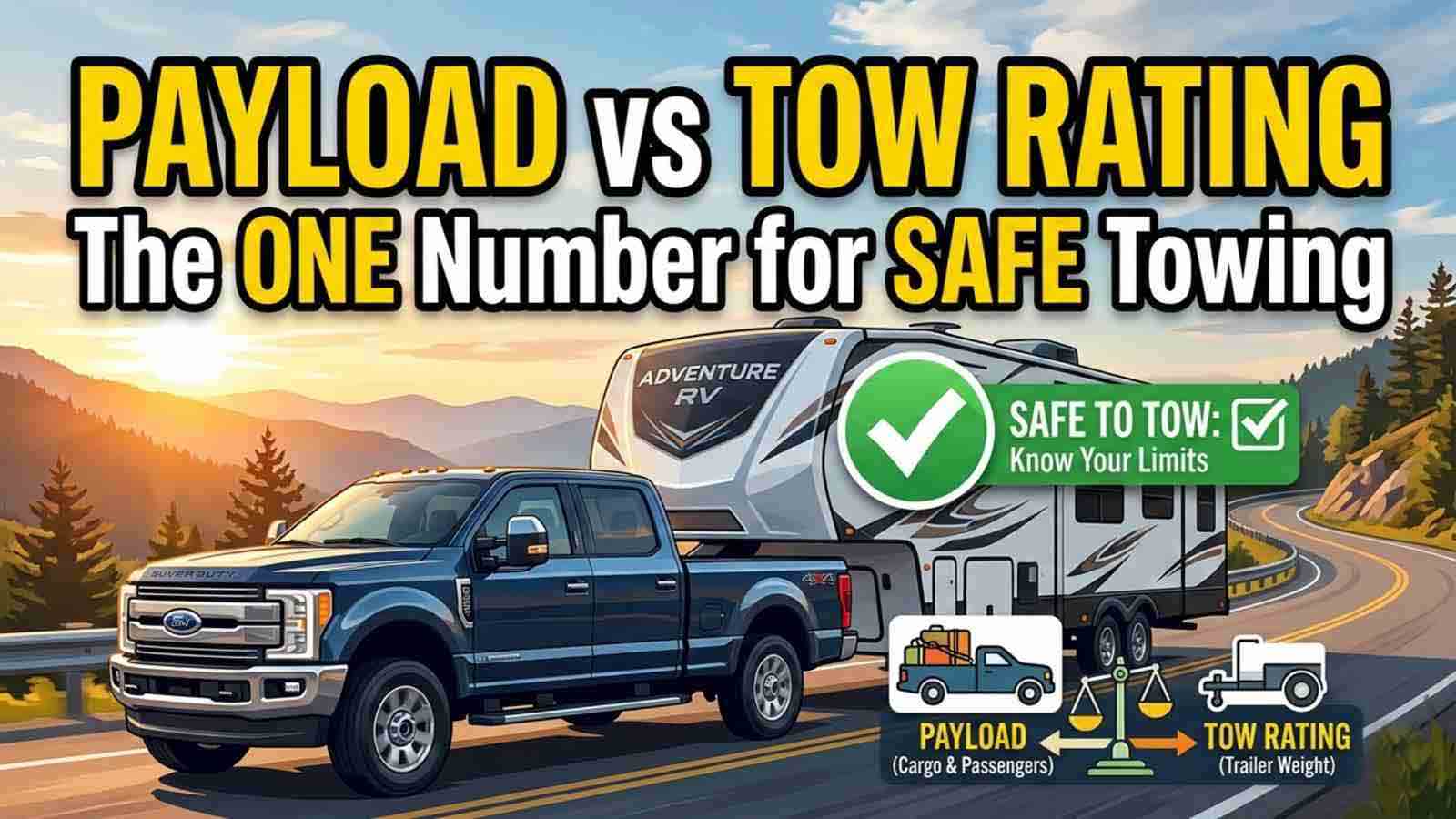
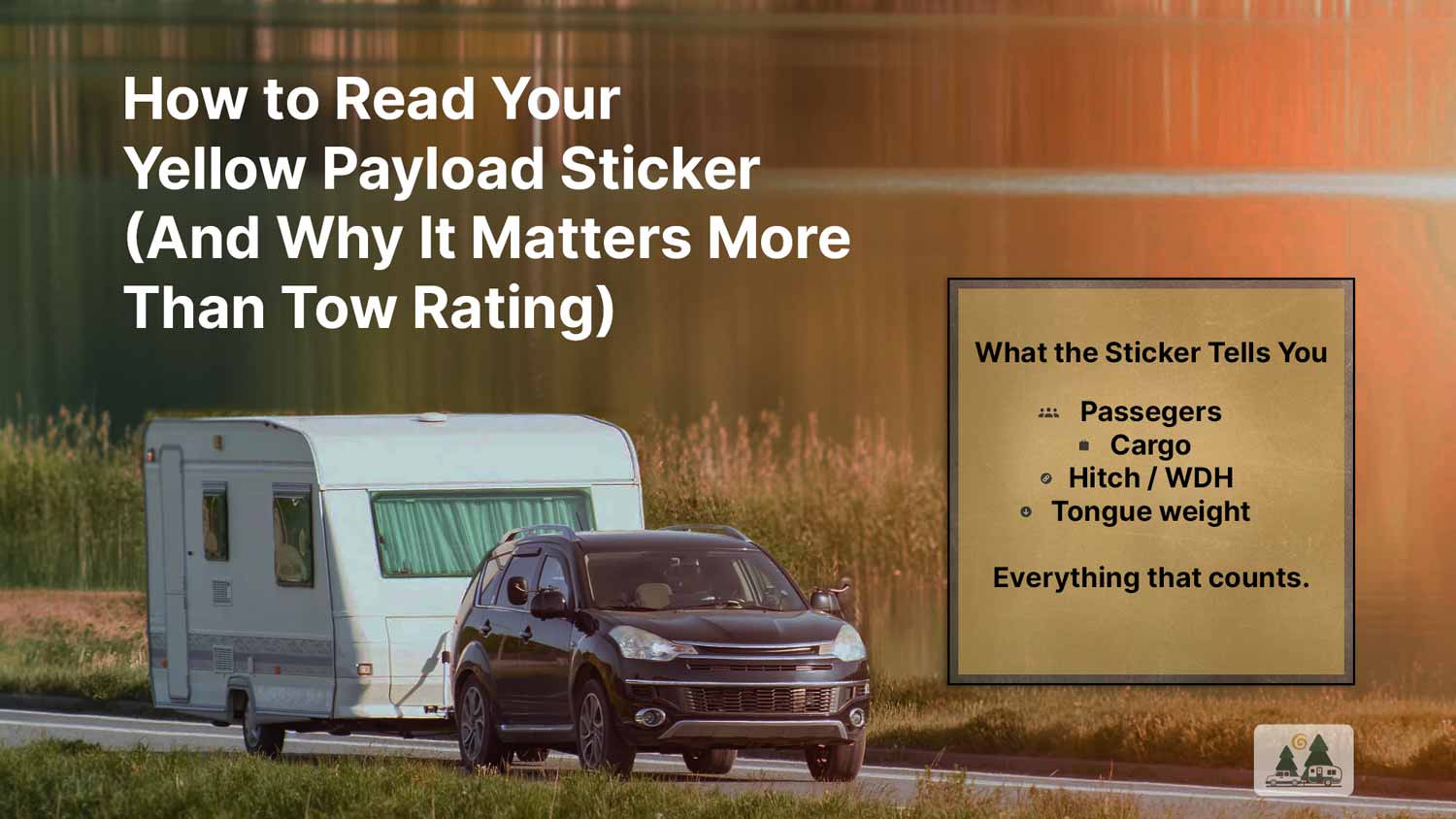
If you only look at the big, shiny tow rating, you can still end up dangerously overloaded. The real day-to-day limiter for half-tons and many SUVs is the yellow Tire & Loading Information sticker on the driver’s door jamb.
That label tells you, in plain numbers, how much people + cargo + hitch hardware + tongue weight your vehicle can carry—in that exact configuration.
Below, we’ll decode the sticker, show how options eat into payload, walk through tongue-weight math, and give you simple, copy-and-paste checklists and examples you can use before your next trip.
You’ll also see how the Towing Limit Pro app turns this whole process into a 30-second check.
TL;DR (But Please Read the Examples)
- The yellow sticker is your vehicle’s payload capacity in its as-built configuration.
- That number must cover everyone in the cab, all cargo, the weight of your hitch/WDH, and the trailer’s tongue weight.
- Options (4×4, larger wheels, sunroof, luxury packages, etc.) reduce payload.
- Tongue weight usually runs 10–15% of a travel trailer’s loaded weight (boats often 5–10%).
- If your payload is gone, you’re overloaded—even if you’re under the marketing tow rating.
What the Yellow Sticker Actually Says
Open the driver’s door. On the jamb you’ll see a yellow/white label that reads something like:
“The combined weight of occupants and cargo should never exceed XXXX lb (XXXX kg).”
That XXXX number is your payload capacity. In practice, it must cover:
- Passengers (driver + everyone else)
- Loose cargo (coolers, tools, firewood, bikes, bed boxes, etc.)
- Aftermarket add-ons (bed rack, topper/canopy, steel bumpers, winch)
- Hitch hardware (receiver accessories, weight-distribution hitch head/bars)
- Trailer tongue weight (downforce from the trailer on your hitch)
Note on fuel: You do not add fuel to payload. The sticker already assumes the vehicle’s operating fluids. Focus on people, gear, hitch hardware, and tongue weight.
Why Two “Identical” Trucks Don’t Share the Same Payload
Brochures list a maximum possible payload for a base model. Your actual payload (the yellow sticker) is calculated for your VIN with your exact options. Heavier options lower payload because they consume part of the available weight budget.
Common payload killers:
- 4×4 systems and transfer case
- Bigger wheels/tires (20″/22″ sets weigh more)
- Luxury packages (power steps, panoramic sunroof, sound system, leather)
- Off-road packages (skid plates, steel bumpers, winch plates, long-travel parts)
- Bed caps/toppers, racks, toolboxes (including anything you’ve added since purchase)
It’s normal to see a 300–600 lb swing between trims of the same model. That’s the difference between a comfortable margin and a white-knuckle drive.
Tongue Weight: Where It Fits (and Why It Eats Half-Ton Payloads)
Tongue weight (TW) is the portion of the trailer’s weight pressing downward on your hitch. It counts against payload—just like a heavy toolbox in the bed.
Typical TW ranges (loaded and ready to camp/launch):
- Travel trailers: ~10–15% of total trailer weight
- Boats: ~5–10% (engines and tanks shift weight)
- Utility/flatbeds: depends on how you load the deck
Weight-distribution hitch (WDH): A WDH can re-balance axle loads for better steering/braking, but it doesn’t erase the total weight; its own hardware (~60–100 lb) also counts against payload.
The Simple Math (Copy/Paste This)
Use this calculation of subtracting all items from your payload every time you hitch up:
Remaining payload = Sticker payload
– (Driver + passengers)
– (Cargo & accessories in/on the vehicle)
– (Hitch/WDH hardware)
– (Trailer tongue weight)
If Remaining payload ≤ 0, you’re overloaded—even if your tow rating looks fine.
Real-World Examples
Example A — Half-ton with a family and a 6,500 lb travel trailer
- Sticker payload: 1,650 lb
- People: 2 adults (360 lb) + 2 kids (180 lb) = 540 lb
- Cargo in truck: cooler + tools + toys = 120 lb
- WDH hardware: 80 lb
- Trailer: 6,500 lb × 12% TW ≈ 780 lb
Remaining payload = 1,650 – 540 – 120 – 80 – 780 = 130 lb (OK but tight)
Reality check: Add a bed rack (75 lb) and two e-bikes (120 lb) and you’re over payload. That’s how “it felt fine on the test drive” turns into sway, under-steer, heat-soaked brakes, and blown tires.
Example B — Three-quarter-ton with the same trailer
- Sticker payload: 2,950 lb
- People: 540 lb
- Cargo: 120 lb
- WDH: 80 lb
- TW: 780 lb
Remaining payload = 2,950 – 540 – 120 – 80 – 780 = 1,430 lb (Healthy margin)
Example C — Boat trailer (lighter TW but gear adds up)
- Sticker payload: 1,800 lb
- People: 2 adults (360 lb)
- Cargo: ice, tackle, inflatable, anchor = 140 lb
- Hitch ball mount: 20 lb
- Boat/trailer: 4,500 lb × 7% ≈ 315 lb TW
Remaining payload = 1,800 – 360 – 140 – 20 – 315 = 965 lb (plenty—until you add a topper (180 lb) and a bed drawer (200 lb); then it shrinks fast).
Why the Sticker Matters More Than Tow Rating
Tow rating tells you how heavy a trailer the powertrain and cooling can pull under ideal conditions. It doesn’t promise your truck can carry the tongue weight and your family and your gear at the same time.
The yellow sticker guards against the most common real-world failure modes:
- Rear-end sag & light steering → delayed braking, wandering, poor emergency handling
- Sway amplification → especially with soft suspensions and short wheelbases
- Tire overload & heat → the fastest way to a blowout
- Axle/GVWR exceedance → potential component failure and liability exposure
Quick Driveway Checklist (Do This Before a Long Trip)
- Read the sticker and write the number on tape by your dash.
- Weigh people & pets realistically. Guess high, not low.
- Inventory cargo (anything in the cab/bed + aftermarket parts).
- Include hitch hardware (20–100 lb).
- Estimate tongue weight (10–15% for travel trailers, 5–10% for boats).
- Subtract all from payload.
- Positive = Go, with margin.
- Near zero = Slim down or reconsider.
- Negative = Overloaded (unsafe/illegal depending on jurisdiction and warranty).
- Adjust: Move heavy items to the trailer axle(s), reduce water in fresh tanks if needed, or choose a lighter trailer.
Pro tip: After you’ve estimated, verify on a CAT scale. Weigh truck alone (as loaded), then truck + trailer. Confirm you’re under GVWR, both GAWRs, tire load ratings, and GCWR. Keep the receipts with your registration.
Common Myths (and the Reality)
- “A WDH increases my payload.”
No. It can restore front-axle load and improve stability, but total weight on the vehicle still counts. - “My buddy tows 9,500 lb with his half-ton just fine.”
Maybe—often with no people/cargo or with overweight axles/tires. The margin disappears fast once you add real life. - “The brochure says 2,200 lb payload.”
That’s a theoretical base truck. Your yellow sticker is the truth for your VIN. - “Fuel goes against payload, right?”
No. The yellow label’s limit is occupants + cargo. Don’t subtract fuel; focus on passengers, gear, hitch hardware, and tongue weight.
How Towing Limit Pro Makes This Automatic
You can do the napkin math every trip—or upload your sticker number and typical passenger/cargo into Towing Limit Pro once. The app then:
- Calculates real-time remaining payload as you tweak trailer weight or add gear
- Flags overloads (payload, GVWR, GAWRs, tire limits)
- Saves profiles for “Solo,” “Family of 4,” “Boats,” and “Weekend Camper”
- Provides a report with your numbers (useful for insurance or campground checks)
Workflow: Input your sticker payload, add people, cargo, hitch hardware, and a trailer weight. The app auto-estimates TW or lets you set it. Green = good; yellow = close; red = overloaded.
Safety Symptoms You Should Never Ignore
If any of these show up, assume payload/TW or axle load is wrong and fix it before driving again:
- Rear squat despite WDH setup
- Light/floaty steering or delayed return-to-center
- Persistent sway above 50–55 mph or in crosswinds
- Excessive tire heat (use an IR thermometer at fuel stops)
- Braking fade on moderate grades
Glossary (Super Short)
- Payload: How much people + cargo + hitch hardware + TW your vehicle can carry (yellow sticker).
- GVWR: Max total vehicle weight (truck + payload).
- GAWR (F/R): Max weight on each axle.
- GCWR: Max combined weight (truck + trailer).
- Tongue weight (TW): Downforce from trailer on hitch (counts against payload).
- WDH: Weight-Distribution Hitch; rebalances axle loads, doesn’t change payload.
FAQs
Q: Where exactly is the yellow sticker?
Driver’s door jamb. It’s the yellow/white Tire & Loading Information label.
Q: My sticker says 1,470 lb. Is that good?
It’s average for many half-tons with options. Whether it’s “good” depends on your people + gear + tongue weight.
Q: Do aftermarket wheels/tires matter?
Yes. Heavier wheels/tires and higher speed/load ratings can change tire capacity and unsprung weight—both affect margins.
Q: Will airbags or helper springs increase payload?
They can level the ride but do not increase the legal payload/GVWR/GAWR. The sticker number still rules.
Q: What tongue-weight % should I use?
Start with 12% for travel trailers and 7% for boats; weigh to confirm.
Conclusion
The tow rating sells trucks.
The payload sticker keeps families safe.
Read it, respect it, and plan around it. When in doubt, weigh.
And if you’d rather tap than tally, Towing Limit Pro turns this entire article into a quick, reliable check before you ever pull onto the highway.