Why Weighing Matters (No, You Can’t “Eyeball” It)
Towing safety isn’t a vibe—it’s math. You need real axle weights and real tongue/pin weight to confirm you’re within:
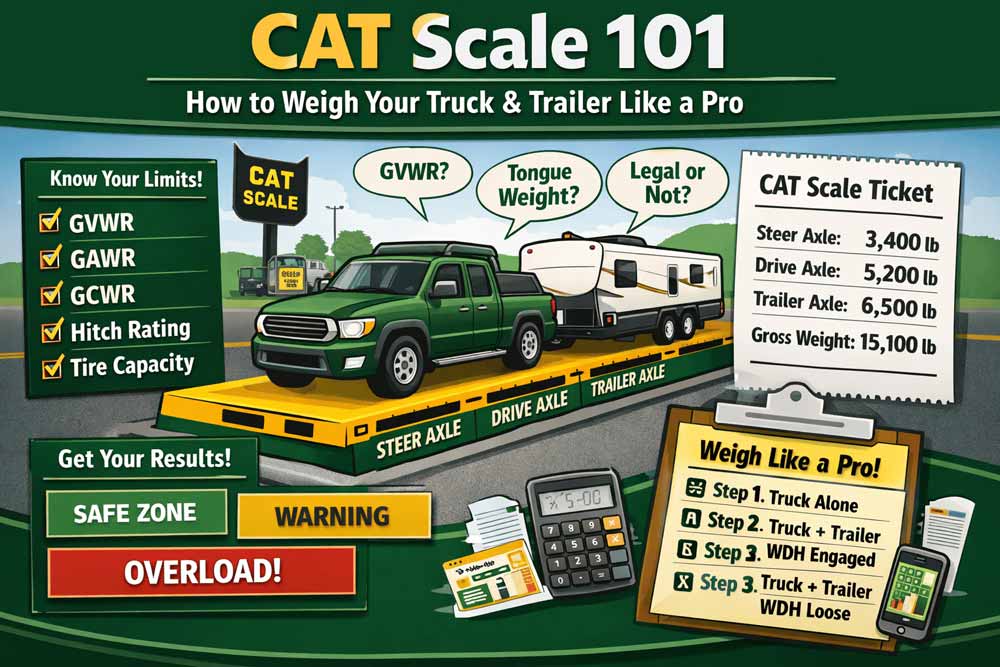
- GVWR (max loaded weight of your truck)
- GAWR (max per axle—front/rear)
- GCWR (max truck + trailer together)
- Receiver rating (hitch & tongue limits)
- Tire load capacity (truck & trailer)
If you skip the scale, you’re guessing on brakes, steering feel, tire temps, and legal compliance. One quick stop at a CAT Scale (available at many truck stops) replaces guesswork with facts.
What You’ll Get From a CAT Scale Ticket
Your ticket (or digital receipt) shows:
- Steer axle (truck’s front axle)
- Drive axle (truck’s rear axle)
- Trailer axle(s)
- Gross weight (all platforms combined)
With two or three quick weighs, you can compute:
- Actual tongue (travel trailer) / pin (5th-wheel) weight
- Front-axle load restoration from your weight-distribution hitch (WDH)
- Compliance vs. GVWR, GAWRs, GCWR, receiver rating, and tire limits
The Fastest Step-by-Step: How to Use a CAT Scale
Pro tip: Show up fully loaded as you’d tow—people, fuel, cargo, typical water/propane. If you change your packing later, re-weigh.
- Approach & position.
Drive onto the scale so steer axle is on platform 1, drive axle on platform 2, trailer axle(s) on platform 3. Stay straight; stop when the platform lights or lines match your axles. - Press the intercom / start at kiosk.
Say: “First weigh.” Provide your plate or basic info if asked. - Roll forward and park safely.
Pick up the printed ticket inside or receive it in the app if supported. - Reweighs (optional but recommended).
You can do one or two quick reweighs without leaving the property (lower cost). See “Weigh Sequences” below.
The Three Weigh Sequences (Travel Trailers & 5th-Wheels)
You can do one weigh and learn a lot. But with 2–3 quick weighs you’ll get the full picture.
Weigh #1 —
Truck Alone (Baseline)
- Why: Establish unhitched front/rear axle loads.
- How: Drive onto the scale without the trailer. Record steer, drive, gross.
Weigh #2 —
Truck + Trailer, WDH Engaged (Normal Towing)
- Why: See real on-road axle loads with your hitch set as you tow.
- How: Pull on with steer on platform 1, drive on 2, trailer axles on 3. Record values.
Weigh #3 —
Truck + Trailer, WDH Bars Loosened (Optional)
- Why: Measure true tongue weight (travel trailer) and see exactly how much the WDH is shifting.
- How: In a safe pull-through spot away from traffic, loosen/uncouple the spring bars (do not unhook the coupler). Re-position on the scale and record. Re-tension after.
Safety note: Only adjust WDH tension where it’s safe and level. Follow your hitch manufacturer’s instructions.
How to Read (and Use) the Numbers
Let’s name the readings:
- S₁, D₁ = Steer/Drive from Weigh #1 (truck alone)
- S₂, D₂, T₂ = Steer/Drive/Trailer from Weigh #2 (WDH engaged)
- S₃, D₃, T₃ = Steer/Drive/Trailer from Weigh #3 (WDH loose)
1) Actual Tongue (or Pin) Weight
- Travel trailer (true tongue weight):
Use Weigh #3 (bars loose).
TW = (S₃ + D₃) − (S₁ + D₁)
(That’s how much extra weight the trailer adds to your truck when no distribution is helping.) - If you only did Weigh #2 (bars engaged):
Added load on truck = (S₂ + D₂) − (S₁ + D₁)
This understates true TW because WDH shifts some weight back to the trailer. It’s still useful for payload math. - 5th-wheel (pin weight): Same formula; there’s no WDH, so one hitched weigh is fine.
PW = (S₂ + D₂) − (S₁ + D₁)
2) Front-Axle Load Restoration (WDH Tuning)
- Steer-axle loss without WDH: ΔF = S₁ − S₃ (often a positive number; front got lighter)
- Steer-axle gain with WDH: S₂ − S₃
- FALR (% restored):
\text{FALR} = \frac{S_2 – S_3}{S_1 – S_3} \times 100\% - Target: Restore most of the lost steer weight (often 50–100%), without pushing the front axle over its GAWR.
3) Compliance Checks (All Must Pass)
- Truck gross: (S₂ + D₂) ≤ GVWR
- Front axle: S₂ ≤ Front GAWR
- Rear axle: D₂ ≤ Rear GAWR
- Combined gross: (S₂ + D₂ + T₂) ≤ GCWR (from manual)
- Receiver rating: Trailer weight & tongue weight within WDH limits
- Tires: Per-axle loads within tire capacities (adjust pressures accordingly)
Example (Travel Trailer With WDH)
Weigh #1 (truck alone): S₁ = 3,400 | D₁ = 2,600 | Gross = 6,000
Weigh #2 (hitched, WDH engaged): S₂ = 3,360 | D₂ = 3,780 | T₂ = 5,600 | Gross = 12,740
Weigh #3 (hitched, WDH loose): S₃ = 3,220 | D₃ = 4,020 | T₃ = 5,420 | Gross = 12,660
Tongue weight (true):
TW = (S₃ + D₃) − (S₁ + D₁) = (3,220 + 4,020) − (3,400 + 2,600) = 1,240 lb
Added load with WDH engaged (for payload math):
(S₂ + D₂) − (S₁ + D₁) = (3,360 + 3,780) − 6,000 = 1,140 lb
FALR:
Steer lost with no WDH: 3,400 − 3,220 = 180 lb
Steer regained with WDH: 3,360 − 3,220 = 140 lb
FALR = 140 / 180 = 78% restored (good)
Now check limits:
- Truck gross (S₂ + D₂) = 7,140 → must be ≤ GVWR
- Front GAWR: S₂ = 3,360 → must be ≤ rating
- Rear GAWR: D₂ = 3,780 → must be ≤ rating
- Combined gross (S₂ + D₂ + T₂) = 12,740 → must be ≤ GCWR
- Receiver/hitch: ensure trailer weight and 1,240 lb TW within WDH/receiver specs
- Tires: confirm loads against tire load tables / placard
If anything is high: increase WDH tension (to move some load forward), redistribute cargo, reduce water/propane up front, or choose a higher-capacity tow vehicle.
Common Mistakes (and Easy Fixes)
- Measuring with empty people/gear. Always weigh as you tow—kids, dogs, coolers, bikes, tools, water.
- Relying on “tow rating” alone. Payload/axles/receiver/tire limits often fail before tow rating.
- WDH bars too soft or too tight. Use FALR math and axle limits to set tension correctly.
- Under-inflated tires. Heat and sidewall roll = sway and blowouts. Match PSI to load; trailer tires usually at sidewall max cold.
- Too little tongue weight (<10%). Invites sway. For many travel trailers, aim 10–15% (Airstreams often 12–14%).
- One-and-done. Re-weigh when you change loadouts (water, kayaks, generator, bikes, etc.).
Special Cases
- 5th-wheels: Use two weighs (truck alone; truck+trailer). Pin weight is the truck’s weight gain between those two. Confirm rear GAWR and GVWR; WDH not used.
- Motorhome + toad: Use similar platform logic; confirm front/rear GAWR of the motorhome and that your tow bar/baseplate ratings aren’t exceeded.
- Dually trucks: Same math—just more tire capacity headroom. Don’t skip the scale.
- Night/24-7 weighing: Many CAT locations are open late. Use intercom/kiosk; follow staff directions.
Brake Controllers, Speed & Road Feel (Quick Hits)
- Integrated or proportional brake controller preferred. Start gain ~5–6, test at 20–25 mph, adjust so the trailer neither shoves nor jerks.
- Speed kills stability. Most sway events begin with too much speed for conditions. Cruise 60–65 mph unless conditions dictate lower.
- If sway begins: Ease off throttle, hold the wheel steady, and manually apply trailer brakes. Do not over-steer.
Pre-Scale Checklist (Print This)
- Fully loaded as you’d tow (people, cargo, water/fuel)
- Tire pressures set (truck & trailer)
- Hitch/receiver ratings verified (WDH required if specified)
- Safety chains crossed, breakaway cable connected, lights checked
- WDH torqued to spec; bars matched to loaded tongue weight
- Know your GVWR/GAWR/GCWR and tire load ratings
FAQs
Do I need to unhook at the scale?
No. Stay hitched. Only loosen/tighten WDH bars if you’re doing the optional third weigh.
What if I only have time for one weigh?
Do Weigh #2 (normal towing). You’ll confirm axle compliance and total combined weight. If close to limits, come back for a baseline and WDH-off weigh.
Are CAT Scales accurate?
Yes—commercial-grade. Keep your axles cleanly on each platform and follow staff directions.
How often should I weigh?
At least once per new setup, and after significant packing changes (water tanks, bikes/generator, extra passengers).
Make It Automatic with Towing Limit Pro
You gathered the numbers—now let the app do the thinking:
- Cat Scale Mode: Enter your steer/drive/trailer readings; the app calculates true tongue/pin weight, FALR, and compliance against GVWR/GAWR/GCWR, receiver, and tires.
- Green/Yellow/Red dashboard: instant clarity on which limit is tight and why.
- WDH guidance: See how much front-axle load you’ve restored and how a link/tilt change affects balance.
- Profiles & history: Save multiple tow vehicles/trailers and weigh tickets to compare “weekend” vs. “long-haul” loadouts.
- Pre-trip checklist: Built-in reminders for torque, tire PSI, brake gain, chains, and lights.
Bottom line: Scales give you facts. Towing Limit Pro turns those facts into fast, confident decisions—so you hitch once, drive straight, and arrive relaxed.