
The Payload Math Most Owners Never Run
By Towing Limit Pro | Truck & Trailer Match-Up Series
The Payload Math Most Owners Never Run
On paper, this looks like an easy match.
A Ram 1500 with the 5.7L HEMI can advertise tow ratings north of 11,000 pounds.
An Airstream 28RB has a GVWR under 9,000 pounds.
Plenty of room, right?
Here’s the uncomfortable part:
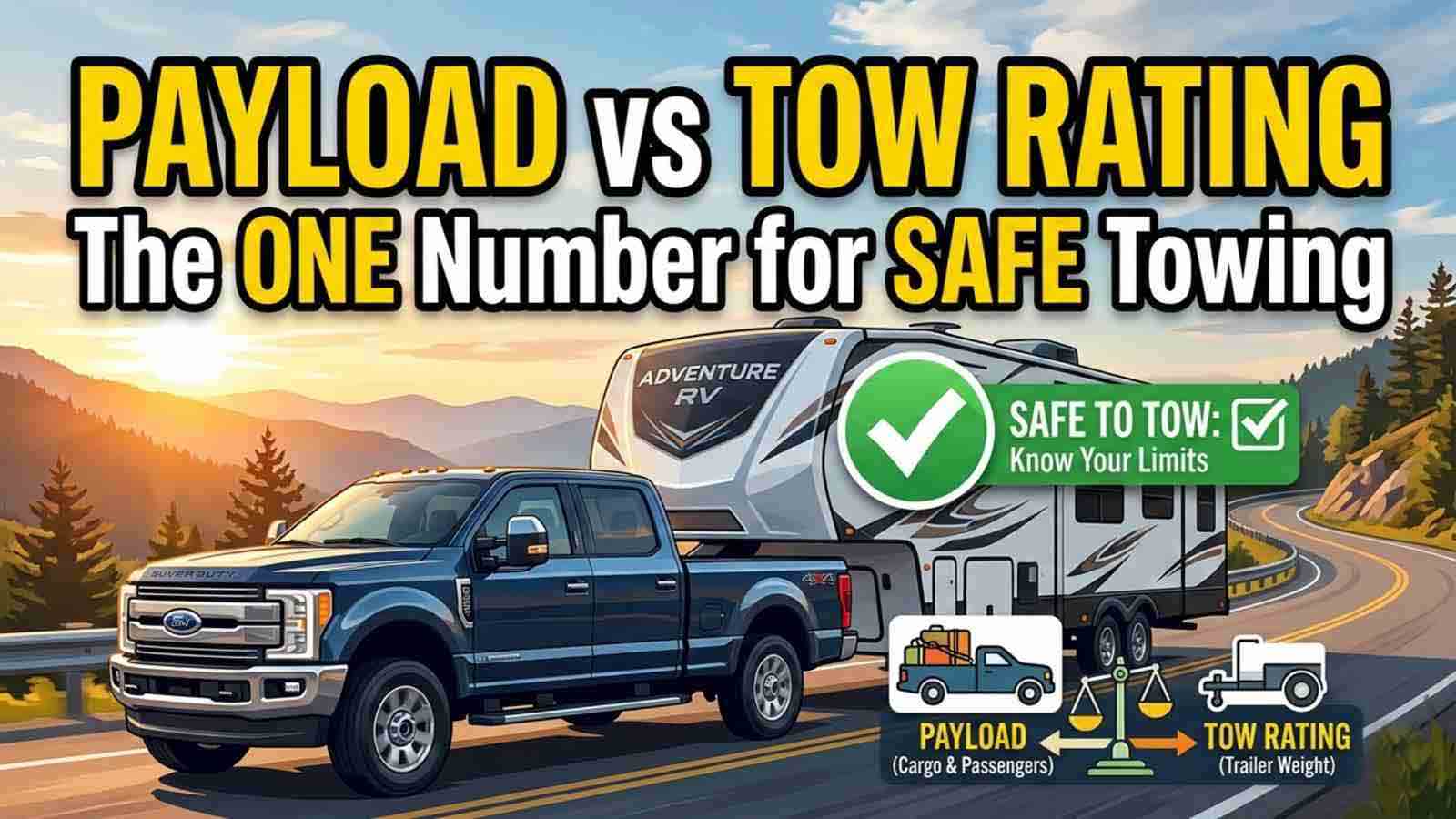
Most Ram 1500 owners towing a 28-foot Airstream are not limited by tow rating — they’re limited by payload. And many don’t realize how tight that margin is until the numbers are already working against them.
The difference between “it pulls fine” and “you’re within limits” can be less than 200 pounds.
This article isn’t about brand loyalty or engine strength.
It’s about subtraction.
Before deciding whether this combination works for you, we need to run the only math that actually matters.
Quick Answer
| Many Ram 1500 crew cab trims ship with 1,300–1,600 lbs of payload — which can disappear entirely with a loaded 28RB.A Ram 1500 can tow an Airstream Classic 28RB in most configurations — but whether it can do so safely and legally depends almost entirely on your truck’s payload rating, not the tow rating on the door sticker. NOTE: The tow rating your dealer quoted you is not a capacity guarantee. It’s a ceiling that assumes conditions your truck probably doesn’t meet. |
The Number That Actually Matters
Most Ram 1500 owners think they have thousands of pounds of margin. Many have less than 200.
Many Ram 1500 buyers walk away from the dealership knowing one number: the tow rating. For many configurations of the Ram 1500 with the 5.7L HEMI, that number sits around 11,000–12,750 lbs. It sounds like plenty of room to pull a 28-foot Airstream.
Then you look at the yellow Monroney sticker inside the driver door and see the payload capacity. Sometimes it reads 1,400 lbs. Sometimes it’s 1,700 lbs. And sometimes — on a loaded crew cab with leather seats, sunroof, and Max Tow Package — it reads closer to 1,300 lbs.
That’s the number that will either keep you legal or strand you roadside.
Here’s the hard truth most dealers won’t say out loud: a truck’s tow rating is largely a marketing number, and the payload rating is the engineering number. Your truck can tow more weight than its payload allows — but it can’t do so within federal load limits.
What Is the Airstream 28RB, Really?
The Airstream Classic 28RB (also sold as the Airstream International 28RB) is a 28-foot twin-bed travel trailer with Airstream’s signature riveted aluminum shell.
Here’s what the spec sheet says:
- Dry weight (UVW): approximately 6,800–7,000 lbs
- Gross Vehicle Weight Rating (GVWR): 8,995 lbs
- Hitch weight (dry): approximately 850–920 lbs
The gap between dry weight and GVWR is roughly 1,900–2,200 lbs. That’s the “allowable cargo” — water, food, gear, bicycles, tools. Most people fill it.
Dry Weight vs. Loaded Weight: Why It Matters for Your Truck
Dry weight (also called Unloaded Vehicle Weight or UVW) is the trailer as it leaves the factory — no water, no supplies, no passengers.
Loaded weight is the trailer as you’ll actually pull it. For a 28RB used on a week-long trip, that could add 500–1,500 lbs easily:
- Fresh water tank (42 gallons × 8.3 lbs = ~350 lbs)
- Clothing and personal items: 150–300 lbs
- Food and kitchen supplies: 100–200 lbs
- Bikes, kayaks, outdoor gear: 200–600 lbs
A “6,800 lb trailer” can realistically weigh 8,200 lbs by the time it leaves your driveway.
The 12–15% Tongue Weight Rule
The tongue weight — the downward force the trailer hitch exerts on your truck’s receiver — should fall between 12% and 15% of the total loaded trailer weight.
For an Airstream 28RB loaded to 8,200 lbs:
- 12% tongue weight = 984 lbs
- 15% tongue weight = 1,230 lbs
That tongue weight lands directly on your truck’s rear axle. It counts against your payload capacity — every pound of it.
This is where the Ram 1500 faces its real test.
The Payload Math: A Real-World Breakdown
Let’s run the numbers on a specific, real-world scenario: a 2023 Ram 1500 Big Horn Crew Cab 4×4 with the 5.7L HEMI and 8-speed automatic.
Published specs for this configuration:
- Tow rating: up to 11,610 lbs (Airstream at 8,200 lbs fits here)
- Payload capacity: 1,590 lbs (per door sticker — this varies by build)
Now let’s fill that payload bucket:
| Item | Weight |
| Driver | 200 lbs |
| Passenger | 160 lbs |
| Two rear passengers | 300 lbs |
| Luggage in truck bed/cab | 150 lbs |
| Aftermarket accessories (toolbox, bed liner, roof rack) | 180 lbs |
| Weight Distribution Hitch (WDH) head unit | 85 lbs |
| Trailer tongue weight (13% of 8,200 lbs) | 1,066 lbs |
| Total payload used | 2,141 lbs |
| Payload capacity: 1,590 lbsPayload used: 2,141 lbsRemaining payload: -551 lbs |
You are over capacity before you leave your neighborhood.
Now let’s run a tighter scenario — solo driver, no accessories, lighter load:
| Item | Weight |
| Driver | 200 lbs |
| WDH head unit | 85 lbs |
| Trailer tongue weight (13% of 7,200 lbs loaded trailer) | 936 lbs |
| Gear in truck | 100 lbs |
| Total payload used | 1,321 lbs |
| Remaining payload: 269 lbs |
That’s not a comfortable margin. That’s not a fun family trip. That’s 269 lbs standing between you and an overloaded rear axle.
If you’re wondering where your truck would land in this calculation, don’t guess.
Not sure if your truck is within safe limits? Towing Limit Pro helps you verify your real setup using your actual payload sticker, passengers, cargo, and trailer numbers.
- Remaining payload (what you actually have left)
- Realistic tongue weight estimate (loaded, not brochure)
- GVWR margin + a clear safety buffer
- Risk-zone warning if your setup is pushing limits
Tip: Use your truck’s yellow door sticker payload for the most accurate result.
Why the Ram 1500 Isn’t the Wrong Truck — It’s Just the Wrong Trim
The Ram 1500 family covers a huge range of payload capacities, and this is a point most comparison articles miss.
A 2023 Ram 1500 Regular Cab with the 3.92 axle ratio and max payload package can be rated at 2,300 lbs of payload. That changes this math entirely. Meanwhile, a Ram 1500 Laramie Longhorn Crew Cab 4×4 may ship from the factory at 1,250 lbs of payload — before a single human being sits down.
The trim, cab configuration, axle ratio, and options all change the payload sticker. Two trucks with identical VIN prefixes can have 1,000 lbs difference in usable payload.
This is why “Ram 1500 can tow 11,000 lbs” is nearly meaningless without the door sticker in front of you.
What a Weight Distribution Hitch Does — and Doesn’t Do
A WDH redistributes tongue weight from the rear axle forward across both axles. It makes the truck ride more level and can improve handling significantly.
What it does not do: add payload capacity. The hitch head still counts against payload. The tongue weight still counts against payload. The WDH is a safety tool, not a math workaround.
Some Ram 1500 owners skip the WDH to save that 80–100 lbs of payload. That’s understandable, but it introduces a different set of handling risks on a 28-foot trailer.
Verdict: Ram 1500 + Airstream 28RB
The combination is viable — under specific conditions:
It works if:
- Your truck’s door sticker shows 1,800+ lbs of payload
- You’re traveling solo or with one passenger
- You load the trailer conservatively (under 7,500 lbs total)
- You run a weight distribution hitch and verify tongue weight
It gets risky if:
- You have a crew cab with heavy options (payload often 1,250–1,450 lbs)
- You carry a full family and gear
- You fill the fresh water tank before departure
- You add aftermarket accessories to the truck
The Airstream 28RB is a beautiful, well-built trailer. The Ram 1500 is a capable, popular truck. Together, they’re a match that requires precision — not assumptions.
Know your real margin before you hook up.
Most half-ton trucks hit their payload limit long before they hit their tow rating limit — and most owners don’t realize it until they’re already committed. Verify your exact setup and know where you stand.
- Remaining payload (your real limit)
- Realistic tongue weight (loaded)
- GVWR margin + safety buffer
- Clear risk-zone indicator
Best results: use your yellow door-sticker payload number and your loaded trailer estimate (not dry weight).
Frequently Asked Questions
What is the towing capacity of a Ram 1500 for an Airstream 28RB?
Most Ram 1500 configurations have a tow rating between 8,490 and 12,750 lbs depending on engine, axle ratio, and package. The Airstream 28RB’s GVWR is 8,995 lbs, which fits within that range — but whether your specific truck has enough payload capacity to legally handle the tongue weight is a separate question that requires checking the door sticker.
How much does an Airstream 28RB weigh when loaded?
The dry weight (UVW) of the Airstream Classic 28RB is approximately 6,800–7,000 lbs. A fully loaded trailer — with water, gear, food, and personal items — can easily reach 8,000–8,700 lbs. Always plan your payload math around the loaded weight, not the dry weight.
What payload capacity do I need in a Ram 1500 to tow an Airstream 28RB?
For a family of four towing a loaded Airstream 28RB, you’ll want at minimum 1,900–2,100 lbs of payload capacity. This accommodates passengers, gear in the truck, a weight distribution hitch, and 13–15% tongue weight from the trailer. Many Ram 1500 crew cab builds fall below this threshold.
What does tongue weight have to do with payload?
Tongue weight — the downward force the trailer applies to your hitch — counts directly against your truck’s payload capacity. For a loaded Airstream 28RB near 8,000 lbs, that tongue weight should be 960–1,200 lbs. That single number can consume 60–90% of a typical Ram 1500 crew cab’s total payload capacity before anyone sits in the truck.
Is the Ram 1500 tow rating of 11,000 lbs reliable for an Airstream 28RB?
The tow rating tells you the maximum trailer weight the Ram 1500 is mechanically capable of pulling under SAE J2807 test conditions. It does not account for how many people are in your truck, your gear, or your aftermarket accessories. Your effective towing capacity is limited by whichever number runs out first — tow rating or payload capacity. For most loaded Ram 1500 crew cabs hauling a 28RB, payload runs out first.