If you own a half-ton truck (F-150, Silverado 1500, Ram 1500, Tundra, Sierra 1500), you’ve probably seen the same pattern: the brochure says your truck can tow 10,000–13,000 lbs, so you assume you can buy a “7,500 lb” travel trailer and be fine.
Then you load the family, the dog, the cooler, the hitch, and the gear… and suddenly the math doesn’t work.
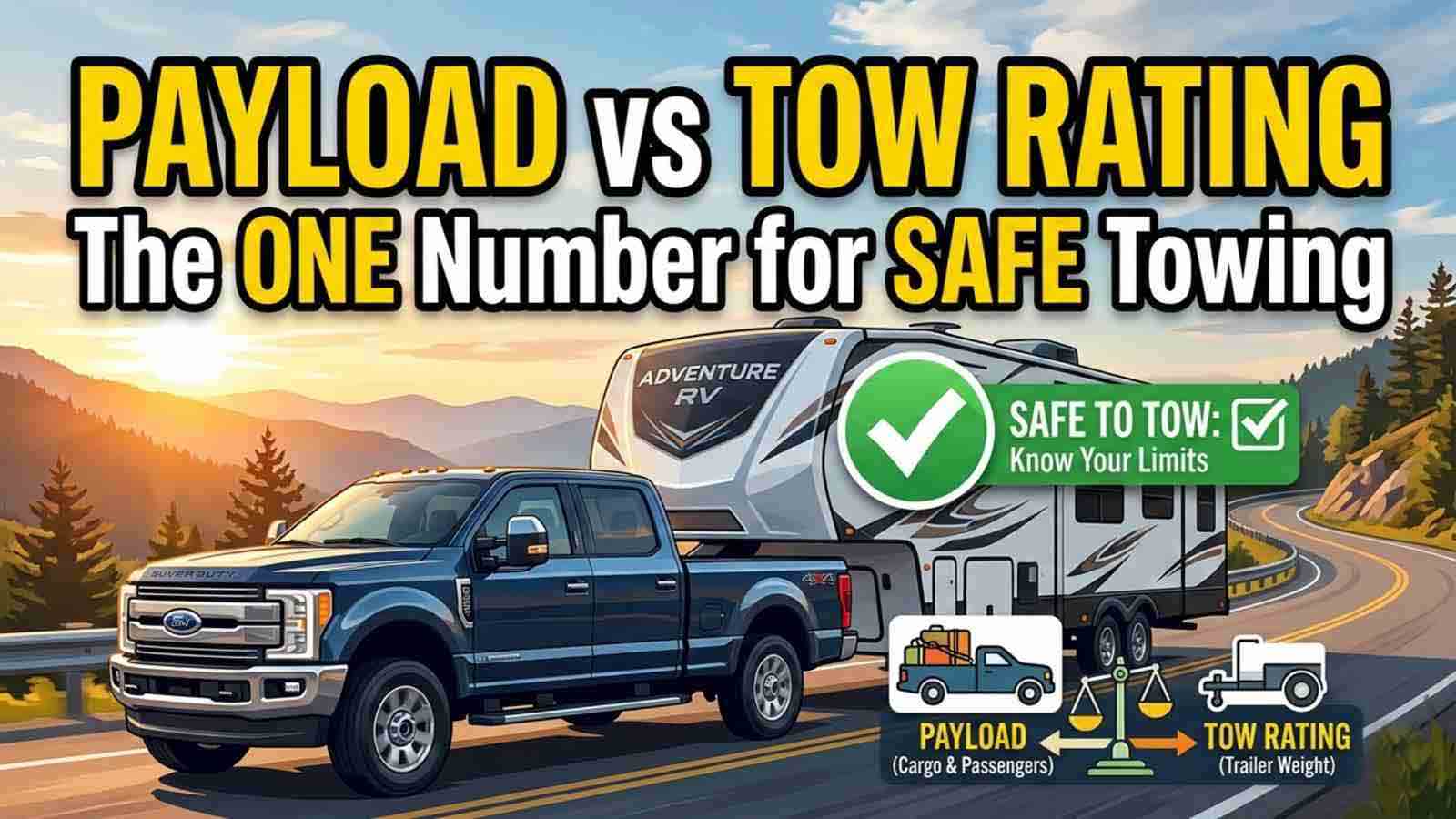
The truth is simple: most half-tons don’t run out of tow rating first—they run out of payload. And payload is what determines whether your setup is actually safe and comfortable on the road.
This guide breaks it down in plain English, then recommends half-ton-friendly travel trailers that tend to work in real life, based on realistic loaded weights and tongue weight.
What Half-Tons Can Realistically Tow (In the Real World)
A typical half-ton can safely tow around:
5,000–7,000 lbs loaded (for most families and typical trims)
Not the “max tow” headline number like 10,000–13,000 lbs, which assumes:
- a lightly-optioned truck
- minimal passengers and cargo
- perfect conditions
- and no real-world camping loadout
Why “Loaded Weight” Is the Only Weight That Matters
Trailers are rarely towed at their dry weight. Add:
- propane
- battery
- fresh water (even partially)
- food, clothes, tools
- camping chairs, grill, hoses
- bikes, generators, firewood (please don’t)
…and your “dry” trailer can easily be 800–1,500 lbs heavier.
Rule of thumb: Plan your trailer using loaded weight, not dry weight.
The Real Limiter: Payload (Not Tow Rating)
Here’s the part most people miss:
Payload = everything your truck carries.
That includes:
- you + passengers
- anything in the cab or bed
- the weight of the hitch hardware
- tongue weight from the trailer (the big one)
Tongue Weight: The Silent Payload Killer
Tongue weight is typically 10–15% of the trailer’s loaded weight.
So if your trailer is 6,500 lbs loaded, your tongue weight is often:
- 650–975 lbs (and many travel trailers land closer to the higher end once loaded)
Then add:
- WDH hardware: ~70–120 lbs
- passengers: 300–700+ lbs depending on family
- bed cargo: 100–500 lbs
That’s how half-tons get maxed out fast—even when the tow rating looks huge.
Why Weight Distribution Matters
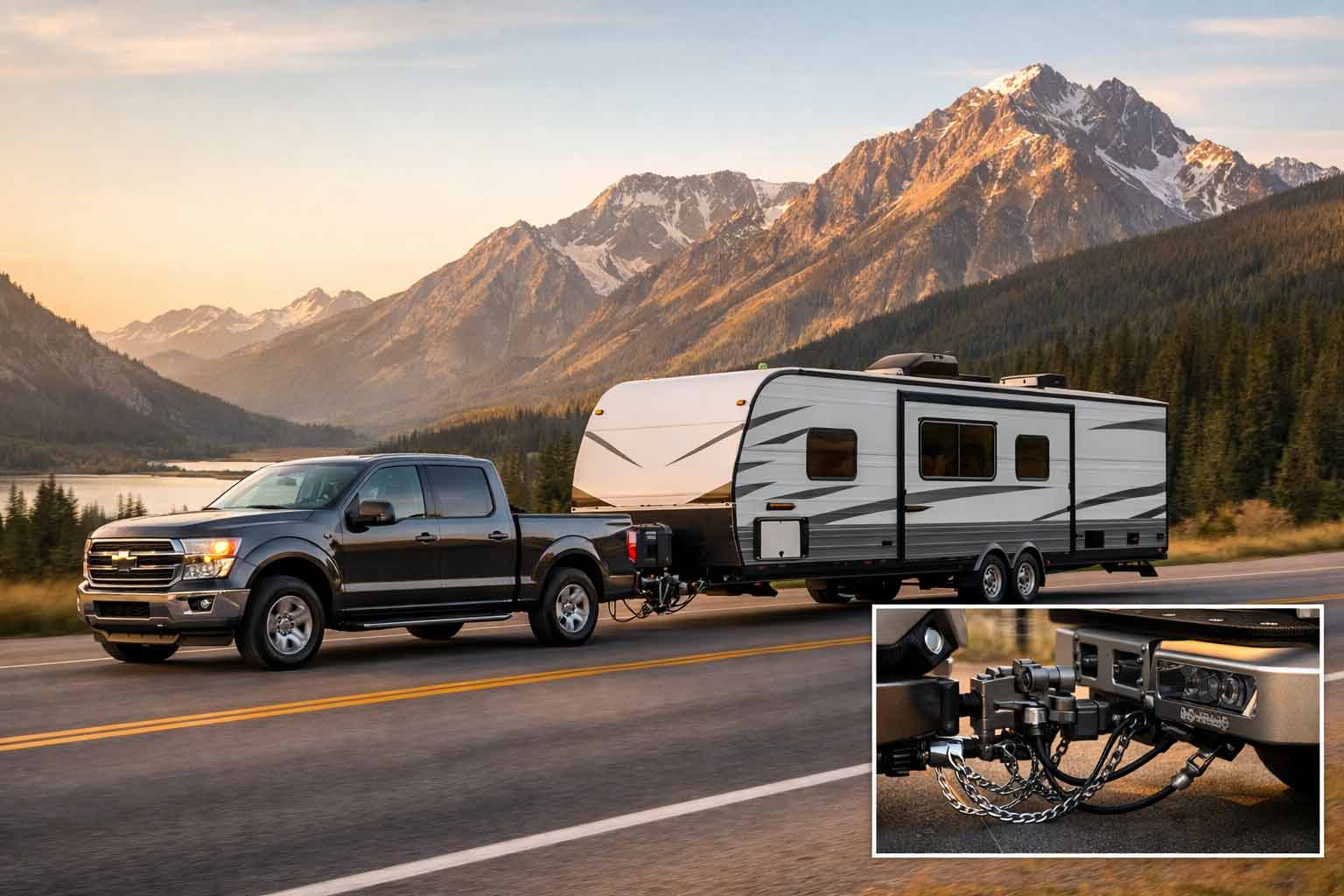
A weight distribution hitch (WDH) is a great tool. It helps:
- restore steering and braking feel
- level the truck and trailer
- reduce rear squat
- improve stability
But it does not:
- increase your payload rating
- increase your axle ratings
- increase your tire capacity
- increase your receiver rating
WDH balances the load—it doesn’t erase it. The weight still exists, and your truck still carries that tongue weight as part of payload.
The Half-Ton Sweet Spot: What to Look for in a Travel Trailer
If you want a travel trailer that matches most half-ton trucks comfortably, aim for:
Target Specs (Practical and Half-Ton Friendly)
- Loaded trailer weight: ~5,000–7,000 lbs
- Tongue weight loaded: ideally 550–850 lbs
- Length: often 22–27 ft is easier to tow than 30+ ft
- GVWR: don’t treat this as what you must hit, but don’t ignore it either
- Storage placement: heavy front storage can push tongue weight up fast
If your truck is a “max payload” build (rare but awesome), you can stretch beyond this. But for many popular half-ton trims with family onboard, the sweet spot above is where towing feels safer and less stressful.
Best Half-Ton-Friendly Travel Trailers (Based on Real Payload Reality)
Below are popular models that are often a better match for half-tons because they’re lighter, shorter, and more manageable—especially once loaded.
Important note: floorplans and options vary. Always verify the specific unit’s sticker weights and run your own numbers.
1) Jayco Jay Feather 22RB
Why it works: A strong “real-life” half-ton option with a comfortable layout and manageable length.
What to watch: like many trailers, tongue weight can climb when loaded—especially if you store gear up front. But overall, this is often one of the more realistic couples/small-family choices for half-ton owners who want a true travel trailer feel without going huge.
Best for: couples, small families, weekend-to-weeklong trips.
2) Airstream Bambi 22FB
Why it works: Airstreams are known for build quality and aerodynamics, and the Bambi 22 is a classic “I want nice but still towable” trailer.
What to watch: Airstreams can be pricey, and adding gear still raises your loaded numbers like any trailer. But if you’re trying to stay in the half-ton comfort zone while upgrading quality, this is one of the cleaner fits.
Best for: couples, minimalist families, people who value quality and resale.
3) Grand Design Imagine XLS 17MKE
Why it works: This one is popular because it offers “big trailer features” in a smaller footprint. It’s often easier to keep within payload limits compared to larger Imagine lines.
What to watch: Don’t underestimate loaded tongue weight—especially with front storage use. Still, it’s commonly a strong half-ton match if you load smart.
Best for: couples, solo travelers, smaller towing setups.
4) Winnebago Micro Minnie 2108DS
Why it works: A well-known lightweight series with smart layouts. Micro Minnie models often land in the “half-ton possible” category, especially if you stay disciplined with cargo.
What to watch: length and features can tempt you to load heavy. Keep an eye on tongue weight and rear axle loads.
Best for: couples/small families wanting amenities without a huge trailer.
A Quick Real-World Example (Why the Brochure Tow Rating Lies)
Let’s say your half-ton has 1,500 lbs payload (very common once you factor trim level/options).
You plan a trailer that ends up 6,500 lbs loaded.
Estimated tongue weight at 13%:
- 6,500 × 0.13 = 845 lbs
Now add:
- WDH hardware: 100 lbs
- Driver + passenger + 2 kids: 550 lbs
- Cooler + tools + gear in bed: 150 lbs
Total payload used:
- 845 + 100 + 550 + 150 = 1,645 lbs
You’re over payload, even though the tow rating might say you can pull far more than 6,500 lbs.
This is why people “feel” towing problems before they see them on paper:
- squatting
- light steering
- poor braking feel
- sway sensitivity
- overheating tires
- rear axle overload
The numbers explain the feeling.
How to Know If a Trailer Is Safe for Your Half-Ton (Fast)
Before you buy any trailer, do this in order:
- Find your payload sticker (driver door jamb)
- Estimate your people + cargo in the truck
- Estimate loaded trailer weight (not dry)
- Calculate tongue weight (10–15%)
- Add hitch hardware weight
- Confirm you’re within:
- payload
- rear axle rating (RAWR)
- tire ratings
- receiver rating
- and tow rating (last, not first)
Pro Tip (Fastest Way)
Before buying a trailer, run your numbers in Towing Limit Pro → it instantly tells you if your setup is safe based on payload, tongue weight, and real-world assumptions, so you don’t fall into the “max tow” trap.
Half-Ton Towing Tips That Make a Big Difference
- Keep the trailer shorter if you’re new: length affects stability more than people expect.
- Don’t load heavy items up front: it spikes tongue weight quickly.
- Weigh your rig (CAT scale): guessing is where mistakes happen.
- Use a quality WDH + sway control: stability is everything.
- Mind your tires: both truck and trailer tire ratings/pressure matter.
- Leave margin: towing “at the limit” is stressful; towing with margin feels easy.
FAQ: Half-Ton Travel Trailer Questions People Always Ask
Can my half-ton tow a 30-foot travel trailer?
Sometimes, but it depends heavily on:
- payload
- tongue weight
- wheelbase
- and how much you carry in the truck
Many half-tons can pull it, but fewer can do it comfortably within payload.
Is dry weight useful at all?
Only as a starting point. You should plan using:
- realistic loaded weight
- and realistic tongue weight
Dry weight is what the trailer weighs before it becomes a camper.
Does a WDH reduce tongue weight?
No. It redistributes some load across axles, but tongue weight still counts against payload.
What’s the safest way to choose a trailer?
Pick the trailer that works with your payload reality, not your tow-rating fantasy—then verify at a scale.
Final Thoughts: Half-Ton Towing Isn’t About Bragging Rights—It’s About Payload Math
Half-ton trucks are amazing tow vehicles when matched correctly. The goal isn’t to tow the biggest trailer the internet says you “can.” The goal is to tow something that:
- stays within ratings
- feels stable
- brakes confidently
- and doesn’t punish your truck on every hill and crosswind
If you want the easiest path: run the numbers first, then shop.
And if you want it done in seconds: open Towing Limit Pro, plug in your truck details, passengers, cargo, and trailer, and it’ll tell you whether you’re actually safe—before you sign anything.